Fast Facts
A Coinbase engineer wired a full brain connectome simulation of a male fruit fly into a live Bitcoin trading account. The project, called Stonkfly, contains 166,700 neurons and 25.6 million connections, and its own documentation admits it has demonstrated no profitable learning. That admission is the point. Brain connectome simulation is not another reinforcement learning pipeline — it is a structurally different approach that trades learning for inherited architecture, and a parallel project is already wiring the same fly brain to a physical robot.
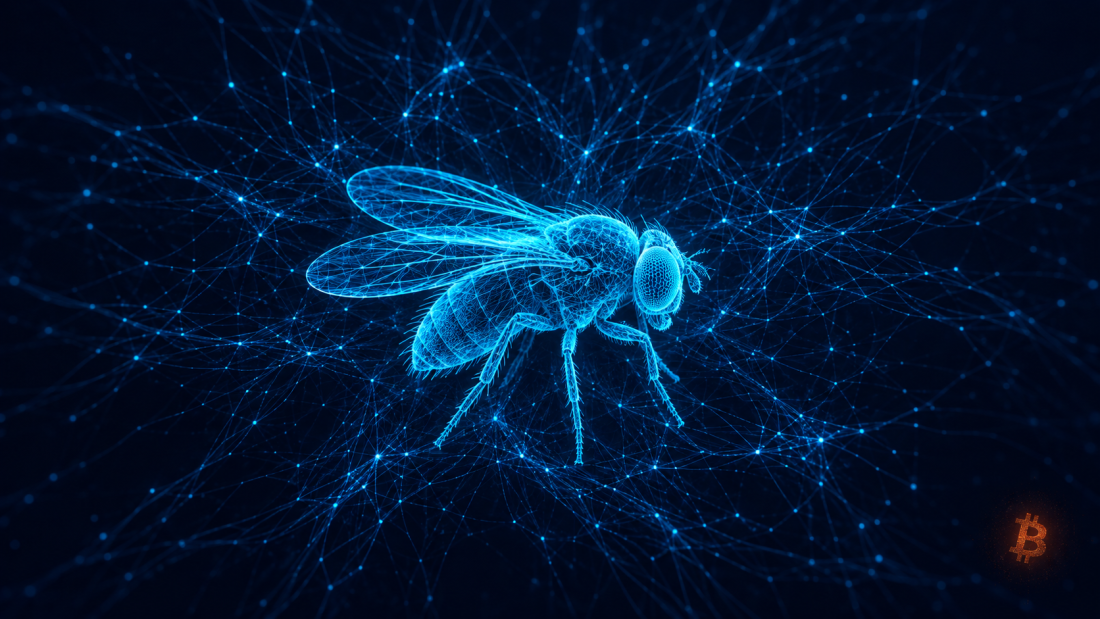
Brain connectome simulation crossed from neuroscience labs into consumer-facing experiments this month, and the way it happened matters more than the crypto stunt. Stonkfly, created by Coinbase software engineer Alex Wormuth, gave a simulated fruit fly nervous system $100 to trade Bitcoin. The fly does not receive prices. It receives a candlestick chart rendered as RGB pixels through simulated photoreceptors, and its neural activity is decoded into buy, sell, or hold.
Profit stimulates 15 identified dopamine neurons. Loss stimulates two aversive dopamine cells. The fly cannot use leverage or shorts, bets a maximum of $10 per order, and makes at most 24 attempts per day.
The documentation is unusually blunt about what this proves: “No profitable learning, strategy improvement, biological replication, or live-funded performance has been demonstrated by this repository’s tests”. The project’s own guidance warns that rising crypto prices alone can make any buyer look skilled.
That honesty is what makes the experiment worth studying. Brain connectome simulation is not being sold as a breakthrough. It is being published as an open-source structure, and the structure itself is the contribution.
Why a Connectome Is Not a Neural Network
The distinction matters for anyone building or buying robotics training infrastructure.
A conventional robot policy is trained. Data goes in, gradients update, weights shift until performance improves. The network’s architecture is a design choice, and the learning is the product.
A brain connectome simulation inverts that. The architecture is a biological map — in this case MaleCNS v1.0, built from large-scale mapping efforts including FlyWire. The graph contains 166,700 neurons, 25,582,938 directed connections, and 124,177,617 synaptic contacts. The structure is not learned. It is inherited.
| Element | What It Is |
|---|---|
| Neurons | 166,700 |
| Directed connections | 25,582,938 |
| Synaptic contacts | 124,177,617 |
| Dopamine neurons (reward) | 15 |
| Aversive dopamine cells | 2 |
| Visual input | 320×180 RGB frame across compound eyes |
The training question changes. Instead of asking whether a policy learns well, the connectome approach asks whether biological wiring produces useful behavior when placed in a new environment. Brain connectome simulation is a test of structure, not a test of learning.
The Prior Result That Makes This Worth Watching
Stonkfly is not the first attempt. In March 2026, Eon Systems wired a simulated fly brain to a virtual body and reported that the model predicted the fly’s motor behavior with 95 percent accuracy, producing walking and grooming sequences without any AI training. The point was not that the fly learned to walk. The point was that biological wiring, replicated at scale, produced recognizable behavior on its own.
An arXiv paper from March 2026 introduced FlyGM, a whole-brain connectomic graph model for locomotion control, and reported that the connectome-structured controller converged faster than non-connectome baselines. The authors framed it as a biologically informed path toward control policy design.
Then, in September 2026, a separate developer published FlyBrain Robot Bridge — an experimental interface connecting a Drosophila connectome simulation to a physical robot via camera input, IMU feedback, and UDP motor control.
That third project is the one robotics procurement teams should track. Brain connectome simulation is no longer confined to virtual bodies. It is being wired to hardware.
⚠ Fiction—composite scenario, not a real event: A robotics team spends six months training a reinforcement learning policy for a warehouse inspection drone, iterating through thousands of simulated episodes. A colleague proposes a different approach: instantiate a connectome-inspired visual navigation graph and fine-tune only the output layer. The connectome version converges faster because the visual processing structure already resembles what biological organisms use to navigate without a map. The team’s training budget assumption was wrong—not because simulation failed, but because they assumed architecture had to be learned rather than inherited.
The Procurement Question This Raises
For anyone evaluating robotics training simulation platforms, brain connectome simulation introduces a third option between two familiar ones.
| Approach | What You Pay For | What You Get |
|---|---|---|
| Traditional RL training | Compute time, episode volume, reward engineering | A policy optimized for your task |
| Synthetic data pipelines | Data generation, scene assets, validation | Training data at scale |
| Connectome-structured controllers | Mapping data access, integration work, fine-tuning | Inherited architecture that may transfer faster |
The EPFL NeuroMechFly v2 framework already exists as a Python library with a Gym interface, meaning connectome-constrained and biomechanical fly models can be used with standard reinforcement learning algorithms. The tooling is available. The question is whether the architecture advantage holds outside locomotion and into manipulation, inspection, and other industrial tasks.
Stonkfly’s own caveat is the honest answer for now. A connectome in a financial environment has not demonstrated profitable learning. A connectome in a robot has demonstrated faster convergence in a controlled locomotion study. Neither result proves general transfer.
Global Implications
For robotics teams in markets without access to massive GPU training budgets, brain connectome simulation offers an appealing proposition: inherit structure instead of paying to discover it. If a biologically constrained visual navigation graph converges faster than a learned one on a specific class of tasks, the cost advantage is real.
The catch is verification. Stonkfly’s documentation explicitly refuses to claim success. FlyGM’s results come from a simulation benchmark, not a deployed robot. FlyBrain Robot Bridge is an experimental GitHub repository, not a shipped product.
The most useful thing an industrial buyer can do is ask simulation vendors a single question: is your controller architecture learned or inherited, and can you show convergence data for both on the same task? Brain connectome simulation is not yet a procurement category. But the question it forces — whether structure can substitute for training — is one that will define the next round of simulation platform comparisons.
💡 CreedTec Analyst’s Note — Daniel Ikechukwu
Strategic Impact: Brain connectome simulation introduces inherited architecture as an alternative to learned architecture in robotics training. Stonkfly’s trading experiment is a public demonstration of the method, and FlyBrain Robot Bridge shows the same approach is already being wired to physical hardware.
Stop: Assuming every robotics policy must be trained from random initialization. Connectome-structured controllers begin from a different premise.
Start: Asking simulation platform vendors whether they support biologically structured controller architectures, not just learned policies.
Watch: Whether connectome-based controllers demonstrate transfer beyond locomotion into manipulation or inspection tasks, and whether the FlyBrain Robot Bridge project publishes real hardware results.
ROI Outlook: If architecture inheritance reduces convergence time on visual navigation and locomotion tasks, the training cost savings could be substantial for teams without large compute budgets. The advantage is unproven outside narrow benchmarks, so procurement decisions should wait for hardware deployment data rather than simulation convergence curves alone.
Sources:
- The Register, “Disembodied fruit fly brain joins the crypto speculation swarm,” September 11, 2026
- Moneycontrol, “What happens when a fruit fly gets USD 100 to trade Bitcoin?,” September 14, 2026
- Tom’s Hardware via Yahoo Tech, “Engineer turns simulated fly brain into a crypto day trader,” September 12, 2026
- GitHub, Stonkfly repository and model documentation, September 10, 2026
- arXiv, “Whole-Brain Connectomic Graph Model Enables Whole-Body Locomotion Control in Fruit Fly,” March 2026
- EPFL FlyGym / NeuroMechFly v2 documentation
- GitHub, FlyBrain Robot Bridge, September 14, 2026
Further Reading:
- Maven Robotics Exits Stealth With $100M for Warehouse Bots
- Synthetic Robot Training Data: The 40% Threshold Undercutting a Billion-Dollar Race
- MIT SceneSmith Attacks the Cost Nobody Talks About in Robot Training
- Human Video Robot Training: Dyna’s 1M-Hour Breakthrough Raises the Right Questions
- World Models Robot Training Crossover 2026