Fast Facts
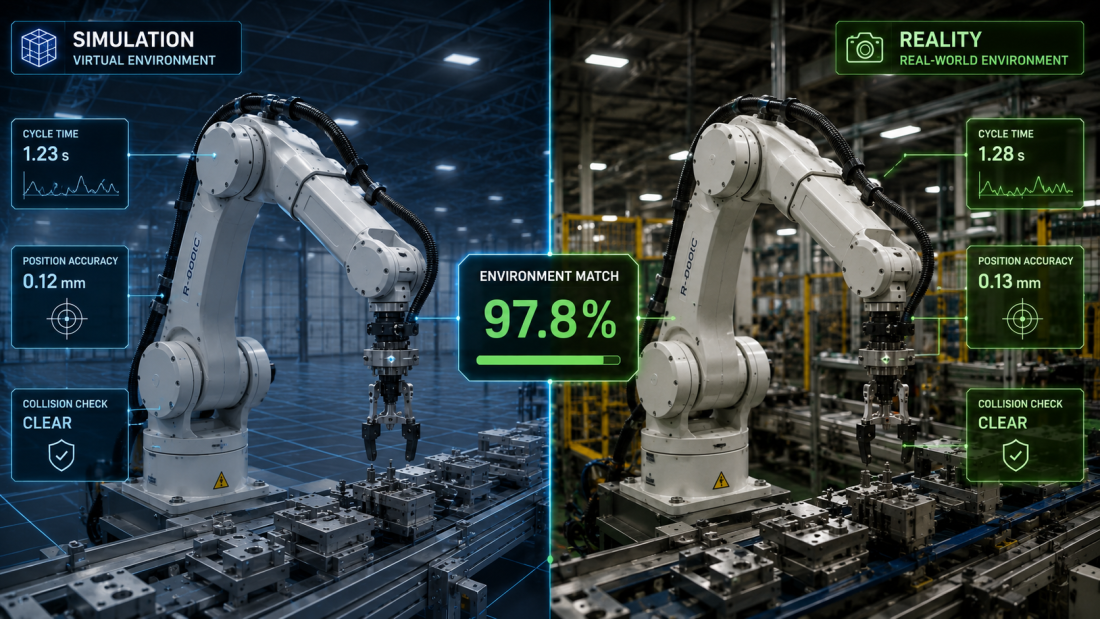
ABB and NVIDIA are embedding Omniverse simulation libraries into RobotStudio under the name HyperReality, claiming up to 99% sim-to-real accuracy, 80% faster setup, 40% lower costs, and 50% faster time-to-market. Foxconn is piloting the system for consumer electronics assembly. The number is real and independently attributable, but it describes one company’s controlled pilot, not a guarantee that transfers to messier industrial environments.
Sim-to-real accuracy just got its most specific headline number yet, and the company behind it has a real customer already running it. ABB is integrating NVIDIA’s Omniverse simulation libraries into its RobotStudio platform under the name HyperReality, targeting sim-to-real accuracy of up to 99%, according to a March 2026 report on the partnership. The companies also claim setup and commissioning time can drop by up to 80%, costs by up to 40%, and time-to-market by 50%, with a full release planned for the second half of 2026.
A Named Customer Behind the Number
Unlike many simulation vendor claims that cite no production deployment, this one has a specific, named early adopter. Foxconn is already piloting HyperReality for consumer electronics assembly, training its robots on synthetic data across multiple production scenarios before deploying them to real lines, according to the same report. Foxconn’s Chief Digital Officer, Dr. Zhe Shi, said the level of accuracy and fidelity now possible in simulation and digital twins wasn’t achievable before this collaboration. That’s a meaningfully different evidentiary standard than an unverified sim-to-real accuracy claim sitting in a press release with no customer attached.
99% — claimed sim-to-real accuracy for ABB and NVIDIA’s HyperReality platform.
80% / 40% / 50% — claimed reductions in setup time, cost, and time-to-market respectively.
Precision is everything in consumer electronics manufacturing and until now, this level of accuracy and fidelity just wasn’t possible in simulation and digital twins.— Dr. Zhe Shi, Chief Digital Officer, Foxconn
What “Pilot” Means Before It Means “Proven”
The word doing the most quiet work in this announcement is “piloting.” Foxconn’s deployment is a pilot for consumer electronics assembly specifically, a controlled, relatively structured manufacturing environment with predictable part geometry and repeatable motion paths, not the variable, cluttered, and less predictable conditions found in heavier industrial settings. A 99% sim-to-real accuracy figure earned in that context doesn’t automatically generalize to warehouse logistics, outdoor infrastructure, or food processing, where lighting, material variation, and unplanned obstructions are the norm rather than the exception. See our analysis where we explain why synthetic training data is already undercutting the real-world data collection race.
⚠ Fiction — illustrative scenario: A food packaging plant licenses a sim-to-real platform after seeing a 99% accuracy figure attached to a different industry’s pilot. The simulation performs beautifully on rigid, uniform packaging. The moment product shape varies by batch, a source of variability the original benchmark never had to handle, accuracy drops sharply, and the plant discovers the number it budgeted around was true, just not true for its own environment.
Why the Second Adopter Matters More Than the First
WORKR, a California-based company, plans to bring HyperReality to small and mid-sized US manufacturers facing labor shortages, extending the platform beyond Foxconn’s electronics-assembly use case into a broader industrial base. That expansion is the real test of whether the claim holds outside its original proving ground, since a single flagship customer in a controlled vertical is a proof of concept, not evidence of general applicability.
Smaller manufacturers typically run more varied product lines with less standardized part geometry than a large electronics assembler, which means the next round of published results, not this one, will show whether ABB and NVIDIA’s platform performs consistently outside a best-case pilot. See our related coverage of ABB RobotStudio’s virtual twin ROI and why NVIDIA’s synthetic data has real limitations on factory floors.
Global Implications
For manufacturers in Nigeria, Southeast Asia, and other emerging markets evaluating whether to license a sim-to-real accuracy platform like HyperReality, the practical question isn’t whether the 99% figure is fabricated, it likely reflects real results in Foxconn’s specific pilot, it’s whether that figure was measured under conditions resembling their own factory floor closely enough to budget against. See our analysis of why MIT’s SceneSmith attacks the cost nobody talks about in robot training and why photorealistic digital twin training applications cut costs in 2026.
💡 CreedTec Analyst’s Note — Daniel Ikechukwu
Strategic Impact: A named, verifiable customer behind a sim-to-real accuracy claim is a meaningfully stronger signal than an unattributed vendor statistic, but the specific manufacturing vertical it was measured in still limits how far the number travels.
- Stop: Assuming a sim-to-real accuracy figure from one manufacturing vertical transfers directly to a different production environment without independent validation.
- Start: Requesting a pilot run in your own facility’s specific conditions before committing budget based on a vendor’s headline accuracy percentage.
- Watch: Whether WORKR’s rollout to small and mid-sized US manufacturers produces published accuracy results outside the consumer-electronics vertical Foxconn validated first.
ROI Outlook: The claimed 80% setup-time and 40% cost reductions are meaningful if they hold in your specific environment, which is a testable, not assumable, condition before signing.
Should buyers request a facility-specific pilot before licensing a sim-to-real platform?
Yes. A vendor’s published sim-to-real accuracy figure reflects the conditions it was measured under, and a short pilot in your own production environment is the only reliable way to confirm that figure applies to your specific use case before committing to a full deployment.
ABB and NVIDIA’s sim-to-real accuracy claim is more credible than most in this category, because it has a named customer and a specific, checkable use case behind it. That’s also exactly why it shouldn’t be read as a universal number. It’s a strong result in one vertical, not yet a proven standard across industrial robotics.
Get CreedTec’s next robotics simulation procurement briefing before your next platform pilot.
Subscribe free
Sources