Lightwheel’s $100M in Q1 orders for physical AI infrastructure landed on May 6, 2026. The headlines called it a financial milestone. But the real signal is economic. Customers are no longer asking if robots can work. They are investing in the infrastructure required to deploy them reliably, at scale, and in real operating environments.
This is not a forecast. It is a purchase order.
The Order Book That Changes the Game
“The $100M in Q1 orders did not come from a single type of customer. It came from two directions… frontier Physical AI teams [and] industrial companies making real commitments to robotics deployment.”
This is the fundamental shift. Industrial buyers are no longer funding pilots. They are signing purchase orders for production-scale infrastructure.
Why Infrastructure Beats Hardware
Robotics hardware is a race to the bottom. GPUs, sensors, and actuators are becoming commodities. The true differentiator is the software and simulation stack that trains the robot, validates its safety, and allows it to improve after deployment.
Fear. The first adopter takes the risk. But the last adopter takes the loss. The manufacturers still “evaluating” AI pilots are the ones who will wake up in 2027 to discover their competitors have already locked down the best infrastructure vendors.
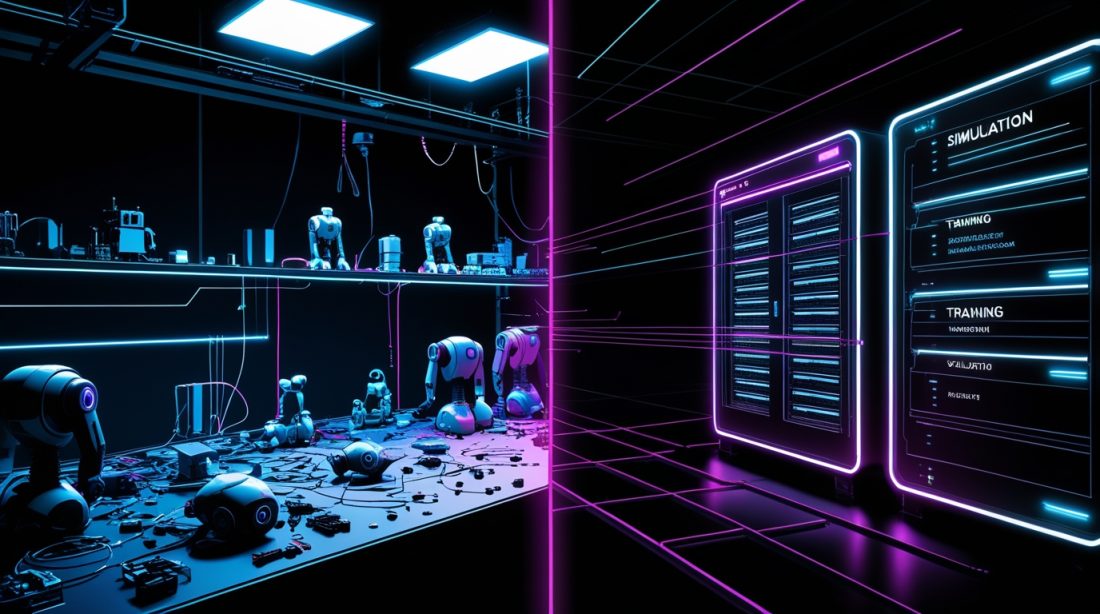
Desire. The desire is for a frictionless outcome. A closed-loop system that connects simulation, training, and real-world feedback is the only way to achieve that at scale.
⚠ Fiction — The Buyer Who Waited Too Long

A procurement director at an automotive parts supplier in Mexico had Lightwheel in her Q1 evaluation queue. The $100M news hit. She flagged it for “Q3 review.” On July 1, she called to initiate a pilot. The lead time for integration? Twelve months. Her competitor, who signed in Q1, will be live before her pilot even finishes.
The CreedTec Procurement Playbook
The question for every industrial buyer in 2026 is not if simulation is essential—the question is how fast can you deploy it?
- Stop treating simulation as a “nice to have.” If a robotics vendor cannot demonstrate their training and evaluation pipeline, they are selling hardware, not a solution.
- Start vetting the “data flywheel.” Can the system improve itself after deployment using real-world data? Lightwheel’s closed-loop architecture is the industry standard.
- Watch the Newton open-source initiative. Lightwheel is a core advisor to the Newton physics engine alongside NVIDIA and Google DeepMind. Adoption here dictates the future physics standard.
The ROI Outlook is a competitive moat. According to MarketsandMarkets’ forecast, the physical AI market is set to explode from $1.50 billion in 2026 to $15.24 billion by 2032. The factories that lock in infrastructure contracts now will capture the efficiency gains before the market prices catch up.
Frequently Asked Questions
What is Lightwheel, and what do they actually sell?
They are a Physical AI infrastructure company, selling the full stack for simulation, synthetic data generation, and model evaluation to deploy robots reliably in the real world.
Why is $100M in orders a big deal for industrial procurement?
It proves that major industrial players are spending millions on AI infrastructure—not just robots. It validates simulation as a budget line item, not a test tool.
What is “SimReady” and why does it matter?
“SimReady” assets are digital twins of physical objects (like parts on a production line) that possess accurate physics properties like weight and friction. Training on these ensures the policy works on the first physical try.
Is Lightwheel a competitor to NVIDIA?
No. Lightwheel builds the data and simulation layer on top of NVIDIA’s compute. Lightwheel was invited to advise on NVIDIA’s Newton open physics project, indicating close collaboration.
How does Lightwheel’s healthcare humanoid deployment work?
Lightwheel partnered with PeritasAI to deploy up to 200 humanoid robots in healthcare settings by 2027, using Lightwheel’s simulation stack to train them for perioperative tasks.
Procurement question: Should we delay purchasing a robotics infrastructure platform?
No. The $100M order backlog signals a capacity crunch. Delaying a Q3 evaluation to 2027 could push your deployment timeline into 2028–2029.
The Economic Pain Point
The $15.24 billion market projection is not just growth. It is a countdown clock. Every month you delay building your simulation and deployment pipeline is a month your competitor spends generating proprietary data, training models, and refining their autonomous workflows.
DO THIS: Audit your robotics procurement pipeline this week. If “simulation integration” is not a line item in your 2027 budget, you are already behind.
Further Reading
- World Models Robot Training Crossover 2026
- NVIDIA Newton 1.0 Physics Engine
- 1 Simulation Metric That Cuts Factory AI Costs by 40%
- MolmoBot Zero-Shot Sim-to-Real Transfer 2026
- 7 Reasons Why Japanese Robots Are Economic Lifelines
Join the Newsletter
Subscribe to CreedTec for weekly analysis on robotics training sims, robotics procurement, and the hard-nosed economics behind the machines.
[Subscribe to CreedTec Newsletter →]