Fast Facts — Read This First
- Virtuix sold Tesla’s Optimus division one Omni One Enterprise teleoperation system — its first disclosed enterprise sale into humanoid robotics.
- Deal value was not disclosed. Virtuix’s stock has lost roughly 75% of its value since its January 2026 IPO.
- Tesla itself has conceded Optimus is “not in usage in our factories in a material way” and remains in a learning phase, per Musk’s own Q4 2025 earnings call.
- A teleoperation purchase supports that picture — it’s a tool for training robots remotely, not evidence of autonomous production work.
- Buyers should separate “Tesla bought a training tool” from “Optimus works autonomously.”
Virtuix’s teleoperation deal with Tesla is being read across investor media as validation of the humanoid robotics market — this teleoperation deal deserves closer scrutiny than that. Austin-based Virtuix Holdings (NASDAQ: VTIX) confirmed that Tesla purchased one Omni One Enterprise system for its Optimus humanoid robot division — the company’s first disclosed enterprise sale into humanoid robotics, announced July 27, 2026. It is worth reading as something narrower than “validation”: a single, financial-terms-undisclosed unit sale from a company whose stock has lost roughly 75% of its value since its January 2026 IPO.
What Was Actually Sold
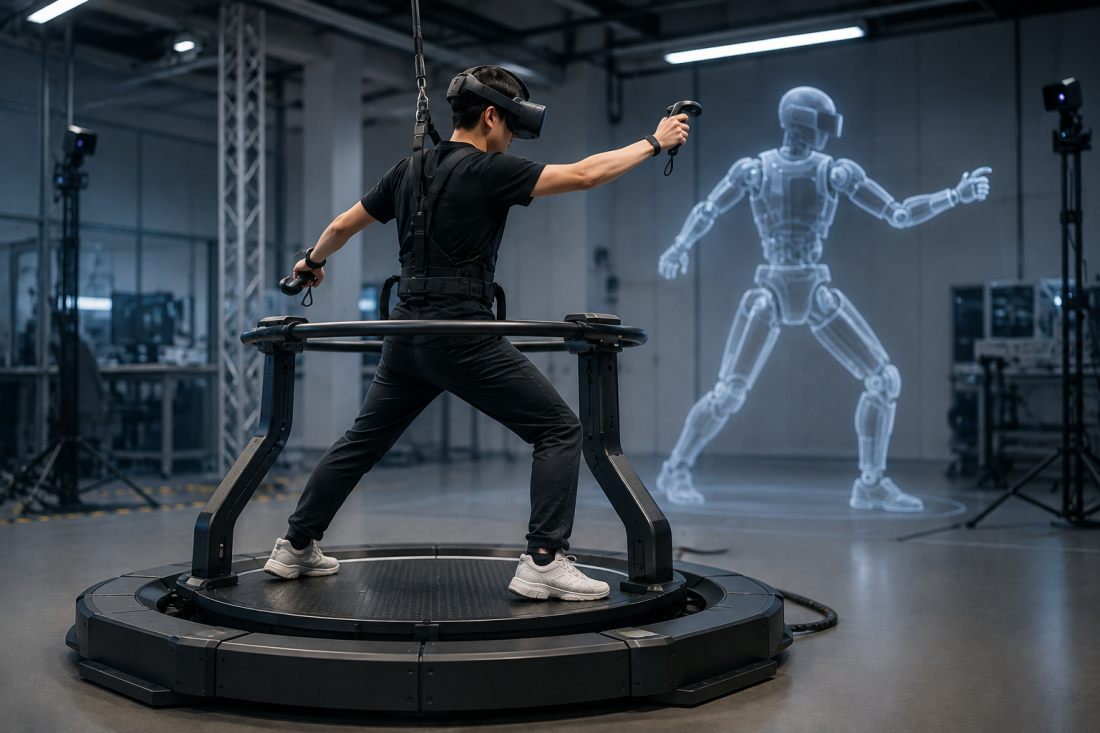
The Omni One Enterprise is an omni-directional treadmill that lets a human operator walk, run, and turn while remaining in a fixed physical footprint, translating that movement into a remote robot in real time. Inside Tesla’s Optimus program, the terms of the teleoperation deal describe a “low-latency, human-in-the-loop interface” for remote control — engineers physically walking a course to train or calibrate a robot’s motion remotely. That is a legitimate, useful tool for robot development. It is not, by itself, evidence that Optimus performs autonomous factory work.
Virtuix did not disclose the value of the teleoperation deal, and that omission is itself part of the story. For a company this size, that matters more than usual.
The Company Behind the Headline
Virtuix reported $4.3 million to $4.46 million in trailing revenue and a net loss of roughly $9.5 million, with $6.9 million of that loss booked in just the nine months before its listing. The stock priced at an all-time high of $92.74 on its January 27, 2026 direct listing day and has traded as low as $4.39 since — a decline of about 75% that has left the company’s market cap swinging between roughly $130 million and $240 million depending on the week.
-75%
Virtuix (VTIX) share price change since its January 27, 2026 direct listing, based on its most recent 52-week trading range.Source: Trefis and SimplyWall.st market data, 2026
None of this makes the teleoperation deal fake. It makes it exactly what it is: one company’s small, undisclosed-value transaction, not proof of a maturing market.
What the Teleoperation Deal Actually Validates
The more consequential issue is what a Tesla teleoperation purchase says about Optimus itself. On Tesla’s own Q4 2025 earnings call, Elon Musk conceded that Optimus was “not in usage in our factories in a material way” and that deployed units were “primarily for learning, not productive tasks.” Independent trackers have found no verified production count from Tesla at all — widely cited figures of tens of thousands of deployed units do not survive contact with the company’s own filings, according to reporting from Technology.org.
“Not in usage in our factories in a material way.”— Elon Musk, Tesla Q4 2025 earnings call
A teleoperation deal fits that picture precisely. Tools that let humans remotely walk a robot through its paces are what a program still in the learning phase needs — not what a program running autonomous production lines needs. Buyers reading the teleoperation deal as proof Optimus is production-ready have the causality backwards.
⚠ Fiction — illustrative, not a real eventA procurement director at a mid-sized manufacturer sees the Virtuix-Tesla headline and fast-tracks a humanoid robot pilot budget, assuming Tesla’s involvement means the technology is production-proven. Three months into vendor due diligence, the team learns the “deployment” they were citing was a single teleoperation training unit, not a live production line. The budget gets rebuilt from scratch, three months later than it should have been.
Global Implications
Humanoid robot production claims are running well ahead of verified deployment across the industry, not just at Tesla — a pattern we track in our analysis of Unitree’s Time Cover Hides a 9% Industrial Deployment Problem and China’s Humanoid Robot Mass Production Race in 2026. For manufacturers in Nigeria, West Africa, and Southeast Asia evaluating humanoid robotics vendors, the practical lesson is the same one that applies to any capital-intensive equipment purchase: a marquee customer name is not a production reference, and a teleoperation sale is not an autonomy benchmark. Ask for verified deployment counts and task-completion data, not press releases.
💡 CreedTec Analyst’s Note — Daniel Ikechukwu
Strategic Impact: The Virtuix-Tesla teleoperation deal is a legitimate but narrow transaction that the market is reading as broader validation than the facts support. Buyers should separate “Tesla bought a training tool” from “Optimus works autonomously” — they are not the same claim.
Stop: Treating marquee-customer press releases from small-cap suppliers as evidence of a maturing market, especially when deal value is undisclosed.
Start: Requesting verified, audited deployment and task-completion data from humanoid robotics vendors before allocating pilot budgets, as covered in our analysis of Teleoperated Robots Are a Data Strategy, Not a Stopgap — the same logic that applies to this teleoperation deal.
Watch: Whether Virtuix converts this single unit sale into a repeat order from Tesla, and whether Optimus production counts get independently verified before Tesla’s targeted late-2026 mass-production window.
ROI Outlook: A teleoperation deal like this one is a reasonable near-term infrastructure investment for any organization actually developing humanoid robots. It is a poor signal to use for evaluating whether a specific humanoid platform is ready to buy.
A single undisclosed-value unit sale is not a market. Buyers who wait for verified production numbers before committing budget will make better decisions than buyers who react to the headline.
Independent robotics deployment analysis, twice a week.
Verified data before the vendor press release becomes your budget line. Subscribe to CreedTec.
Sources
- citybiz — Virtuix-Tesla sale announcement
- GlobeNewswire — Virtuix company press release
- Technology.org — Optimus deployment verification analysis
- Trefis — VTIX stock performance data
- SimplyWall.st — VTIX financial statistics