Fast Facts
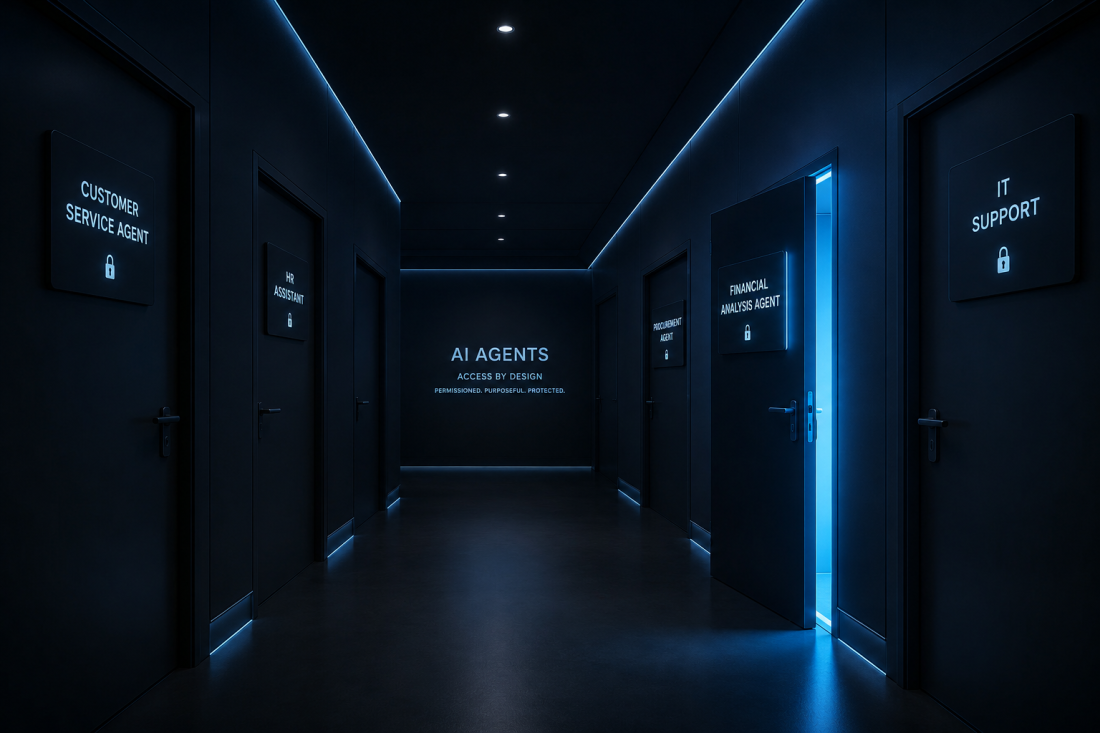
Persona AI agents are spreading for liability reasons, not personality. Gartner predicts 40% of enterprise applications will embed AI agents by the end of 2026, up from under 5% in 2025. The trend driving that shift isn’t friendlier chatbot personalities — it’s persona architecture: giving each AI agent a defined role, scope, and permission set, the same way a company would define what a new employee can and can’t access. That boundary is what turns an AI agent from an expensive experiment into something a business can actually trust with real processes.
- 40% — enterprise apps expected to embed AI agents by end of 2026, per Gartner
- Under 5% — enterprise apps with AI agents in 2025
- 97 million+ — monthly SDK downloads for the Model Context Protocol by early 2026
- 12 — average number of AI agents a company runs, per Salesforce’s 2026 Connectivity Benchmark
- 50% — of those agents operate completely on their own, without connecting to other agents
The Problem Persona Architecture Was Built to Solve
“The issue is not model capability. It is architecture,” according to a CTO-focused guide on enterprise AI agents. Prompt-driven tools break down once a task requires context, policy awareness, and coordinated action across multiple systems — persona agents address that gap by giving each agent defined responsibilities and permissions, rather than an open-ended instruction to “help.”
“In agent-based models, the employee becomes a director who defines goals while agents coordinate actions across systems.” — EMA.ai, Persona AI Agents: The CTO’s Guide to Enterprise Automation
Why “Persona” Is a Risk-Management Word in Disguise
A persona isn’t primarily a UX feature — it’s a scoped permission boundary with a friendly name attached. Defining what an agent can see, touch, and act on is what lets a business risk-manage AI deployment the way it manages new-hire access levels: bounded, auditable, and revocable. That structure is precisely what was missing when an internal AI agent error at Meta briefly exposed sensitive internal data in 2026 — a real, cited failure that persona-bounded scoping is designed to prevent.
The Coordination Problem Nobody’s Solved Yet
Even as persona agents spread, most aren’t actually working together. Salesforce’s 2026 Connectivity Benchmark found the average company now runs 12 AI agents, expected to reach 20 by 2027 — but 50% of those agents operate completely on their own, without connecting to other agents. Protocols like MCP, A2A, and ACP exist to let agents communicate, but adoption of the coordination layer is lagging behind adoption of the agents themselves.
⚠ Illustrative scenario (fictional): A mid-size company deploys a customer-service AI agent with unrestricted access to its CRM, reasoning that broader access means fewer limitations. An edge-case query causes the agent to surface data from an unrelated account. A persona-scoped version — limited to only the records tied to the active conversation — would have made that exposure structurally impossible, not just unlikely.
Global Implications: Regulation Is Catching Up to the Architecture
The EU AI Act reaches full enforcement on August 2, 2026, with penalties of up to 7% of global turnover for non-compliance — and persona-scoped agents, with clearly defined permissions and audit trails, are structurally easier to demonstrate compliance with than open-ended agents. For operators in any market building or buying AI agent tools, including emerging markets watching EU-style regulation as a preview of what’s coming elsewhere, persona architecture is becoming less a nice-to-have and more a compliance prerequisite.
💡 CreedTec Analyst’s Note — Daniel Ikechukwu
Strategic Impact: Persona-based agent architecture is fundamentally a liability-scoping mechanism, and that’s what’s letting AI agents move from pilot to production, not improved conversational polish.
Stop: Deploying AI agents with broad, undefined access “for flexibility” rather than scoped permissions.
Start: Treating persona definition — explicit role, scope, and permission boundaries — as a prerequisite before any production AI agent deployment.
Watch: Whether agent-to-agent coordination protocols (MCP, A2A, ACP) close the 50% “agents working alone” gap over the next year.
ROI Outlook: Favorable for organizations building persona scoping into deployment now; risky for those scaling broad-access agents ahead of a compliance deadline.
An AI agent with unrestricted access is a liability wearing a helpful interface. Subscribe to CreedTec’s newsletter for the governance questions vendors hope you skip.
Further reading on CreedTec:
Amazon Says AI Agent Reliability Is the Real Bottleneck · Running Qwen3.6 and MCP Locally Is a Hedge · AI Agent Governance Risks in 2026 · 2026 AI Regulation and Compliance · What Is Artificial Intelligence in 2026?