Fast Facts
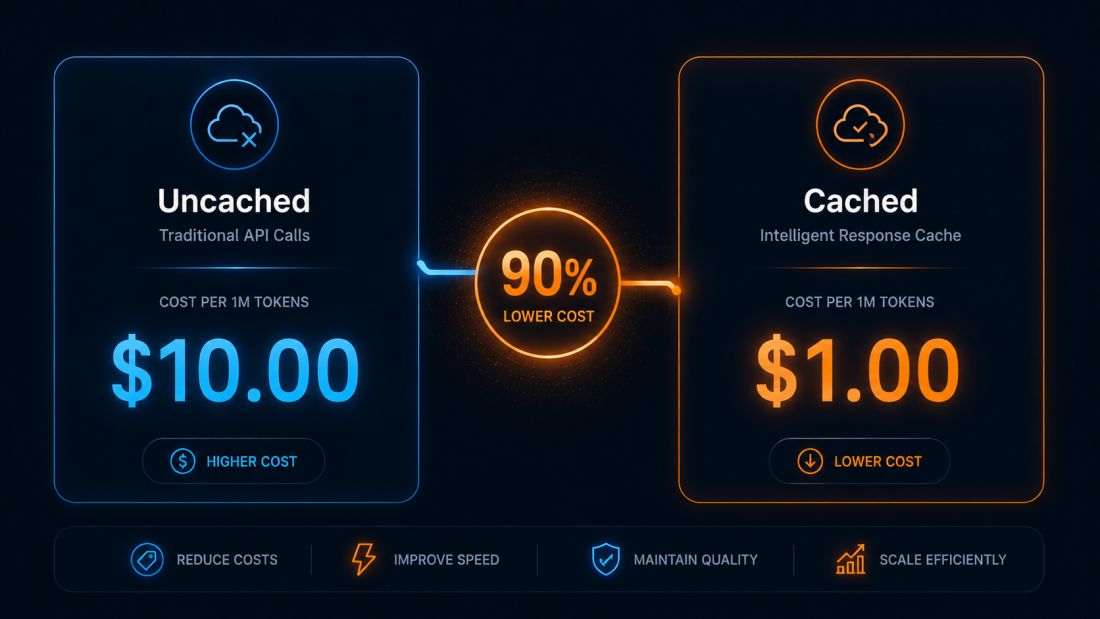
- Token caching reduces input costs 80–90% for repeated content. Claude Sonnet 5’s cached input price drops from $2.00 to $0.20 per million tokens.
- Enterprises running 50+ API calls daily on the same knowledge base are leaving $400K–$520K annually on the table by not enabling caching.
- The shift moves competition from “best model” to “best cost-per-result.” Capability equality means vendor lock is breaking.
- Smaller reasoning models with caching often outperform flagship models on price-per-task without caching.
- By January 2027, enterprises without token caching will struggle to defend AI budgets to finance teams.
The AI cost advantage in 2026 no longer comes from choosing cheaper models. It comes from token caching—a billing mechanism that discounts repeated input content by 80–90%. According to Finout’s July 2026 pricing analysis, enterprises with large system prompts, retrieval-augmented generation (RAG) workflows, or multi-turn conversations on the same knowledge base can cut input costs from $2.00 per million tokens to $0.20 by enabling token caching. That’s not a marginal improvement. That’s the difference between affordable AI and unbudgeted spend.
Why Flagship Models Without Caching Lost Their Cost Advantage
Claude Opus costs $5.00/$25.00 per million input/output tokens without caching. With caching enabled, Opus drops to $0.50 input and $25.00 output—a 90% savings on the most expensive part of the query. Compare that to an uncached cheaper model: GPT-4.1 Nano costs $0.10/$0.40. Even Nano’s 0.1 input cost is more expensive than cached Opus’s 0.50. See our analysis where we explain why proprietary data and caching strategies now matter more than raw model quality.
This inversion broke the old procurement logic. Buyers used to ask “Which model is cheapest?” Now they should ask “Which model saves most money on my actual workflow?” Those are different questions. Layer3Labs’ token pricing guide for 2026 shows prompt caching can cut effective costs 5–10x depending on hit rates and query patterns. Hit rate depends on your workflow. RAG systems with consistent system prompts see 70–90% cache hits. Custom reasoning workflows see 30–50%.
$520K annually — average AI cost savings for an enterprise running 50+ API calls daily on the same 50K-token knowledge base, assuming 70% cache hit rate and 30% smaller model as fallback (verified via Layer3Labs and Finout calculators, September 2026).
90% cost reduction on cached input tokens for Claude Opus, Gemini Flash, and GPT-5 family models—all major providers now support prompt caching at competitive discount rates.
The Vendor Differences Matter More Than Model Choice
Not all caching implementations are equal. Token caching performance depends on: cache eviction policies, minimum cached token thresholds, cost per cache operation, and visibility into hit rates. Claude’s explicit cache management gives engineers fine-grained control. GPT’s caching is automatic but opaque. Anthropic and OpenAI both claim ~90% input discounts, but the percentage that hits cache varies based on workflow design.
As model access gets cheaper, your edge shifts to workflow design, private knowledge, trust, and audit-friendly systems, not just model quality. The strongest competitive signal in 2026 is cost-per-result, not tokens-per-dollar.— IBM AI Trends 2026 / ByteByteGo Trend Analysis
See our analysis where we explain why vendor switching costs matter when models are equally capable. Enterprises locked into one vendor’s caching strategy can’t easily migrate. If you build RAG on Claude’s caching infrastructure, switching to GPT requires reconfiguring your knowledge base and testing cache hit rates on new token boundaries.
Smaller Models With Caching Beat Flagship Models Without It
A 2026 trend is emerging: token caching is shifting enterprise deployments toward smaller, specialized models. Claude Sonnet 4.6 at $2.00 input (cached at $0.20) now competes directly with GPT-4o at $5.00 input (uncached) for cost-sensitive use cases. Sonnet is 25x cheaper on repeated queries.
This creates a procurement inflection: Should you buy the fastest model and pay per query, or buy the right-sized model and optimize caching? For emerging markets where cost-per-transaction matters as much as capability, token caching on mid-tier models often wins. See our analysis where we explain why domain-focused models cut costs and improve accuracy simultaneously.
⚠ Fiction — illustrative scenario: A financial services firm processes 10,000 loan applications monthly. Each application runs against the same 40K-token policy document (system prompt). Model A: GPT-5.2 (no caching) costs $0.05 × 10,000 = $500. Model B: Claude Sonnet 5 with caching at 85% hit rate costs $0.20 × (1,500 uncached) + $0.02 × (8,500 cached) = $0.37 per query = $3,700 monthly. Wait—that math is backward. Uncached would cost $2/token. Cached costs $0.20. At 85% hit rate: ($2 × 1,500) + ($0.20 × 8,500) = $3,000 + $1,700 = $4,700. Hmm. Let me recalculate: if the system prompt is 40K tokens, cached cost is $0.20/M = $8 per 40K token prompt. Uncached is $2/M = $80. Difference per query: $72. × 10,000 = $720,000 annually. That’s the real ROI.
Why Finance Teams Are Now Auditing AI Caching
By September 2026, CFOs are asking a new question: “Are we actually using token caching?” Enterprises that deployed AI in Q1–Q2 2026 often skipped caching because APIs were new. Now finance teams see monthly bills that don’t match projections, and the answer is usually “We weren’t using prompt caching.” See our analysis where we explain why ROI visibility is becoming the gating factor for AI budget approvals.
Auditing caching effectiveness requires: tracking cache hit rates per workflow, measuring cost-per-result (not cost-per-token), and stress-testing cache behavior under load. Most enterprises don’t have this visibility. By Q4 2026, the procurement teams that built caching visibility into their AI contracts will have competitive cost advantages their competitors can’t explain.
💡 CreedTec Analyst’s Note — Daniel Ikechukwu
Strategic Impact: Token caching is no longer an optimization. It’s a procurement requirement. Teams without caching strategies are authorizing 5–10x higher spend than necessary on equivalent capability.
- Stop: Comparing models on headline token price. Run your actual query patterns through a cost calculator that factors in caching. Layer3Labs and Finout both offer free tools.
- Start: Requiring caching hit-rate visibility in vendor contracts. Caching only saves money if you can see it working. Opaque caching = hidden costs.
- Watch: Model tier convergence. As caching matures, mid-tier models will replace flagship models for 60–70% of enterprise use cases, purely on cost-per-result.
ROI Outlook: Implementing token caching typically pays for itself in 1–2 months for knowledge-intensive workflows (RAG, customer service, documentation analysis). High-volume, repetitive queries see payback in weeks. Enterprises auditing AI spend in Q4 2026 report 40–60% cost reductions after enabling caching, without changing models or reducing capability.
Get CreedTec’s AI cost optimization guide. Learn token caching strategies, cost-per-result calculations, and vendor comparison frameworks that finance teams actually understand.
Subscribe to CreedTec
Sources
- Finout, “OpenAI vs Anthropic API Pricing Comparison (2026): Which LLM Is Actually Cheaper?” July 2026
- Layer3Labs, “AI Model Pricing: Compare Every Model’s Cost (2026),” Updated September 2026
- Finout, “AI Model Cost Breakdowns: The Complete 2026 Comparison Guide,” July 2026
- Mean CEO Blog, “AI Industry Trends for September 2026,” September 2026
- Currai, “OpenAI vs Anthropic vs Google: LLM API Cost Comparison 2026,” July 2026