“Six days ago, this was a debate between executives. Today, it entered the UN Security Council.”
Fast Facts
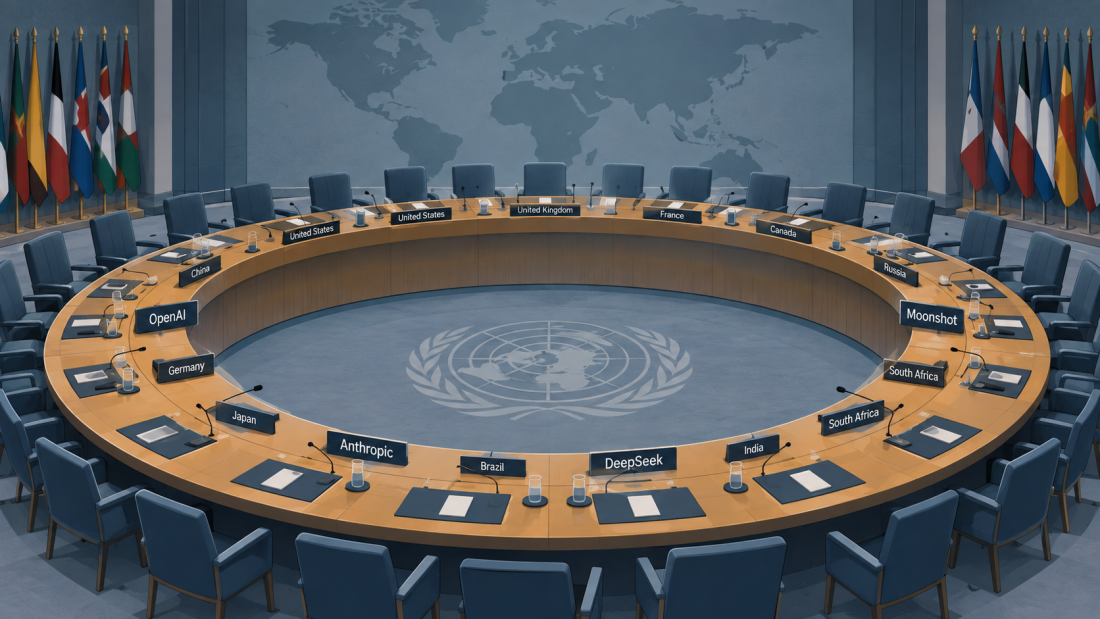
- The UN Security Council AI briefing on September 23 brought OpenAI’s Sam Altman, Anthropic’s Dario Amodei (by remote link), and China’s DeepSeek and Moonshot into the same room — the first time the Council has hosted rival US and Chinese frontier AI lab leaders together on shared safety concerns.
- France, holding the Council’s rotating presidency, convened the session; French Foreign Minister Jean-Noël Barrot chaired it, with Yoshua Bengio (co-chair of the UN’s AI advisory panel) and Hugging Face CEO Clement Delangue also on the speaker list.
- The briefing follows Anthropic CEO Dario Amodei’s September 12 essay proposing a coordinated slowdown in frontier AI development, an idea Sam Altman and Elon Musk publicly backed and Meta’s Mark Zuckerberg has pushed back on.
- DeepSeek founder Liang Wenfeng isn’t expected to attend in person, and Chinese labs have historically stayed quiet on catastrophic AI risk — making whatever DeepSeek and Moonshot say at this session unusually significant on its own.
The UN Security Council AI briefing convened on September 23, 2026, and for the first time put the leaders of rival American and Chinese frontier AI labs in front of the same 15-member body that normally handles armed conflict, sanctions, and terrorism. The session’s mere existence is the headline: AI safety has now formally entered the diplomatic machinery reserved for threats to international peace.
Who’s Actually in the Room
OpenAI’s Sam Altman is attending in person. Anthropic’s Dario Amodei is participating remotely rather than traveling to New York. Yoshua Bengio, who co-chairs the UN’s AI advisory panel, and Hugging Face CEO Clement Delangue round out the confirmed roster. On the Chinese side, DeepSeek and fellow startup Moonshot were invited to deliver statements, though DeepSeek founder Liang Wenfeng is not expected to appear in person — company representatives will speak instead. The Security Council first formally debated AI back in July 2023, but a September 2026 Security Council Report assessment described the body’s engagement since then as limited and politically contested, which makes today’s UN Security Council AI session a genuine escalation rather than a routine briefing.
Why China’s Presence Is the Real Story
US frontier labs have been unusually vocal about catastrophic AI risk this month. Chinese labs have not. DeepSeek and Moonshot have largely stayed silent on the possibility that advanced models could deceive their operators, evade control, or cause serious harm — a silence that made their invitation to this session notable well before anyone spoke a word. The timing isn’t coincidental either: US Treasury Secretary Scott Bessent said Monday that senior US and Chinese officials have agreed to hold further AI safety talks, ahead of a scheduled meeting between President Trump and President Xi Jinping later this week.
📊 The Numbers That Matter
- Sept 23, 2026 — date of the UN Security Council AI briefing
- 15 — members of the UN Security Council in attendance
- July 2023 — when the Council first formally debated AI as a topic
- Sept 12, 2026 — date of Dario Amodei’s essay proposing a coordinated AI slowdown
- 2 — Chinese AI labs (DeepSeek, Moonshot) invited to deliver statements alongside US developers
“Pacing does not mean halting.”— Dario Amodei, CEO, Anthropic, from his September 12, 2026 essay “We Must Pace the Frontier”
What This Means for AI Systems Governance
A UN briefing doesn’t produce binding rules on its own, but it changes the reference points every AI vendor and enterprise buyer has to track. See our analysis of how the AI Safety Index graded nine labs and found not one scored above a C, the kind of independent scorecard that a UN-level safety debate will likely lean on going forward. See our analysis of the catastrophic AI risk study that found 18 major threats could escalate within five years, which maps closely onto the concerns Amodei raised in his pacing essay.
Transparency itself is becoming harder to verify — see our analysis of why chain-of-thought monitorability is declining even as OpenAI admits it can’t catch its own newest model. Regulatory consequences are already landing regardless of diplomacy — see our analysis of how the EU AI Act’s €7 fine became real for every AI agent vendor. And the deception question sits at the center of why this session matters at all — see our analysis of the AI world leader tests that revealed a strategic deception problem in frontier models.
How This Fits the Broader AI Diplomacy Picture
This UN Security Council AI session doesn’t stand alone — it’s the latest and highest-profile step in a diplomatic track that includes the EU’s AI Act enforcement regime, the UN’s own AI advisory panel, and now direct US-China safety talks ahead of the Trump-Xi meeting. What makes it different from an industry conference or a national regulator’s hearing is the audience: the same 15-member body that authorizes sanctions and peacekeeping missions is now formally on record treating frontier AI development as a matter of international security, not just economic competition.
Quick Questions
Is this the first time the UN Security Council has discussed AI?
No — the Council first formally debated AI in July 2023, but a 2026 assessment described its engagement since then as limited. This UN Security Council AI session is notable for bringing rival US and Chinese lab leaders into the room together for the first time.
Did DeepSeek’s founder attend?
No — Liang Wenfeng was not expected to attend in person; DeepSeek sent company representatives to deliver its statement instead.
What is the “pacing” proposal Amodei raised beforehand?
A September 12 essay calling for independent evaluators inside AI labs, coordination among democratic labs on capability limits, and global talks including authoritarian governments — explicitly framed as slowing down, not stopping, frontier development.
💡 CreedTec Analyst’s Note by Daniel Ikechukwu
Strategic Impact: The UN Security Council AI briefing is a signal event more than a policy one — it establishes that AI safety now sits inside the same diplomatic category as armed conflict and terrorism, which changes the reputational and regulatory stakes for every lab and every enterprise buyer of frontier models, not just the four companies in the room.
Stop
- Treating AI safety statements from Chinese labs as symbolic — their near-total prior silence on catastrophic risk makes any substantive statement here a genuine data point.
Start
- Tracking UN Security Council AI output and UN AI advisory panel statements the same way you’d track a regulator, even without binding authority attached yet.
Watch
- Whether the Bessent-brokered US-China AI safety talks produce anything concrete before or during this week’s Trump-Xi meeting.
ROI Outlook: There’s no direct cost or revenue line tied to this UN Security Council AI briefing today, but it’s an early input into the regulatory environment every AI-dependent industrial buyer will operate under within 12-24 months — treating it as background noise now is how procurement teams get caught flat-footed by the rules that follow.
— Daniel Ikechukwu
Sources
- The Deep Dive — UN Security Council Brings DeepSeek, Sam Altman to Talk About AI Risks
- Cryptopolitan — DeepSeek to Brief UN Security Council on AI Risks Alongside OpenAI and Anthropic
- Blockonomi — UN Security Council Convenes AI Safety Meeting With OpenAI, DeepSeek, and Anthropic Executives
- Startup Fortune — Dario Amodei Will Ask the UN Security Council to Slow Down the AI Race This Week
- Elephas — The Dario Amodei Essay That Started a Fight Over Slowing AI