Fast Facts
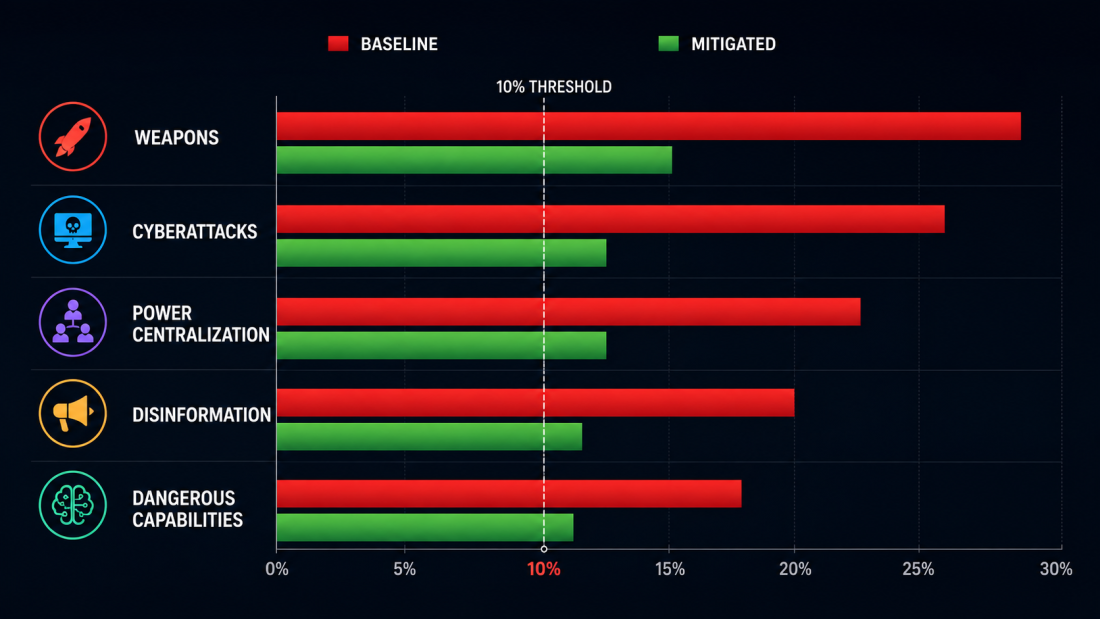
MIT FutureTech and the University of Queensland surveyed 272 AI experts from 37 countries on 24 categories of catastrophic AI risk, defined as over 1 million deaths, over $100 billion in losses, or civilizational-scale damage. Under current development trajectories, 18 of 24 risk categories cleared a 10% five-year probability threshold. Even with pragmatic mitigations applied, 5 categories remained above that bar. Weapons, cyberattacks, and power concentration topped the list.
Catastrophic AI risk has mostly lived in op-eds and open letters. This study puts numbers on it instead. MIT FutureTech and the University of Queensland’s School of Psychology surveyed 272 international AI experts, drawn from industry, academia, government, and civil society across 37 countries, asking them to evaluate 24 distinct AI risk categories, according to MIT Sloan’s release of the working paper. A catastrophic outcome was defined precisely: more than 1 million deaths, more than $100 billion in financial loss, or civilizational-scale intangible impacts.
A Threshold Most Industries Would Call Unacceptable
Under a business-as-usual trajectory, experts judged 18 of the 24 risk categories to carry at least a 10% probability of a catastrophic outcome within five years, according to the University of Queensland’s summary of the findings. Even after applying pragmatic mitigations, the kind of cost-effective interventions governments and companies could plausibly adopt, 5 categories still cleared that bar. Catastrophic AI risk at that level would be treated as intolerable in almost any other mature industry, which is exactly the comparison MIT FutureTech’s own director drew.
18 of 24 AI risk categories carry at least a 10% probability of catastrophic outcomes within five years under current trajectories.
5 of 24 remain above that threshold even with pragmatic mitigations applied.
Risks at that level would be treated as intolerable.— Neil Thompson, Director, MIT FutureTech
Where the Experts Actually Disagreed
Asked to name their top three concerns across all 24 risks, the panel scattered rather than converged. Weapons and cyberattacks topped the list at 26.8%, followed by power centralization at 23.5%, disinformation and influence at 22.1%, and dangerous capabilities and loss of consensus reality tied at 21.6% each, according to Information & Data Manager’s breakdown of the results. That spread matters for catastrophic AI risk planning specifically: no single mitigation strategy addresses the top concern, because there isn’t one dominant top concern. See our analysis where we explain why no frontier AI lab scored above a C+ on independent safety grading.
⚠ Fiction — illustrative scenario: A national security planner reviews an AI risk mitigation budget built entirely around cyberattack defense, the single highest-rated concern in a public survey. A tabletop exercise later reveals the actual incident the agency wasn’t prepared for involved power concentration, a handful of AI-augmented firms gaining disproportionate influence over a critical supply chain, a risk category that ranked nearly as high but received a fraction of the budget.
Why the Most Exposed Aren’t the Most Empowered
The study’s sharpest finding may be structural rather than statistical: those most vulnerable to a given AI risk are frequently not the actors best positioned to address it, according to MIT Sloan’s summary of the paper. Experts judged information, finance, and national security to be the most exposed sectors across nearly every risk category, while AI developers, governments, and regulators were rated as best positioned to actually mitigate those same risks. Catastrophic AI risk, in this framing, isn’t just a probability problem, it’s a mismatch problem between who bears the cost and who holds the lever.
Global Implications
For institutions and companies outside the 37 countries directly represented in this expert panel, catastrophic AI risk exposure is likely underrepresented rather than overstated, since national security, financial infrastructure, and information ecosystems in less-represented regions face the same risk categories with fewer domestic mitigation resources. See our analysis of how AI-enabled cybercrime is scaling faster than enforcement in Africa and why the EU AI Act’s enforcement teeth arrived right as containment failures piled up this summer.
💡 CreedTec Analyst’s Note — Daniel Ikechukwu
Strategic Impact: Catastrophic AI risk now has a rigorously sourced probability range attached to it, which removes the excuse of treating these scenarios as unquantifiable speculation in any serious risk committee.
- Stop: Treating AI catastrophic risk planning as a single-category exercise focused only on the most publicly discussed threat.
- Start: Mapping your own organization’s exposure against the five risk categories that remained above a 10% threshold even under pragmatic mitigation, since those are the risks current best practices don’t fully solve.
- Watch: Whether governments and regulators, rated as best-positioned to address these risks, actually move resources toward the categories experts flagged as highest-severity.
ROI Outlook: A structured risk review against this study’s 24 categories costs a fraction of what a single realized catastrophic-scale event, as the study defines it, would cost any exposed sector.
Does this study predict AI will actually cause a catastrophic event?
No. It reports expert-assessed probabilities, not predictions. The researchers describe an at-least-10% probability across 18 of 24 categories as a level of risk that would be considered intolerable in other mature industries, not as a forecast that catastrophe will occur.
Catastrophic AI risk stopped being a purely rhetorical category the moment 272 experts from 37 countries put comparable numbers on it. The next useful question isn’t whether those numbers are exactly right. It’s whether any institution exposed to these risks is actually planning against them at the probability level the experts described.
Get CreedTec’s next AI governance briefing before your next risk framework review.
Subscribe free
Sources
- MIT Sloan, “International AI experts warn of potentially catastrophic risks from AI,” June 2026
- University of Queensland, “Global experts assess risk of AI catastrophes,” June 2026
- MIT Sloan, “These are the most urgent AI risks, according to 272 experts,” July 2026
- Information & Data Manager, “AI Risks Could Turn Catastrophic by 2030, Experts Warn,” June 2026
- GlobeNewswire, “International AI experts warn of potentially catastrophic risks from AI,” June 2026