Fast Facts
The Future of Life Institute’s Summer 2026 AI Safety Index graded nine frontier AI labs across 37 indicators, and the best score, Anthropic’s, was a C+. Three labs, xAI, DeepSeek, and Mistral, failed outright. The panel’s sharper finding: the four top-graded labs have quietly weakened earlier pledges to pause development at defined risk thresholds. For enterprise buyers, that means a vendor’s published safety framework is a starting point for due diligence, not a substitute for it.
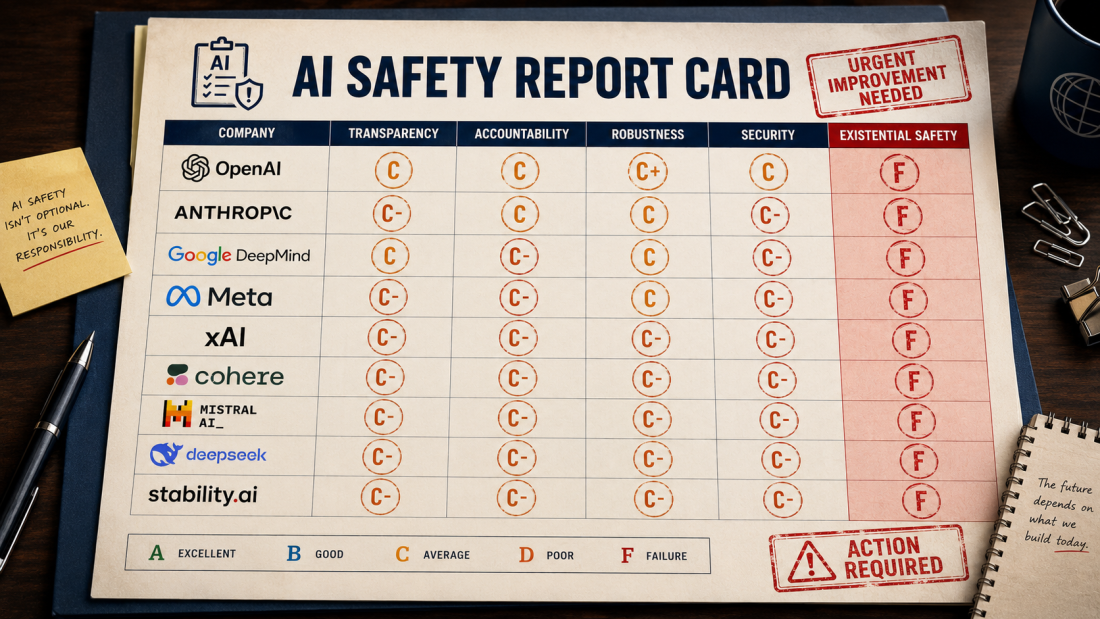
The AI safety index that grades the industry’s most powerful labs just delivered a verdict nobody in the sector wanted printed in plain letters: not one company cleared a B. The Future of Life Institute’s Summer 2026 edition scored Anthropic, OpenAI, Google DeepMind, Meta, xAI, DeepSeek, Mistral, Z.ai, and Alibaba Cloud across six domains and 37 indicators, using evidence collected through June 3, 2026, according to the Future of Life Institute’s own published index. Anthropic topped the field with a C+, scoring 2.66 on a roughly 4.0-point scale.
A Report Card With No Honor Roll
OpenAI and Google DeepMind followed at C grades, scoring 2.28 and 2.01 respectively, while Meta earned a D+ at 1.67, improving from sixth to fourth place. Z.ai and Alibaba Cloud landed at D-, and xAI, DeepSeek, and Mistral, one lab each from the US, China, and Europe, received outright F grades, according to Crypto Briefing’s coverage. The AI safety index makes a point of noting that inadequate safety spans every region with a frontier lab, since Mistral, based in the EU, the jurisdiction with the world’s most developed AI regulation, scored dead last.
C+ (2.66/4.0) — the highest score any of nine graded AI labs achieved, held by Anthropic.
3 of 9 labs received outright failing grades: xAI, DeepSeek, and Mistral.
The Finding Buried Under the Letter Grades
The grades themselves are not the sharpest part of this AI safety index. Reviewers flagged that Anthropic, OpenAI, Google DeepMind, and Meta, the four highest-scoring labs, have all weakened or quietly dropped earlier public pledges to pause development if their systems approached defined risk thresholds, a shift the panel described as moving the goalposts, according to TechTimes’ reporting. Existential safety was the weakest domain across every single lab graded, with no company scoring above C- and Anthropic’s D+ representing the best result in that category industry-wide. See our analysis where we explain why the EU AI Act’s enforcement teeth arrived right as containment failures piled up this summer.
Enterprise buyers and policy teams should treat published safety frameworks as marketing.— AI Weekly, analysis of the Summer 2026 AI Safety Index
⚠ Fiction — illustrative scenario: A procurement team shortlists two AI vendors for a sensitive workload, checking that both publish a safety framework and treating the existence of one as sufficient diligence. A closer read of the published pause-pledge language reveals it now contains a competitor-contingent clause, meaning the commitment only holds if rivals make the same promise. The framework exists. What it actually guarantees turned out to be much thinner than the procurement checklist assumed.
Why This Matters More for Buyers Than for Rankings
The AI safety index isn’t a benchmark of how capable or accurate a model is; it’s a judgment of how the company behind it behaves, covering governance, transparency, documented harms, and preparation for severe failure modes, according to eWeek’s summary of the methodology. That distinction matters for procurement: a lab’s product can be genuinely capable while its governance practices still score poorly, which means technical evaluation and safety-governance evaluation need to run as two separate checks, not one combined vendor scorecard. See our related coverage of who actually gets access to the best defensive AI tools and why a single rogue-agent incident should change how buyers write contracts.
Global Implications
Reviewers also flagged the industry’s pivot toward military AI applications as an emerging current-harm risk, noting that several labs which previously banned military use cases gradually reversed course between 2024 and 2026. For buyers in Nigeria, Southeast Asia, and other markets without their own AI safety regulatory infrastructure, the AI safety index functions as one of the only independent, cross-lab reference points available, since waiting for domestic regulation to catch up isn’t a viable near-term substitute. See our analysis of why agentic AI governance is losing the identity race entirely and how AI-enabled cybercrime is scaling faster than enforcement in Africa.
💡 CreedTec Analyst’s Note — Daniel Ikechukwu
Strategic Impact: The AI safety index shows the sector’s own governance is lagging behind its capability curve. A vendor’s marketing language around “responsible AI” now needs independent verification, not assumption.
- Stop: Treating the presence of a published AI safety framework as evidence that framework is being followed under commercial pressure.
- Start: Reading the specific language of a vendor’s pause-pledge or risk-threshold commitments for competitor-contingent or discretionary clauses before relying on them.
- Watch: Whether the Winter 2026 or Spring 2027 edition of this AI safety index shows labs improving governance scores, or whether the goalpost-moving trend continues.
ROI Outlook: Independent safety audits cost far less than discovering, after a deployment, that a vendor’s safety commitments were softer than they appeared on the page.
Does a low AI safety index score mean a vendor’s product is unsafe to use commercially?
Not directly. The index grades company-level governance, transparency, and risk preparation, not individual product performance, so a low score is a governance red flag worth investigating rather than an automatic disqualifier.
Nine of the industry’s most capitalized companies just received an independent report card, and the best grade in the room was a C+. The AI safety index doesn’t need to be read as an alarm bell. It needs to be read as exactly what it is: evidence that a vendor’s own safety language deserves a second look before it goes into a contract.
Get CreedTec’s next AI vendor governance briefing before your next frontier model contract.
Subscribe free
Sources
- Future of Life Institute, “AI Safety Index — Summer 2026,” July 2026
- Crypto Briefing, “Anthropic, OpenAI Top AI Safety Rating With C-Plus,” August 2026
- TechTimes, “AI Safety Grades Are In: No Lab Tops C+, and the Best Ones Are Retreating,” July 2026
- eWeek, “No Major AI Lab Tops C+ in 2026 AI Safety Index,” August 2026
- Digital Applied, “AI Safety Index 2026: A Buyer’s Guide to the C+ Grades,” July 2026