Fast Facts
A humanoid robot spec sheet is a marketing document first and an engineering one second. Numbers like degrees of freedom and payload are only meaningful with conditions attached. On October 21, NVIDIA and Agile Robots announced the Agile ONE SN reference humanoid with 31 degrees of freedom and 3 kg payload per arm, a useful test case.
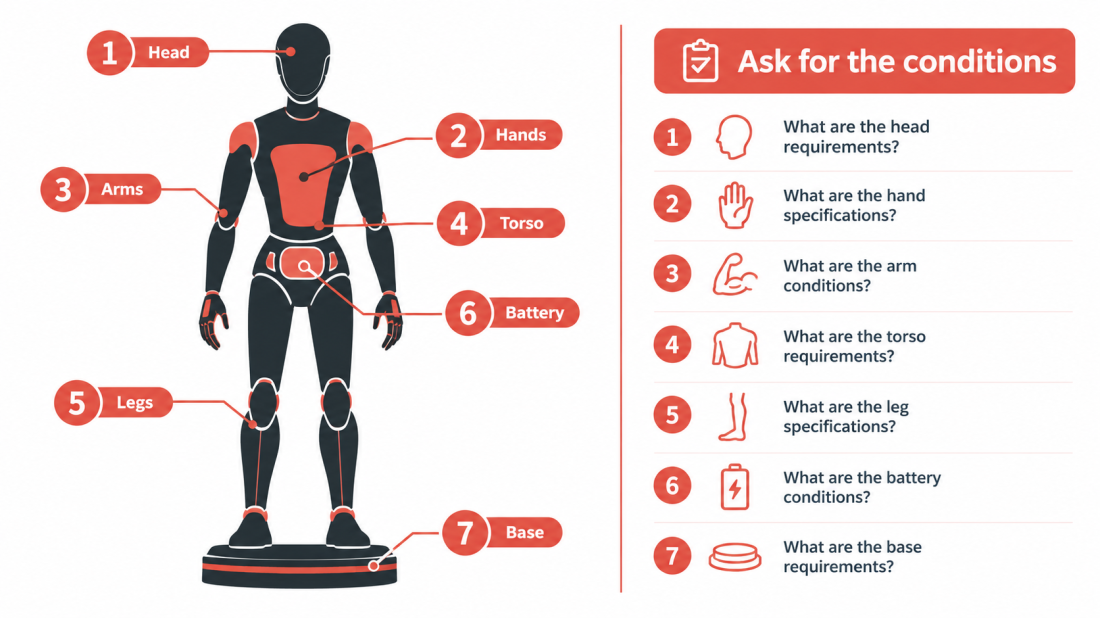
The announcement gives no price, runtime or battery data, and ships in early 2027. Use these seven checks on any humanoid quote, whether the vendor is new or established.
Humanoid launches arrive with impressive numbers and thin conditions. Reading a humanoid robot spec sheet well means asking what each number leaves out. The Agile ONE SN announcement is a clean example, because it publishes more detail than most and still omits what a buyer needs most.
What the Agile ONE SN Humanoid Robot Spec Sheet Shows
Per NVIDIA, announced at GTC Berlin, the robot stands 1.40 m tall and weighs 40 kg, with 31 degrees of freedom and a 3 kg payload per arm. It carries two WUJI Hand 2 units, each with 20 degrees of freedom, 1 kHz force control and tactile sensing, plus NVIDIA Jetson Thor compute at 2,070 FP4 teraflops with 128 GB of memory. It is built on Isaac GR00T, is aimed at humanoid research and development, and is due in early 2027. NVIDIA says the platform cuts setup time from weeks to days, a company claim.
31 DoF | 3 kg per arm | early 2027
As published by NVIDIA and Unite.ai. No price, runtime or battery figures were stated, and Halos safety integration is planned, not confirmed.
“The breakthrough for humanoids is usefulness at scale.”
— Zhaopeng Chen, Agile Robots CEO
Seven Checks for Any Humanoid Robot Spec Sheet
1. What stage is it? Announcement, prototype, pilot and shipping product are different things. The Agile ONE SN is a research platform due in 2027. See our analysis where we explain why humanoid production numbers like 50,000 units are hard to verify.
2. Where do the degrees of freedom live? Here, 31 total sits beside two hands of 20 each. Forty hand joints exceed 31, so the release does not make clear whether hand joints are counted. That is a question to ask, not an error to assume. Totals on a humanoid robot spec sheet are easy to inflate, so ask for the split by arms, legs, torso and hands.
3. Under what conditions is payload measured? A 3 kg figure depends on arm pose, duration and speed. Ask for payload at full reach, not held close to the body.
4. What are runtime and charging? The Agile ONE SN announcement omits both. Runtime sets how many productive hours a robot delivers. See our analysis where we explain why Digit 5’s 20-hour day depends on a charging dock.
5. Which autonomy mode produced the demo? Teleoperation, shared autonomy and full autonomy look alike on video. A September post by humanoid-comparison site Humanoza advises assuming the mode most favorable to the maker when none is stated. That source sells its own comparisons, so use the point, not the site. See our analysis where we explain why teleoperated robots are a data strategy, not a stopgap.
6. How does it fail, and who certifies it? NVIDIA says Halos safety integration is planned. Ask what happens on power loss or a fall. See our analysis where we explain what humanoid robot safety standards exist and what is still draft.
7. What is the service story? Fingers, actuators and feet wear out, and no humanoid robot spec sheet is complete without spares terms. See our analysis where we explain how the Boston Dynamics Atlas hand drops a finger to fix dexterity, a design built around serviceability. Ask for spares pricing, replacement lead times and whether modules are field-replaceable.
⚠️ Hypothetical scenario: A Lagos warehouse operator shortlists two humanoids and picks the one with the higher joint count. Six months later neither can run a full shift, and the winning robot’s hand actuators are back-ordered abroad. The operator realizes the humanoid robot spec sheet never listed runtime or spares, and nobody asked.
💡 CreedTec Analyst’s Note by Daniel Ikechukwu
Strategic Impact
Reference platforms like the Agile ONE SN lower the entry cost for builders, which will multiply humanoid spec sheets in 2027. Buyers who learn to read them will separate demos from deployable machines.
Stop / Start / Watch
- Stop: comparing humanoids by headline degrees of freedom.
- Start: requiring conditions, runtime, failure behavior and spares terms in writing.
- Watch: the Agile ONE SN price, runtime and first outside customers in 2027.
ROI Outlook
No price is public, so no ROI figure is defensible. For any humanoid, model productive hours per day and spare-part downtime before labor savings. A robot with gaps on its spec sheet carries hidden costs.
— Daniel Ikechukwu