Fast Facts
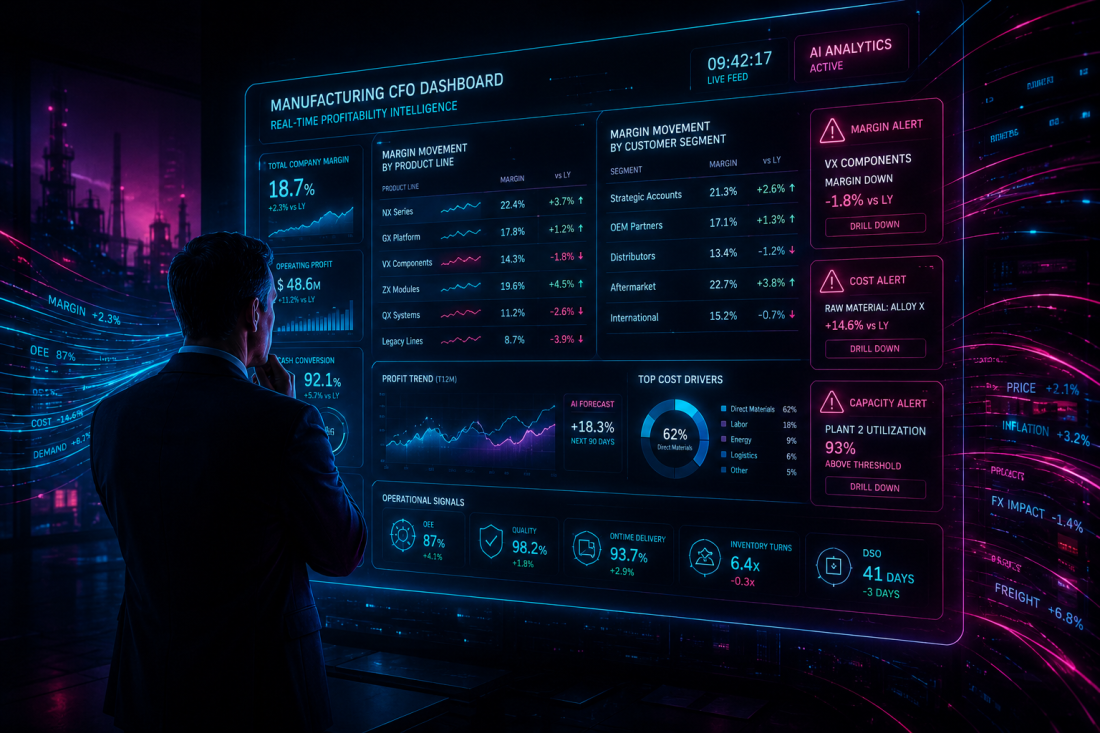
Commercial margin intelligence for industrial companies reached a product milestone on June 16, 2026, when Revenue Analytics launched CMI — the first agentic AI platform purpose-built to turn industrial margin data into margin action. The distinction between what it replaces (margin reporting) and what it delivers (margin intelligence) is the entire argument. Industrial companies have had dashboards for years. They have not had a system that tells a sales rep what to do about margin erosion before the quarter closes.
📊 By the Numbers
| Stat | Value |
|---|---|
| 80bp | “Gross margin was down 80 basis points last quarter” — the symptom CMI is designed to replace with actionable cause identification |
| 5 | Leakage vectors CMI monitors: price, customer, product, cost, and sales behavior — simultaneously |
| 20–30% | Maintenance cost reduction achievable through AI-driven industrial analytics — Analytics Insight, 2026 |
Commercial margin intelligence for industrial companies is not a new concept. What Revenue Analytics launched on June 16, 2026, is the first purpose-built system that operationalizes it — running continuously above ERP and CRM systems as an always-on commercial management layer that identifies where margin is leaking, explains why, and generates the specific commercial actions required to recover it.
That last clause is the one that matters. According to Revenue Analytics’ Business Wire announcement, CMI targets manufacturers, distributors, and industrial companies — including those backed by private equity — across five simultaneous leakage vectors: price, customer mix, product mix, cost movement, and sales behavior. No existing ERP or BI tool runs that analysis continuously and converts it to a commercial action without a multi-week analytics project.
The Execution Gap That Finance Reports Cannot Close
Industrial companies have had margin visibility for years. Finance reports gross margin monthly. BI dashboards show product-level profitability. Quarterly reviews flag the erosion. And yet, as Revenue Analytics SVP Mark Sjurseth writes: “If your current margin process answers what happened but cannot consistently answer what to do next, you do not have margin intelligence yet. You have margin reporting.”
The distinction is not semantic. Quarterly close cycles are too slow for industrial pricing decisions. By the time the deck is built, the rep has already quoted the deal, the customer has accepted, and the margin outcome is locked in. The damage is done before the analysis is complete. Performance-linked pricing models require this kind of continuous margin monitoring to function — without it, you cannot measure what you are linking performance to.
“Industrial companies don’t have a visibility problem. They have an execution problem. Margin leakage hides across thousands of daily decisions spanning price, customer mix, product mix, cost movement, and sales behavior.”— Jared Wiesel, EVP Manufacturing and Distribution, Revenue Analytics (June 16, 2026)
The Human Behavior Dimension of Margin Leakage
Five leakage vectors sounds like a systems problem. It is also a human behavior problem. Sales reps discount to close deals. Account managers protect relationships by absorbing cost increases rather than passing them through. Product managers prioritize volume over margin mix. Each individual decision looks rational in isolation. Aggregated across thousands of daily transactions, they produce the 80-basis-point quarterly miss that finance reports after the fact.
CMI’s agentic architecture is designed to intervene at the decision point — not the reporting cycle. Industrial AI revenue generation at the commercial layer requires exactly this kind of real-time signal: which rep, which customer, which product, which behavior is creating margin exposure today. The system’s value is not in identifying that margin fell. It is in identifying which of 10,000 daily decisions caused it and which ones can be corrected before the quarter closes.
⚠ Fiction — Illustrative Scenario
A distribution company’s VP of Sales reviews the monthly margin report. Gross margin is down 1.2 points. Three hours of pivot table work identifies that the erosion is concentrated in one product category, two regional reps, and a cluster of accounts that received unapproved freight concessions over the previous six weeks. By the time this analysis is complete, 340 more deals have been quoted under the same conditions. CMI would have flagged the freight concession pattern in week two.
The Private Equity Lens — and Why It Sharpens the Argument
Revenue Analytics specifically names private equity-backed industrial companies as a target segment. That is not coincidental. PE-owned manufacturers and distributors operate under compressed timelines for margin improvement, with quarterly covenants and EBITDA targets that tolerate neither slow reporting cycles nor execution gaps. Bain’s industrial automation hourglass model projects that AI-driven commercial and operational tools will capture disproportionate value through 2030. CMI positions itself in the commercial intelligence layer of that hourglass — above ERP, below strategic planning, and running continuously where the revenue decisions actually happen.
For Supply & Demand Chain Executive’s coverage, the CMI launch signals a broader shift: industrial companies are no longer asking whether AI can improve margin management. They are asking which platform converts that improvement into a recoverable, documentable financial outcome fast enough to matter within a fiscal quarter.
💡 CreedTec Analyst’s Note
By Daniel Ikechukwu — Strategic Impact Assessment
Strategic Impact: CMI addresses the most persistent blind spot in industrial commercial management: the gap between knowing margin fell and knowing which decisions caused it in time to intervene. The agentic AI architecture — continuously running, action-generating, operating above ERP — is the structural difference between a BI dashboard and a commercial operating system. That structural difference determines whether margin intelligence is a reporting exercise or a revenue recovery mechanism.
- ⛔ Stop: Using quarterly margin reviews as a management cadence for commercial decisions that happen daily. The reporting cycle and the decision cycle are running at incompatible speeds — and margin leaks in the gap between them.
- ✅ Start: Evaluating commercial AI platforms on whether they generate specific actions, not just insights. A dashboard that shows margin erosion without naming the rep, the customer, and the corrective action is still a reporting tool.
- 👁 Watch: Revenue Analytics’ client results from PE-backed industrial companies over the next two quarters. If CMI delivers documented margin recovery at the case study level, it will accelerate adoption among mid-market manufacturers who currently manage margin through Excel and gut instinct.
ROI Outlook: The ROI case for asset-based AI pricing models in industrial settings requires continuous margin monitoring to be defensible. CMI is the monitoring layer that makes performance-linked commercial contracts measurable. Without it, industrial companies are pricing on historical data and hoping the market doesn’t move faster than their reporting cycle. With it, they are pricing on current behavior — which is where margin is actually made or lost.
📬 CreedTec Weekly
If your industrial business manages margin through quarterly reviews and BI dashboards, your reporting cycle is slower than your pricing decisions. Subscribe to CreedTec’s weekly briefing — industrial AI revenue strategy and the financial logic behind the machines. → creedtec.online