
Fast Facts
Industrial AI revenue generation isn’t primarily about cost reduction — that’s the floor, not the ceiling. The real money comes from unlocking data streams, uptime windows, and predictive insights that factories couldn’t monetize before AI existed. Most operators are sitting on revenue they haven’t structured a model to capture.
| Metric | Value |
|---|---|
| $47B | AI in manufacturing revenue projected for 2026 (MarketsandMarkets, 2025) |
| $680B | Untapped industrial data value globally by 2030 (McKinsey, 2024) |
| 62% | Industrial firms citing AI as direct revenue contributor (Deloitte, 2025) |
The question framing most conversations about industrial AI revenue generation is wrong from the first word. “How does AI cut costs?” is the question CFOs ask in year one. It’s also the question that keeps most factories stuck at the surface of what AI can actually do to their P&L.
The deeper question — the one that separates facilities building durable competitive advantage from those running expensive efficiency pilots — is this: what can AI monetize that was previously impossible to sell? The answer to that question is where the real revenue conversation starts.
Cost Savings Are the Entry Fee, Not the Prize
According to Bain & Company’s AI-enhanced pricing research, manufacturers shifting toward AI-driven and outcome-based pricing structures are outperforming firms still dependent on traditional software licensing models. The gap isn’t only about technology quality — it’s about how value is packaged, monetized, and retained across the industrial stack.
Cost reduction is real and measurable. Predictive maintenance alone prevents unplanned downtime that costs manufacturers an average of $260,000 per hour in automotive settings. But cost savings have a ceiling. You can only reduce a cost to zero. The Bain hourglass model for AI revenue through 2030 shows that the highest-value industrial AI deployments treat efficiency gains as the base layer — and build revenue-generating services on top.
The Monetization Layer Most Factories Have Not Built
Every AI-monitored production line generates continuous data: machine health signals, throughput rates, quality deviation patterns, energy consumption curves. In most facilities, that data feeds internal dashboards and stops there. It has no commercial structure around it.
The monetization insight is straightforward: that same data stream, packaged correctly, becomes a sellable asset. AI downtime prediction is already being bundled with insurance analytics — insurers pay for access to predictive risk data because it prices their exposure more accurately than actuarial tables alone. The factory becomes a data provider. That’s a revenue line that didn’t exist before the AI was installed.
“The estimated value of untapped industrial data globally reaches $680 billion by 2030 — most of it sitting on factory floors with no commercial model attached.”
— McKinsey Global Institute, 2024
Outcome-Based Pricing Changes Who Pays and When
Traditional AI deployment sells software licenses. The vendor gets paid regardless of whether the system delivers value. Asset-based AI pricing models invert that structure — the vendor’s revenue is tied to measurable operational outcomes: uptime percentage, yield improvement, defect rate reduction.
For the manufacturer, this model removes the disconnect between cost and value. For the AI vendor, it creates a recurring revenue stream tied to real performance — which is both more defensible and more scalable than a one-time license fee. Both sides benefit when the structure is built correctly. Most contracts in 2026 still aren’t built that way.
⚠ Fiction — Illustrative Scenario
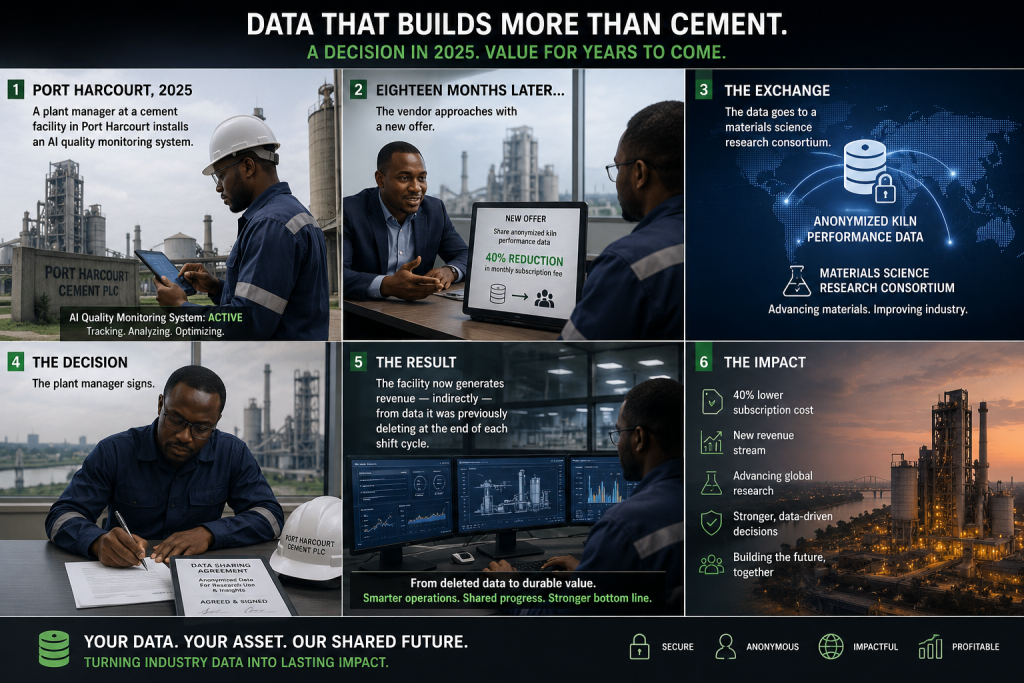
A plant manager at a cement facility in Port Harcourt installs an AI quality monitoring system in 2025. Eighteen months later, the vendor approaches with a new offer: share anonymized kiln performance data in exchange for a 40% reduction in the monthly subscription fee. The data goes to a materials science research consortium. The plant manager signs. The facility now generates revenue — indirectly — from data it was previously deleting at the end of each shift cycle.
Emerging Markets Are Closest to the Untapped Revenue Pool
The $680 billion in untapped industrial data McKinsey identifies is disproportionately concentrated in markets where AI monitoring infrastructure is newest — which means the data is cleanest, least commoditized, and most commercially valuable to global buyers. Industrial AI revenue in Nigeria and across West Africa sits at the earliest stage of this curve — which is not a disadvantage. It’s a timing advantage for operators who structure commercial data agreements before the market standardizes pricing downward.
The facilities that will generate the most durable AI revenue over the next decade are not necessarily the largest. They are the ones that recognized early that industrial AI revenue growth in emerging markets follows a different curve than mature economies — faster adoption, less legacy pricing inertia, and more negotiating room on data commercialization terms.
💡 CreedTec Analyst’s Note
Daniel Ikechukwu — Strategic Impact
The industrial AI revenue conversation is still dominated by cost-reduction metrics because that’s what procurement committees approved the budget against. But the facilities winning commercially in 2026 have moved past that frame. They’re generating revenue from data assets, outcome-based vendor contracts, and insight resale models that didn’t exist in their industry three years ago. The gap between these two groups is widening faster than most industry reports are capturing.
- Stop: Measuring AI ROI exclusively against cost reduction. That metric captures less than half the financial value a well-structured deployment generates.
- Start: Auditing your AI-generated data streams for commercial value. If your vendor owns the data your machines produce, that is a contract renegotiation, not a technology question.
- Watch: Outcome-based AI contracts entering procurement RFPs across West Africa and Southeast Asia in 2026. The facilities that negotiate data rights now will have a structural revenue advantage within 24 months.
ROI Outlook: Facilities combining predictive maintenance savings with one additional data monetization stream — insurance analytics, research partnerships, or supplier intelligence — typically see 36-month AI ROI that is 2× to 3× higher than cost-reduction-only deployments. The ceiling difference is the revenue model, not the technology.
Frequently Asked Questions
Can a mid-size factory realistically generate revenue from AI data?
Yes — the data commercialization model doesn’t require scale, it requires structure. A facility with consistent AI monitoring data and a clear data rights clause in its vendor contract can participate in research partnerships, insurance analytics, or supplier intelligence markets regardless of size.
What should procurement teams demand in AI contracts to protect revenue potential?
Three clauses: data ownership (you retain rights to operational data your machines generate), commercialization rights (you can share or sell anonymized data independently), and outcome-based pricing options (at least one performance-linked fee structure). Most standard vendor contracts include none of these by default.
Is the revenue opportunity different for factories in Nigeria or West Africa?
Structurally, yes — and in the operator’s favour. Industrial data from emerging markets carries a novelty premium for global research buyers. Less historical data saturation means higher marginal value per data point. The commercial window is open now; it narrows as more facilities come online and data becomes commoditized.
Industrial AI revenue strategy, financial models, and market intelligence — built for operators who want the commercial picture, not just the technical one.