This article is part of CreedTec’s Enterprise Automation TCO Week, a 4-day analytical series breaking down the hidden financial metrics behind the world’s largest Industrial AI and robotics ecosystems.
Fast Facts
The flat software license is losing ground in industrial AI. According to Gartner, 60% of large IT services contracts will include outcome-linked clauses by 2026. Factory CFOs who still buy AI on a per-seat basis are paying for access, not results — and vendors are increasingly willing to price on the outcome precisely because they know the math works in their favour. The question is whether buyers know it too.
📊 By the Numbers
- 60% — Share of large IT services contracts projected to include outcome-linked levers or “AI clawback” clauses by 2026 (Gartner, via HighRadius, 2026)
- 43% — Enterprise buyers who consider outcome-based or risk-share pricing a significant factor in purchase decisions (Getmonetizely, citing buyer surveys, 2026)
- 41% — Share of AI vendors using hybrid pricing models in 2026, up from 27% in 2025 (Bessemer Venture Partners, via Korix, 2026)
- $260K — Average cost of one hour of unplanned downtime in automotive manufacturing — the metric that anchors most performance-linked AI contracts (f7i.ai, 2026)
The contract structure for performance-linked pricing in industrial AI is changing faster than most procurement departments are updating their RFP templates. For decades, industrial software was sold the same way: a seat, a login, a maintenance agreement, and a hope that someone used it enough to justify the line item. That model is being quietly replaced — and the replacement puts a number on results rather than access.
According to Gartner’s 2026 enterprise contract outlook, 60% of large IT services contracts will include outcome-linked levers or clawback clauses by the end of 2026. In industrial settings where AI is being asked to prevent downtime, improve yield, and reduce waste, the move to performance pricing isn’t abstract — it’s a direct function of the fact that the outcomes are measurable in dollars per hour.
The Per-Seat Model Was Never Built for Autonomous Systems
Per-seat licensing made sense when software required a human to operate it. One person, one login, one value unit. Industrial AI revenue generation has moved past that frame entirely. A predictive maintenance system running on a factory floor doesn’t occupy a seat — it monitors 400 assets simultaneously, fires alerts without prompting, and makes decisions between shifts when no licensed user is present.
Charging for that system per seat is like charging a security guard by the chair. According to Flexprice’s February 2026 pricing analysis, 78% of IT leaders now report unexpected charges from consumption-based AI pricing models — a direct consequence of seat-based and flat-license structures being retrofitted onto systems that operate on usage and outcome logic. The mismatch isn’t a billing error. It’s a structural incompatibility between a 1990s pricing model and a 2026 operational reality.
Vendors Are Offering Outcome Pricing Because the Math Favours Them
Here is the part most procurement guides leave out: when an AI vendor offers performance-linked pricing — pay per hour of downtime avoided, per percentage point of yield improvement, per defect caught — they are doing so because their internal model shows the outcome is reliably deliverable. Asset-based AI pricing models are structured around verified operational results, which means the vendor’s confidence in the outcome is embedded in the offer.
For factory buyers, this is both a signal and a negotiating lever. According to Getmonetizely’s 2026 SaaS pricing guide, 43% of enterprise buyers now consider outcome-based or risk-share pricing a significant factor in vendor selection. When a vendor declines to offer performance-linked terms, that reluctance is data. It tells you something about their confidence in their own system’s results.
“By 2026, 60% of large IT services contracts will include AI clawback clauses or outcome-linked levers — because enterprise software is no longer about buying a dashboard. It is about buying an autonomous workflow.”
— Gartner, via HighRadius Enterprise Pricing Analysis, 2026
The Downtime Number Is the Foundation of Every Performance Contract
Industrial performance contracts anchor on a single metric more than any other: unplanned downtime cost. At $260,000 per hour in automotive manufacturing, a predictive maintenance AI that eliminates one major unplanned stop per quarter generates a calculable, auditable return. That figure becomes the denominator in every performance pricing negotiation — and how AI downtime prediction is being monetised now extends beyond the factory gate into insurance and supply chain analytics.
According to Sphere Inc’s 2025 predictive maintenance analysis, AI-driven monitoring reduces equipment downtime by up to 50% in documented industrial deployments, with maintenance costs dropping an average of 25%. These are the benchmarks performance contracts are written against — not the vendor’s marketing slide, but the industry-standard outcome range that both parties can verify independently.
⚠ Fiction — Illustrative Scenario
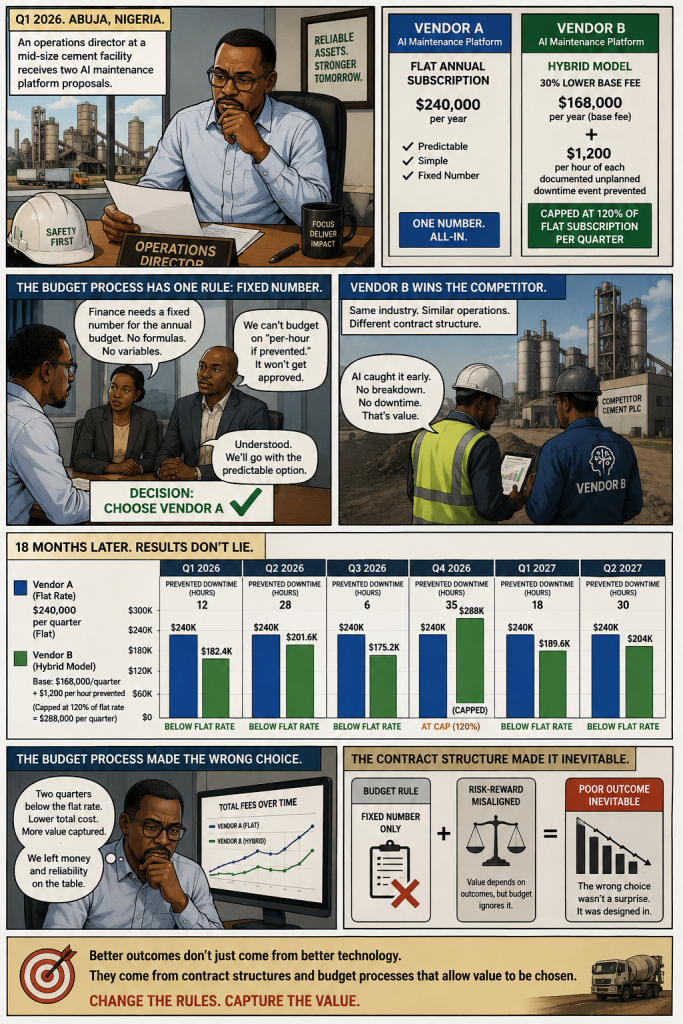
An operations director at a mid-size cement facility in Abuja receives two AI maintenance platform proposals in Q1 2026. Vendor A offers a flat annual subscription. Vendor B offers a hybrid model: a lower base fee plus a per-hour charge for each documented unplanned downtime event prevented, capped at 120% of the flat subscription in any quarter. Vendor B’s base fee is 30% lower. The operations director chooses Vendor A because the budget process requires a fixed number. Eighteen months later, Vendor B’s model — which went to a competitor — has generated two quarters where the total fee came in below the flat rate. The budget process made the wrong choice. The contract structure made it inevitable.
Emerging Market Factories Have the Most to Gain — and the Least Negotiating Template
For facilities in Nigeria, Ghana, and Southeast Asia, performance-linked pricing carries a specific advantage that global benchmarks understate. In markets where capital is constrained and budget approval for AI platforms requires demonstrable ROI before the first invoice, outcome-based contracts remove the upfront risk entirely. The factory pays for results that have already been delivered — which is a structurally easier conversation with a board than a multi-year software licence commitment against projected savings.
The gap is that most procurement teams in these markets are working from RFP templates built for flat-license structures. Industrial AI revenue growth in emerging markets is being shaped right now by whoever writes the contract terms first — and vendors entering these markets know that operators without outcome-clause precedents are easier to lock into flat structures. Bain’s hourglass model for AI revenue identifies this exact window — the gap between outcome-model awareness and contract adoption — as the highest-value period for both buyers and vendors to establish pricing precedents.
💡 CreedTec Analyst’s Note
Daniel Ikechukwu — Strategic Impact
Performance-linked pricing is not a concession vendors are making because buyers demanded it. It is a commercial strategy vendors are advancing because it increases customer retention, reduces churn, and creates a defensible recurring revenue structure tied to real operational outcomes. Factory buyers who enter these negotiations without understanding that dynamic are ceding leverage before the first clause is drafted. The shift to outcome pricing is real, it is accelerating, and the question for every industrial operator in 2026 is not whether to adopt it but how to negotiate it correctly.
- Stop: Approving AI software budgets on flat-license structures without first requesting an outcome-based pricing alternative. If the vendor refuses, that refusal is a due diligence signal.
- Start: Building procurement RFPs that include outcome metric definitions — downtime hours, yield percentage, defect rate — as contractual performance anchors, not just aspirational KPIs.
- Watch: The Bessemer data showing hybrid pricing adoption rising from 27% to 41% of AI vendors in a single year. That trajectory means flat-license-only offers will become increasingly rare — and increasingly suspicious — by 2027.
ROI Outlook: Facilities that negotiate performance-linked clauses into their first AI platform contract create a pricing template they can replicate across every subsequent deployment. The first outcome contract is the hardest to write. Every one after it uses the same structure. The long-term procurement advantage compounds — and it starts with one clause in the next RFP.
Frequently Asked Questions
What is the difference between usage-based and performance-linked AI pricing?
Usage-based pricing charges for consumption — API calls, tokens, compute hours — regardless of whether the output delivered value. Performance-linked pricing charges against a defined operational outcome: downtime hours prevented, yield improvement percentage, defect rate reduction. Usage-based creates unpredictable bills. Performance-linked creates shared accountability for results.
What should a procurement team include in an outcome-based AI contract?
Four elements: a defined performance metric (e.g., unplanned downtime hours per quarter), a measurement methodology both parties agree on before signing, a baseline measurement period to establish the pre-deployment benchmark, and a clawback or fee adjustment clause if performance thresholds aren’t met within an agreed window. Most standard AI contracts include none of these.
Is performance-linked pricing realistic for factories in Nigeria or West Africa?
It is structurally more advantageous in these markets than in mature economies — because it removes the upfront capital commitment that makes AI platform adoption difficult under constrained budgets. The challenge is that most vendor proposals entering these markets default to flat-license structures because operators haven’t yet demanded otherwise. The leverage exists. It requires a procurement team that knows to use it.
Industrial AI contract strategy, pricing intelligence, and revenue frameworks — for operators who want to negotiate from knowledge, not assumption.