
Fast Facts
On June 7, 2026, Axiom Space and Prada unveiled the liquid cooling and ventilation inner layer of the NASA lunar spacesuit. The story being told is about fashion meeting space. The story worth reading is about what Prada brought that no AI design system could replicate — and what that means for every industrial operator asking AI to close their engineering capability gap.
📊 By the Numbers
- $1.3B — NASA contract value under which Axiom Space is developing the AxEMU spacesuit, with Prada contributing materials expertise (CultureMap Austin, 2024)
- 8 hours — Minimum spacewalk duration the Prada-engineered liquid cooling and ventilation garment must sustain at the lunar South Pole (Axiom Space/Fox Business, June 7, 2026)
- 50+ years — Gap since the last human lunar surface mission the Artemis program is closing, making the spacesuit’s performance non-negotiable (Axiom Space)
- June 7, 2026 — Date Prada and Axiom Space unveiled the LCVG inner layer at a press event in New York City (Fox Business / SatNews, 2026)
The NASA Prada Axiom spacesuit unveiled in June 2026 is being covered as a luxury brand story. Prada goes to space. Fashion meets the cosmos. That framing is accurate and completely misses the point.
What the Prada-Axiom partnership actually documents is the boundary of AI-assisted design — the precise point where pattern recognition, generative modeling, and materials science databases run out of answer, and where half a century of craft expertise from an Italian fashion house becomes the engineering solution that a $1.3 billion NASA contract depends on.
What Prada Actually Built — And Why No AI Could Have
On June 7, 2026, Fox Business reported Axiom Space and Prada’s unveiling of the Liquid Cooling and Ventilation Garment — the inner layer of the AxEMU spacesuit that will protect astronauts during 8-hour spacewalks at the lunar South Pole. Prada’s contribution covered advanced 3D modeling, high-tech knitting, thermal fabric selection, and specialized sewing techniques developed across decades of high-performance product development, including their Luna Rossa America’s Cup sailing programme.
These are not decorative inputs. Thermal regulation under lunar surface conditions — temperature extremes from +127°C to -173°C, dust infiltration, constant motion load — requires material behaviour knowledge that no AI training corpus assembled from public data possesses. Axiom Space President Matt Ondler was direct about it: “We have broken the mold. The Axiom Space-Prada partnership has set a new foundational model for cross-industry collaboration.”
The word “foundational” is the one worth unpacking. AI decision-making systems in industrial settings operate on the same constraint: the model performs within the boundaries of its training data. Where the domain knowledge required to solve a problem exists outside that corpus — in a craft tradition, a specialist trade, a generation of manufacturing experience — the AI cannot self-generate the answer. Prada’s atelier knowledge is that missing corpus.
The Cross-Industry Model That Industrial AI Deployments Are Missing
Axiom’s statement from the June 7 unveiling carried the clearest articulation of the model: “By bringing together the best in both aerospace engineering as well as luxury craftmanship and advanced product development, we have developed a garment that neither company could have created independently.” That sentence is the procurement principle. Neither party alone. Both required.
Most industrial AI deployments are structured the opposite way: an AI platform vendor, a systems integrator, and an internal IT team — all drawing from overlapping technical knowledge bases, none possessing the irreplaceable domain expertise that defines the specific operating environment. The hidden integration cost of industrial platforms is partly a symptom of this: the gap between what the platform can do and what the operating environment requires is filled by expensive, time-consuming customisation work that a cross-domain partnership could have structured from day one.
“We have developed a garment that neither company could have created independently — and that is exactly the kind of cross-industry thinking that will define the next era of human spaceflight.”
— Axiom Space Statement, Fox Business, June 7, 2026
The Procurement Question Hidden in the Headline
For industrial operators reading the Prada-NASA story as a curiosity rather than a case study, there is a question worth sitting with: what domain expertise in your organisation or supply chain represents the Prada equivalent — knowledge that exists nowhere in a standard AI training dataset — and is your current AI deployment structured to incorporate it?
The AI productivity paradox consistently surfaces in deployments where the technology is capable but the domain knowledge required to configure it for a specific environment is absent. Prada’s contribution to the AxEMU wasn’t glamour. It was irreplaceable material science applied to a problem no algorithm had previously solved. The same principle applies to the master welder whose defect intuition no vision model has been trained on, the metallurgist whose alloy knowledge never made it into a public database, and the process engineer whose understanding of a specific plant’s behaviour lives entirely in her head.
⚠ Fiction — Illustrative Scenario
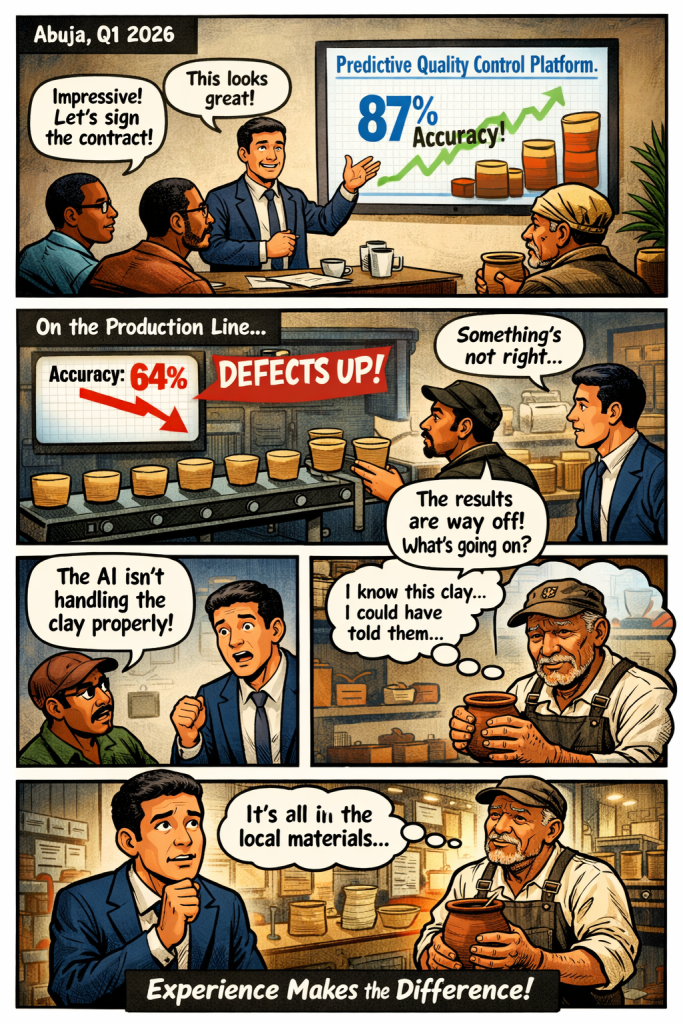
An AI systems integrator presents a predictive quality control platform to a ceramics manufacturer in Abuja in Q1 2026. The platform performs at 87% accuracy on the demo dataset. On the live production line, accuracy drops to 64%. The gap isn’t computational — it’s material. The specific clay composition sourced from a local deposit behaves differently from anything in the model’s training data. The ceramics master who has been working the kiln for 22 years could have identified the variance in 20 minutes. He wasn’t in the room when the contract was signed.
What Emerging Market Industrial Operators Should Take From This
For manufacturers in Nigeria, Ghana, and Southeast Asia, the Prada-NASA model carries a structural insight that applies immediately: the AI systems being sold into these markets were trained on datasets that almost certainly don’t contain the specific operating conditions, material inputs, and environmental variables of local production environments. Understanding what AI systems actually can and cannot do in 2026 is the prerequisite for structuring deployments that perform rather than disappoint.
The Prada contribution to NASA’s spacesuit isn’t a story about luxury entering space. It’s a story about what happens when an organisation with irreplaceable domain expertise is formally brought into a technically sophisticated collaboration from the design stage. Trustworthy industrial AI deployments follow the same logic. The domain expertise needs to be in the room before the contract is signed — not called in after the model underperforms.
💡 CreedTec Analyst’s Note
Daniel Ikechukwu — Strategic Impact
The Prada-Axiom partnership is the most publicly documented case in 2026 of what cross-industry domain expertise contributes to technically sophisticated systems development. Prada’s 3D modeling, knitting, and thermal fabric knowledge solved problems that Axiom Space’s aerospace engineering team and their AI design tools couldn’t solve independently. For every industrial operator running an AI deployment that underperforms, the diagnosis is rarely the algorithm. It is usually the absence of the equivalent of Prada — the domain knowledge that exists outside the training data and was never formally incorporated into the system design.
- Stop: Treating AI system underperformance as a technology problem before auditing the domain expertise gap. The algorithm is usually fine. The missing input is usually a human who wasn’t in the room.
- Start: Mapping the craft and domain knowledge inside your operations that no AI training corpus contains. That inventory is your Prada asset — and it should be formally structured into your next AI deployment contract.
- Watch: Cross-industry AI collaboration contracts becoming a procurement category. As the Axiom-Prada model proves commercial and technical viability at NASA scale, expect enterprise AI vendors to begin offering structured domain partnership frameworks as a premium deployment tier by 2027.
ROI Outlook: AI deployments that formally incorporate domain expertise partnerships at the design stage — rather than attempting to patch the gap post-deployment — consistently outperform technically equivalent deployments without that structure. The cost of the partnership is recoverable. The cost of a failed deployment without it typically is not.
Frequently Asked Questions
What exactly did Prada contribute to the NASA spacesuit — and why did it matter?
Prada contributed advanced 3D modeling, high-tech knitting techniques, specialized fabric selection, and thermal material expertise developed across decades of high-performance product work. For the liquid cooling and ventilation garment specifically, these inputs determined how the suit regulates astronaut body temperature during 8-hour spacewalks at lunar South Pole temperatures ranging from +127°C to -173°C. No aerospace engineering database contained this specific material behaviour knowledge.
What is the procurement lesson from the Prada-Axiom model for industrial AI buyers?
Identify the domain expertise in your operations or supply chain that no AI training corpus contains — and structure that expertise formally into the AI deployment contract before the system is configured, not after it underperforms. The Axiom-Prada partnership worked because Prada was involved at the design stage of the garment, not brought in to fix a finished product that wasn’t performing.
Is the Prada-NASA spacesuit actually for Artemis III or Artemis IV?
Both missions are involved. The original AxEMU spacesuit outer design was unveiled in October 2024 for the Artemis III mission. The liquid cooling and ventilation garment inner layer — unveiled June 7, 2026 — is specifically cited by Fox Business as supporting NASA’s Artemis IV mission, currently targeted for early 2028. The collaboration is ongoing and expanding across both missions.
AI systems analysis, cross-industry deployment intelligence, and domain expertise strategy — for operators who want performance, not just procurement.