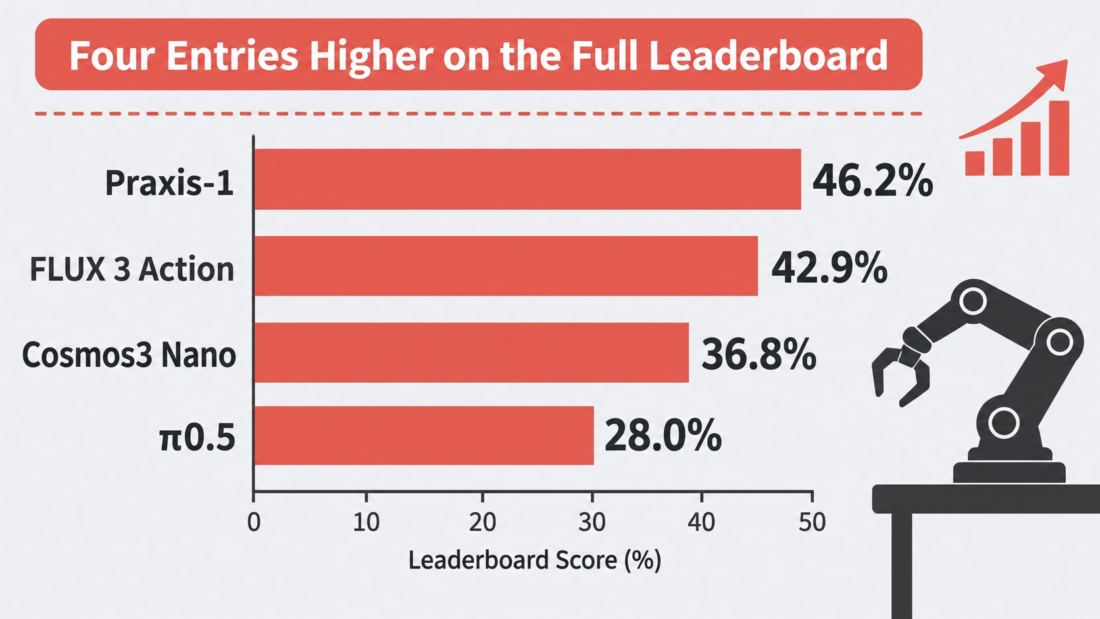
The Praxis-1 world action model from Runway is open-weight under Apache 2.0 and scored 46.2% across 1,200 episodes on NVIDIA’s (Nasdaq: NVDA) RoboLab-120. Runway calls it the top world action model, yet it debuted fifth on the full leaderboard, and the scores are the company’s own.
For buyers, the useful number is not 46.2%. It is the gap between a simulated score and your own pilot. Ask for the real-trial count behind Runway’s reported 0.95 correlation, then send the evidence request below.
Runway released Praxis-1 on November 11, 2026, a 27-billion-parameter mixture-of-experts diffusion transformer that predicts video and robot actions together. Open weights remove the license barrier for robotics teams, and a fresh industry feature this month put the model at the center of a bigger question: can a world model both train a robot and grade it? The Praxis-1 world action model is a clean test case, because its claims are specific enough to check.
What the Leaderboard Does and Does Not Prove
RoboLab-120 is a set of 120 tabletop tasks built in NVIDIA Isaac Sim, such as moving a banana into a bowl. Policies are not trained there. They see the simulator only at test time, and success is a geometry check, so it works as an exam. Runway’s table shows Praxis-1 at 46.2%, ahead of FLUX 3 Action at 42.9%, Cosmos3 Nano at 36.8% and π0.5 at 28.0%. Yet the same leaderboard placed it fifth overall, so stronger entries exist outside Runway’s chosen comparison. NVIDIA separately reports that its own GR00T 2 ranks among the top three models on RoboLab, though the two disclosures differ in scope.
Anastasis Germanidis, Runway’s CTO and co-founder, says benchmark gains tracked gains on real robot arms as pre-training data grew. That is a mechanism claim worth testing: Praxis-1 adapts to a new body through LoRA fine-tuning on your embodiment, cameras and tasks, not through any automatic learning on site. See our analysis where we explain what a sim-to-real accuracy number leaves out before you accept a headline score.
Stat callout (Runway-reported, Nov 11, 2026)
46.2% RoboLab-120 success across 1,200 episodes, versus 28.0% for π0.5.
80.0% vs 52.4% success on SimplerEnv after fine-tuning on Google’s RT-1 robot (Alphabet, Nasdaq: GOOGL), against the original RT-1 policy.
5 hardware targets named: H100, B200, RTX 5090, RTX PRO 6000 and Jetson Thor. Tests were run by Runway; no independent replication was cited.
“Simulations are doomed to succeed.”Jonathan Hurst, chief roboticist and co-founder, Agility Robotics (Nasdaq: AGLT)
Sim Scores Versus Real Trials
For the Praxis-1 world action model, Runway reports that simulating policies inside its world model predicts real-world results with a 0.95 correlation. The page I read gave no trial count. For comparison, Google fine-tuned Veo to predict how Gemini Robotics policies would play out, then checked the predictions against more than 1,600 real-world trials. Amey Deosthali, AMD’s (Nasdaq: AMD) head of robotics, industrial, healthcare and embedded computing, warns that in contact-rich manipulation small prediction errors compound over time. See our analysis where we explain why speed claims in robot simulation carry an asterisk, and why richer world models still leave robot training unproven.
⚠️ Hypothetical scenario, not a real event: A warehouse manager in Lagos reads “state-of-the-art” and “open weights,” then signs a pilot for a pick-and-place arm. The demo uses clean tabletop objects. Her cartons are dusty, shiny and mixed, and the first week’s success rate lands far below the brochure number. Nobody wrote down what counted as a success or who paid for retraining, so the argument starts after the invoice.
The Evidence Request to Copy
Send this before any pilot built on the Praxis-1 world action model, or any model sold on a simulation benchmark:
Subject: Evidence request before pilot - benchmark claim

Before we scope a pilot, please provide:
1. Your rank among ALL entries on the cited benchmark, not a sub-category.
2. Who ran the evaluation, and whether a third party has reproduced it.
3. The number of real-world trials behind any sim-to-real correlation, and which failure types were excluded.
4. Hours and cost to adapt the model to our robot, cameras and tasks (LoRA or full fine-tune).
5. A written success definition for OUR task, plus takeover rate and recovery time targets.
6. Stop behavior when the model is uncertain or wrong.

We will write the maximum acceptable sim-to-pilot gap into the contract.
Formulas: Sim-to-pilot gap = benchmark success % − your pilot success %. Cost per accepted task = (robot hours × hourly cost + supervisor minutes × wage + adaptation cost) ÷ accepted tasks. Your KPI is the second number, not the leaderboard.
What Open Weights Change for Buyers
Open weights lower switching cost, since you can run, inspect and adapt the model on your own hardware. They do not lower evidence cost. See our analysis where we explain why big chip vendors are buying robot simulation assets, because the grading layer is becoming a product category. See also our test of a world model that runs fast yet stays untested on hardware.
The Praxis-1 world action model will likely be fine-tuned widely, and the numbers that matter will come from those deployments, not from the launch page.
💡 CreedTec Analyst’s Note by Daniel Ikechukwu
Strategic Impact
Open models move the competition from access to proof. The vendor who publishes real-trial counts and failure categories will win procurement against the vendor who publishes only a leaderboard rank.
Stop / Start / Watch
- Stop: treating “top in category” as “top overall.”
- Start: writing a sim-to-pilot gap limit into every pilot contract.
- Watch: independent replications of RoboLab-120 scores and published adaptation costs.
ROI Outlook
With the Praxis-1 world action model, free weights shift spend to adaptation, supervision and evaluation. If supervisors still catch most failures, cost per accepted task, not model price, decides whether a pilot scales.
— Daniel Ikechukwu
Get the vendor-evidence checklist for robot pilots. One copy-paste procurement tool per issue: subscribe to the newsletter.
Robot simulation, policy evaluation and sim-to-real validation vendors: buyers are asking for exactly this proof. Sponsor and partnership inquiries: creedtec@creedtec.online