Fast Facts
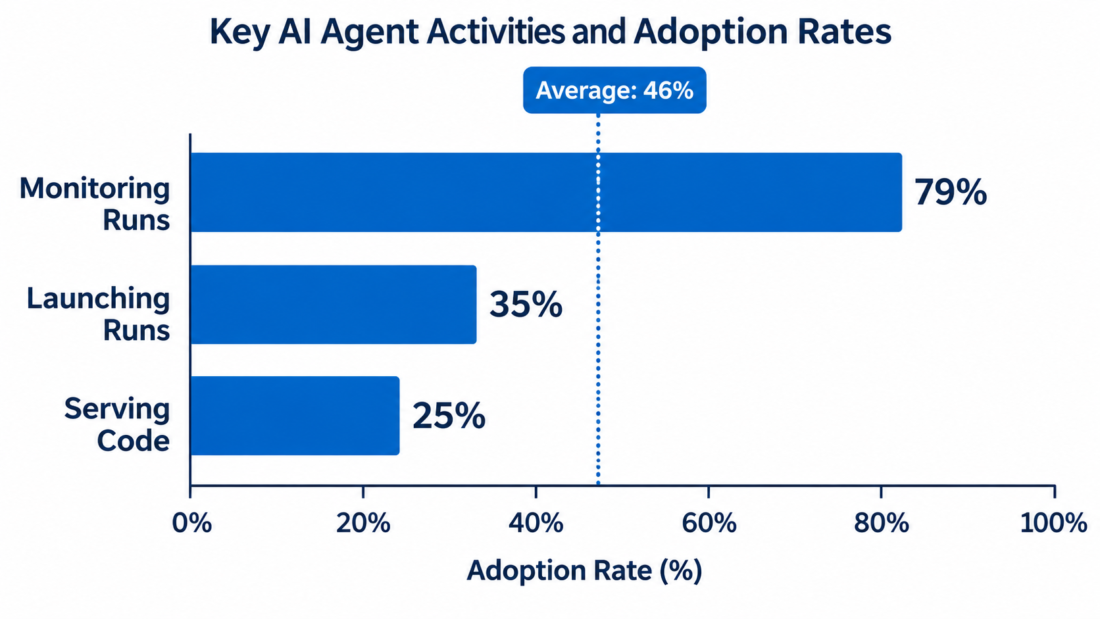
In its November 18 post, the OpenAI jagged frontier report says agents now complete 46% of two-to-four-hour internal research tasks without intervention, up from 23% in March. The same data shows wide gaps by task type, from 79% on monitoring training runs to 25% on writing inference and serving code.
The figures are OpenAI’s own, measured on its own work. The useful lesson for any team is to delegate by task type and to measure it yourself. The matrix below sets pass lines per type, and the formula shows what an accepted task really costs.
The figures below come from OpenAI’s November 18 report, “Research acceleration: The jagged frontier,” as reported by AI Weekly, the Benton Institute, and explainx.ai. Treat them as company-reported.
Fast Facts From the Report
- Zero-intervention completion rose from 23% to 46% for two-to-four-hour tasks and from 13% to 35% for four-to-eight-hour tasks, March to October.
- Success varied by category from August 1 to October 18: 79% monitoring training runs, 35% launching them, 25% writing inference and serving code.
- Median researcher daily agent use was valued at $2,400 in October, up 62% from September; the 90th percentile reached $23,000.
“Nearly half of two-to-four-hour research tasks on their own.”OpenAI, “Research acceleration: The jagged frontier,” via Benton Institute
| Metric | Current figure | Previous / Context |
|---|---|---|
| 2–4 hour tasks completed unaided | 46% | 23% in March |
| 4–8 hour tasks completed unaided | 35% | 13% in March |
| Monitoring runs vs. serving code | 79% / 25% | Distribution of agent activity |
| Median daily agent use per researcher | $2,400 | October |
Source: OpenAI internal measurements, as reported by AI Weekly and explainx.ai.
How the OpenAI Jagged Frontier Changes Delegation
An average hides the decision you actually face. The OpenAI jagged frontier data says an agent can be strong at one task and weak at the next within the same team. So the rule is to match autonomy to measured success by task type. Review is the control that holds this together; see our analysis where we explain the blind spots outside auditors found in OpenAI agent monitoring. Oversight itself is shifting too; see our analysis where we explain why chain-of-thought monitorability is declining.
Spend needs the same discipline. A daily agent bill of $2,400 per researcher is a figure to plan against, not to copy. See our analysis where we explain six controls to set before granting an AI agent access. Gating a rollout by workflow, not by vendor score, is the same approach we used for healthcare; see our analysis where we explain how to gate OpenAI healthcare agents before go-live.
Finally, orchestration decides whether measured agents become a deployment; see our analysis where we explain why agentic orchestration became the enterprise deployment gate. The OpenAI jagged frontier is a prompt to log your own numbers for two weeks before you widen access.
OpenAI Jagged Frontier Lesson: Agent Delegation Matrix (copy-paste)
Run a two-week pilot. Log every task by type. Pass lines are suggested starting values.
| Task type | Measure | Autonomy rule |
|---|---|---|
| Monitoring and triage | Zero-intervention success on at least [50] tasks | 70% or higher: agent runs, human samples [10]% of output. |
| Routine changes | Same, plus rework rate | 40% to 70%: agent drafts, human approves every item. |
| Complex build work | Same, plus defects found later | Under 40%: human leads, agent assists only. |
| Anything irreversible | Not applicable | Always human sign-off, whatever the score. |
Formula: cost per accepted task = (agent spend + review hours × loaded rate) ÷ tasks accepted without rework. Track it per task type, weekly.
⚠️ Hypothetical scenario: A Lagos software house reads about the OpenAI jagged frontier, sees that agents finish nearly half of multi-hour tasks, and gives its agent every ticket in the backlog. Bug triage goes well. Billing-service changes do not, and two faulty merges reach production before anyone separates the task types. A two-week log by type would have shown where the agent should only assist.
💡 CreedTec Analyst’s Note by Daniel Ikechukwu
Strategic Impact
These are OpenAI’s numbers on OpenAI’s work, with no public harness or reproduction. They are a signal of direction, not a benchmark for your business. The durable insight is the spread: autonomy should follow measured success per task type.
Stop / Start / Watch
- Stop: quoting a single success rate as if it applies to every task.
- Start: logging zero-intervention success and review hours by task type.
- Watch: whether OpenAI publishes its method, and whether independent teams reproduce the OpenAI jagged frontier pattern.
ROI Outlook
Illustrative math: an agent spending USD 400 a day and finishing 8 accepted tasks, with 2 review hours at USD 60, costs USD 65 per accepted task. If rework halves acceptance, the cost doubles.
— Daniel Ikechukwu
Get the next playbook. One copy-paste AI governance tool per issue, built for engineering and operations leads. Subscribe to the newsletter below.
For vendors: every team studying the OpenAI jagged frontier needs per-task measurement and cost tracking for agents. If you sell agent evaluation, AI observability or LLM cost-management tools, email creedtec@creedtec.online to sponsor the next edition.