Fast Facts
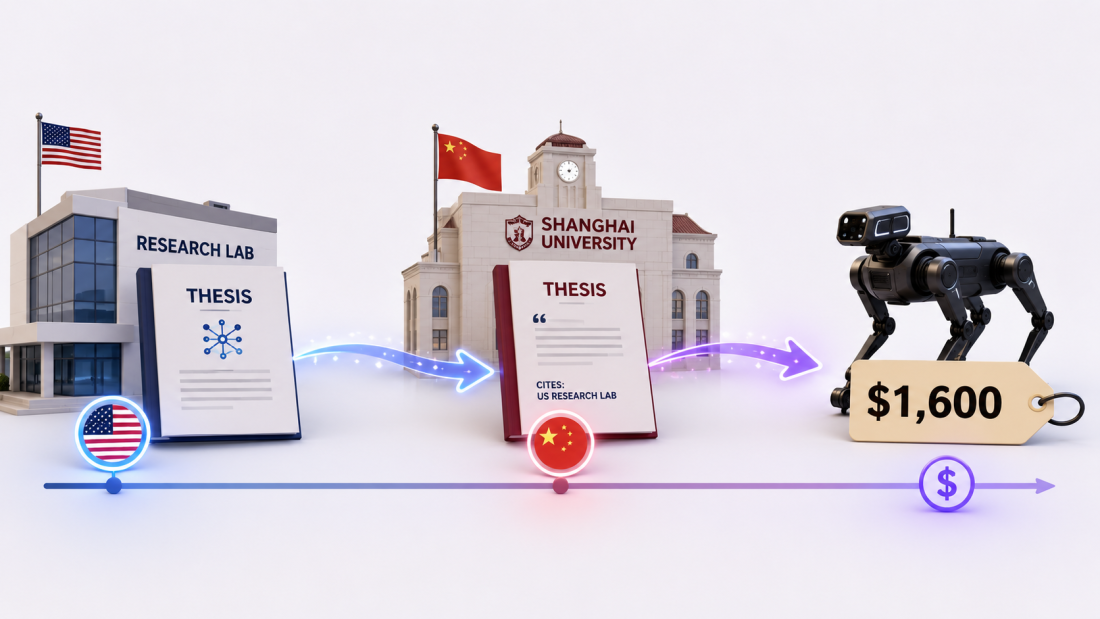
Unitree’s dominant Go2 robot dog, priced at $1,600, traces its core leg-actuator design back to quadruped research funded by DARPA and the US Army Research Laboratory at MIT and UPenn. A researcher’s published master’s thesis on the actuator design was copied by Chinese manufacturers within six months. Unitree’s founder cited that same MIT research directly in his own 2016 thesis. The technology transfer wasn’t theft. It was the predictable outcome of open academic publishing colliding with a manufacturing base that could commercialize faster than the original funders.
Unitree robot dogs owe their most important technical breakthrough to the US military, not to Chinese state industrial policy. Reuters found that Unitree based designs for its most successful robot dogs on innovations funded by DARPA and the US Army’s DEVCOM Research Laboratory, according to a Military Times report on the investigation, citing a former US defense technology official and three researchers directly involved in the original work.
A Six-Month Gap Between Publication and Replication
The technical lineage behind Unitree robot dogs is well documented. In 2016, University of Pennsylvania researchers, including Gavin Kenneally, eliminated heavy central gearboxes and moved motors into robot legs, improving the ability to sense and respond to terrain, building on DARPA-funded work at MIT’s Biomimetic Robotics Lab. By 2019, that MIT lab unveiled the Mini Cheetah, adding strength and the ability to perform backflips. Months before that unveiling, MIT researcher Ben Katz published his master’s thesis detailing the Mini Cheetah’s actuator design. Unitree robot dogs entered mass production almost immediately after: Katz found Chinese manufacturers selling actuator copies on AliExpress within six months of his thesis going public.
$1,600 — launch price of Unitree’s Go2 model in 2023, the product that helped Unitree robot dogs dominate the global quadruped robot market.
6 months — time between an MIT researcher’s published actuator thesis and Chinese manufacturers selling copies commercially.
Within six months, he found Chinese companies manufacturing copies you could buy on AliExpress.— Ben Katz, former MIT Biomimetic Robotics Lab researcher
The Founder Who Cited His Own Source
Unitree founder Wang Xingxing didn’t hide the lineage. In his own 2016 master’s thesis at Shanghai University, reviewed directly by Reuters, Wang cited the MIT team’s work, including earlier iterations of the Cheetah platform, and outlined design principles consistent with the US lab’s approach. Wang founded Unitree in 2013 at age 26, three years before that thesis, and the company’s growth from a small startup into one of the world’s largest producers of Unitree robot dogs and humanoid platforms tracks almost exactly with how quickly it could absorb and manufacture around openly published US research. See our analysis where we explain why Unitree’s magazine cover hides a real industrial deployment problem.
⚠ Fiction — illustrative scenario: A US defense lab researcher publishes a promising actuator design as part of standard academic practice, expecting it to advance the field and eventually reach American manufacturers first. A procurement officer at a domestic robotics company plans a product roadmap around licensing that same research through the normal channels. By the time internal approvals clear, a Shanghai-based competitor has already shipped a commercial product built on the identical principles, at a fraction of the projected cost.
What This Means for Defense-Funded Innovation
Another Unitree robot has appeared on Chinese state television, armed and accompanying People’s Liberation Army troops during an exercise, a detail that sharpens the strategic stakes of the Unitree robot dogs lineage well beyond a commercial pricing story. Publicly funded defense research is designed to advance US capability, but open academic publishing, the same norm that lets researchers build careers and attract talent, creates no barrier against a faster-moving manufacturing base commercializing the same ideas first. See our related coverage of how a Unitree security crisis turned a humanoid robot into a spy and cyber weapon concern and why China’s robot hands are winning the volume war.
Global Implications
For manufacturers and defense-adjacent research institutions outside the US and China, this pattern is a warning about assuming a first-mover technical advantage translates into commercial dominance. Unitree robot dogs prove that manufacturing speed and cost discipline can outrun the country that funded the original breakthrough, a dynamic that applies just as much to civilian robotics categories as to anything defense-adjacent. See our analysis of why the US robot import ban doesn’t stop China, it redirects it and China’s humanoid mass-production race in 2026.
💡 CreedTec Analyst’s Note — Daniel Ikechukwu
Strategic Impact: Unitree robot dogs demonstrate that open publication of publicly funded research carries a real commercial transfer risk when the funding country’s manufacturing base moves slower than a competitor’s.
- Stop: Assuming publicly funded research breakthroughs automatically translate into domestic commercial advantage.
- Start: Tracking how quickly competitor manufacturers commercialize published defense-adjacent research, as a leading indicator of where cost-competitive alternatives like Unitree robot dogs will emerge next.
- Watch: Whether US defense research funders adjust publication timing or licensing terms in response to this disclosure.
ROI Outlook: Buyers evaluating quadruped and humanoid robotics platforms should weight manufacturing speed and cost structure as heavily as claimed technical originality, since this case shows the two are frequently decoupled.
Did Unitree do anything illegal by building on published US military research?
No. The underlying research was published openly through standard academic channels, and Reuters’ reporting describes a legal, if strategically significant, transfer of ideas rather than theft of proprietary or classified material behind Unitree robot dogs.
Unitree robot dogs didn’t win the quadruped robot market through a secret the US military lost. They won it by manufacturing a publicly available idea faster and cheaper than anyone the idea was originally funded to benefit. That gap, not any single design choice, is the part worth studying.
Get CreedTec’s next robotics procurement briefing before your next vendor evaluation.
Subscribe free
Sources