Fast Facts
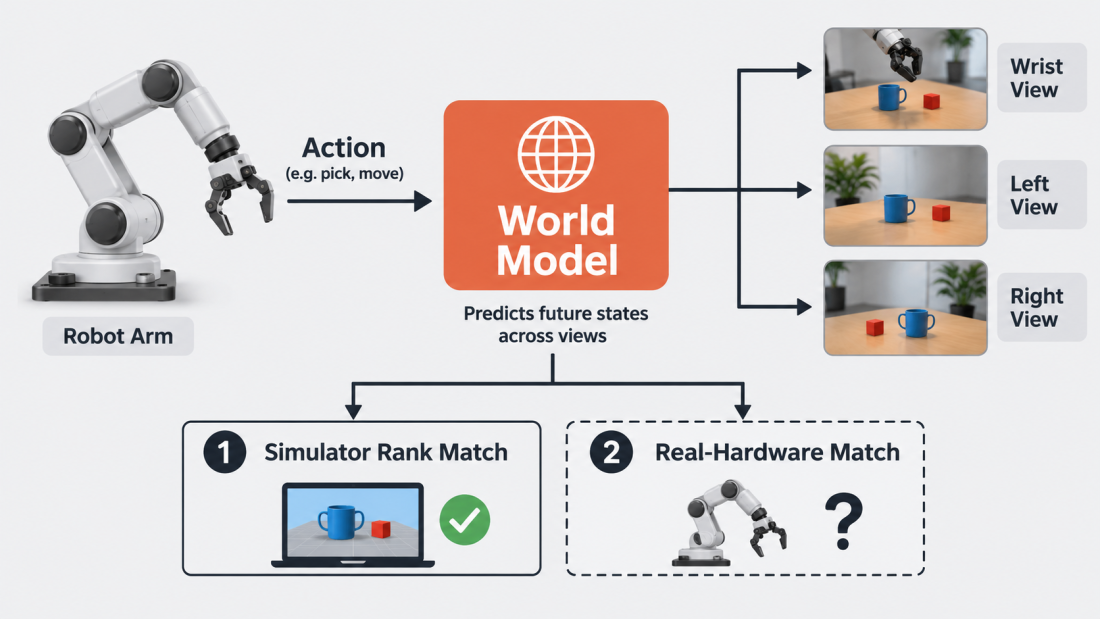
PrimeBot Research and eight academic labs published PrimeSim on November 4, a generalist world model that acts as a simulator for robots. The PrimeSim robot world model generates three camera views at 10.1 frames per second on one A100 GPU and leads four of five WorldSimProbe suites against five open-source rivals.
Its own paper says fine-grained local calibration still trails the field, and the reported experiments ran in simulators, not on a physical robot. For buyers, it is a cheap screening tool for policies, not yet proof that a policy will work on a real floor.
Simulating contact-rich robot work with a physics engine is slow and hand-built. A learned world model promises a faster alternative trained from demonstration video. The PrimeSim robot world model is the latest attempt, and unusually, it comes with open weights and training code.
What the PrimeSim Robot World Model Learned From
PrimeSim was midtrained on 30,110 hours of robot demonstrations across 22 platforms, 20 dataset families and 1.52 million episodes, at roughly an 84:16 real-to-simulated ratio. A unified action representation lets one model handle different robot bodies, and view-aware attention keeps objects consistent across three cameras.
It reports the best overall EWMBench score at 6.09 versus 5.82 for GE-Sim (LTX), and 37.1 on the Interaction Dynamics probe, a 48.4% relative gain. That implies the prior best was near 25, by our arithmetic, so the absolute score is still low. See our analysis where we explain why Genie 4’s world model leaves robot training unproven.
| Metric | Value |
|---|---|
| FPS | 10.1 |
| Views | 3 |
| GPU configuration | One A100 |
| Hours of demonstrations | 30,110 |
| Probe suites led | 4 of 5 |
| Success after GRPO | 61.7% → 73.2% |
Sources: PrimeSim paper (arXiv 2611.04870) as reported by AI Weekly and CCTest. Success rates are measured inside the simulator.
Adaptation and Policy Learning Results
Held-out robots, the xArm 7 and ViperX 300, converge within 100 to 200 gradient steps, while the pretrained video backbone produced no action-following rollout within a 2,000-step budget. A 200-step GRPO run inside PrimeSim lifted an SFT policy’s success from 61.7% to 73.2% on LIBERO, an 11.5-point gain, about 19% relative by our arithmetic.
The paper also reports that policy rankings in PrimeSim track a physics simulator, and AI Weekly puts the success estimate within 1.6 points of it. That comparison is simulator to simulator. See our analysis where we explain why the 100x robot simulation speed claim has an asterisk.
What Is Still Missing
CCTest notes that all experiments used simulated settings such as AgiBot G2, LIBERO and RoboTwin, and that the 10.1 FPS figure shows inference speed, not a validated real-world control loop. Visual plausibility does not guarantee accurate physics, and the paper’s abstract admits fine-grained local calibration still trails the field
.
That is the gap buyers should price in. See our analysis where we explain what ABB and NVIDIA’s 99% sim-to-real accuracy claim leaves out, and how world models and robot training are crossing over in 2026. A GitHub repository and Hugging Face model page are listed, so teams can test it themselves. For budget context, see our analysis where we explain the ceiling industrial robotics training sims just hit.
⚠️ Hypothetical scenario: A Lagos robotics integrator must choose among three candidate pick policies for a bottling line. It screens them inside an open world model overnight and gets a clear ranking. Before buying, the lead engineer runs the top two policies for 20 trials each on the real cell. The ranking flips. The integrator keeps the world model as a first filter but writes a rule: no policy ships without a hardware rank check.
💡 CreedTec Analyst’s Note by Daniel Ikechukwu
Strategic Impact
The PrimeSim robot world model shifts simulation from a vendor-held service to something teams can run and audit. Open weights lower the cost of screening policies, but the decision value depends on whether its rankings match real-robot results.
Stop / Start / Watch
- Stop: treating simulator-to-simulator agreement as hardware validation.
- Start: measuring rank correlation between world-model scores and a small set of real trials.
- Watch: independent replications, hardware experiments, and results on contact-rich tasks.
ROI Outlook
At 10.1 FPS on one GPU, overnight policy screening is cheap. The return is real only if it prunes bad policies before costly hardware time, so validate the filter on a pilot cell first.
— Daniel Ikechukwu
Evaluating robot policies in simulation?
The CreedTec Robotics Sims Brief shows which sim benchmarks hold up on real hardware.
Subscribe to the Sims Brief
Sources
- AI Weekly: PrimeSim robot world model hits 10.1 FPS, leads 4 of 5 probes (Nov 4, 2026)
- CCTest: PrimeSim builds a long-horizon robot simulator from cross-embodiment data
- Hugging Face papers: PrimeSim, A Generalist World Model Simulator from Large-Scale Cross-Embodiment Demonstrations (listing; page not opened)