Fast Facts
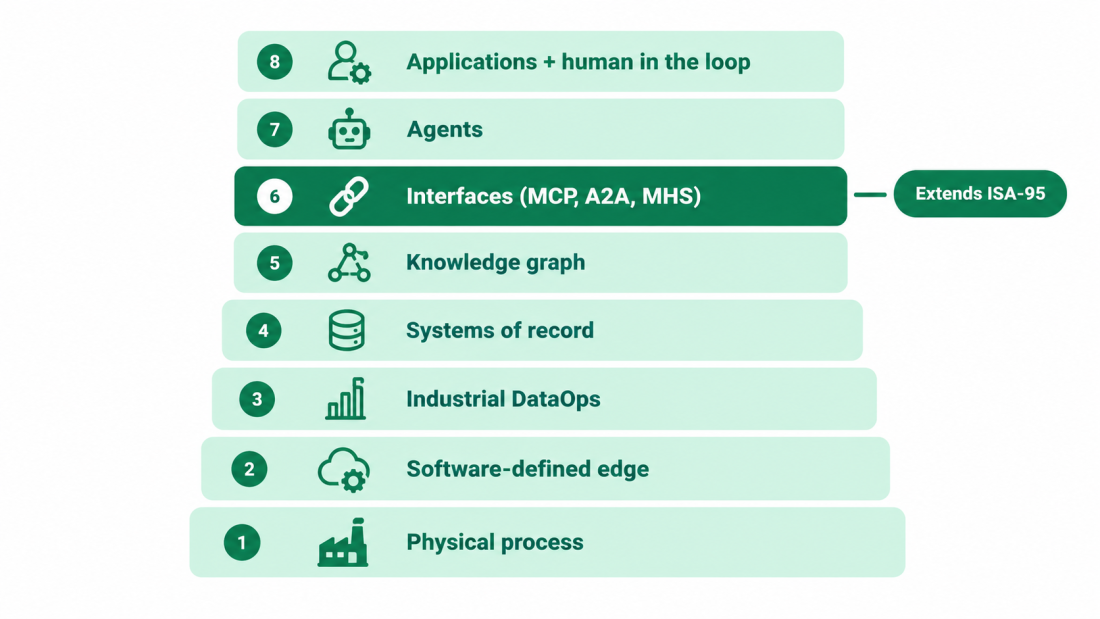
The industrial AI tech stack is the set of layers that lets an AI agent act on a factory, from machines at the bottom to applications at the top. IoT Analytics, after interviewing more than 30 people at IMTS 2026, proposes eight: physical process, software-defined edge, industrial DataOps, systems of record, knowledge graph, interfaces, agents, and applications with a human in the loop.
The model matters because most AI pilots fail at the lower layers, not the agent. If machines are not connected, data is not contextualized and interfaces are not standard, an agent has nothing reliable to read or control. This is one analyst’s framework, not a standard.
Industrial software used to follow ISA-95, a hierarchy from sensors to enterprise systems. IoT Analytics argues that model has no equivalent for the layers AI adds. Its IMTS 2026 recap, based on the show in Chicago in September, lays out the industrial AI tech stack as an extension of ISA-95 rather than a replacement.
The Bottom Four Layers: Where Data Is Made
Layer one is the physical process: machines, robots and production lines. Layer two is the software-defined edge, where logic and data collection run near the equipment. Layer three is industrial DataOps, which cleans, models and routes machine data. Layer four is systems of record such as ERP, MES, PLM, CMMS and historians. These layers are not new, but they decide whether anything above them works.
Connectivity choices live here. Kai Waehner’s October 12 landscape says the unified namespace has become the dominant integration pattern inside the plant, and that a broker without contextualization is “a message bus, not a namespace.” He adds that the common 2026 pattern pairs OPC UA, which describes what equipment is, with MQTT and Sparkplug B, which distribute the data. See our analysis where we explain what a unified namespace is for manufacturers.
8 layers | 30+ interviews | 40 pages
Layers in IoT Analytics’ proposed industrial AI tech stack, interviews at IMTS 2026, and length of its underlying report. Source: IoT Analytics, IMTS 2026 recap. This is a proposed framework, not an adopted standard.
The Top Four Layers: Where AI Acts
Layer five is the knowledge graph and ontology, which captures how assets, processes and documents relate. IoT Analytics argues knowledge graphs are replacing the centralized cloud data lake in this role. Layer six is interfaces: MCP, A2A and MHS. Layer seven is agents. Layer eight is applications and human-in-the-loop review. The graph is the part vendors treat as proprietary.
“Our knowledge graph is our moat.”
— Graham Immerman, CRO, MachineMetrics (via IoT Analytics)
The interface layer is moving fastest. IoT Analytics says MCP, introduced by Anthropic in November 2024, is now overseen by the Linux Foundation and lets agents query systems where the data lives. It lists vendors offering MCP servers: Rockwell’s free Emulate3D server, Limble’s CMMS server, Vention’s design and digital-twin server, and PTC’s Onshape FeatureScript server, with Creo and Windchill expected to follow. It describes AWS’s Industrial Data Fabric as using knowledge graphs through Amazon Neptune.
Hardware Interfaces Are the Hard Part
MHS, the Model Hardware Standard, is Anthropic’s attempt to give devices standard read and write drivers with a plain-language description of capabilities and safety limits. IoT Analytics says it was released as a research preview on August 27, 2026, in a gated preview with open source planned, and that partners include Universal Robots, Doosan Robotics and AWS. It does not expect MHS to spread as fast as MCP, citing determinism, safety and the installed machine base. See our analysis where we explain how Anthropic’s model hardware standard took a lab task from 58% to 99.3% success.
Evidence in plants is thin. Universal Robots tested MHS with four cobots using an agent built on Claude Opus 4.8 and called it a proof of concept, with no published performance figures. MaintainX cofounder Nick Haase said the company aims to stay “a half step behind” on AI autonomy. See our analysis where we explain why 93% have an MES integration but only 23% finished the job.
Using the Industrial AI Tech Stack to Buy Better
Treat the layers as a checklist. For each vendor, ask which layer it owns, which it assumes, and what it exports. A vendor selling agents at layer seven should say where its knowledge graph lives and whether you can take it with you. Lock-in tends to hide in layers three and five. See our analysis where we explain why industrial IoT protocol fragmentation hides a real lock-in cost.
Older plants face a different problem. See our analysis where we explain why the real cost of legacy equipment integration isn’t the machines. For plants with decades-old controllers, the work starts with layers one to three, and agents come last.
⚠️ Hypothetical scenario: A Lagos food plant sees a demo of an AI maintenance agent that reads work orders over MCP. Back home, its fifteen-year-old filling line has no data connection, the maintenance log is a spreadsheet, and nobody has mapped which pump feeds which line. The agent has nothing to read. The first six months go to connecting machines and cleaning records, not to the agent.
💡 CreedTec Analyst’s Note by Daniel Ikechukwu
Strategic Impact
The industrial AI tech stack reframes the buying question from “which agent?” to “which layers do we own?” Value accrues to whoever controls the knowledge graph and the interfaces, so vendors will fight there. Open interfaces such as MCP reduce switching cost; proprietary graphs raise it.
Stop / Start / Watch
- Stop: funding agent pilots on plants without reliable layers one to four.
- Start: mapping your current systems to the eight layers and marking gaps and owners.
- Watch: whether MHS leaves its gated preview and gains real plant deployments, and who ends up owning the knowledge graph.
ROI Outlook
Most of the cost sits below the agent: connectivity, data cleanup and integration. For emerging-market plants with older equipment, that is also where most of the return starts. Budget for the lower layers first, and treat any claim about the industrial AI tech stack as a vendor view until measured results are published.
— Daniel Ikechukwu