Fast Facts
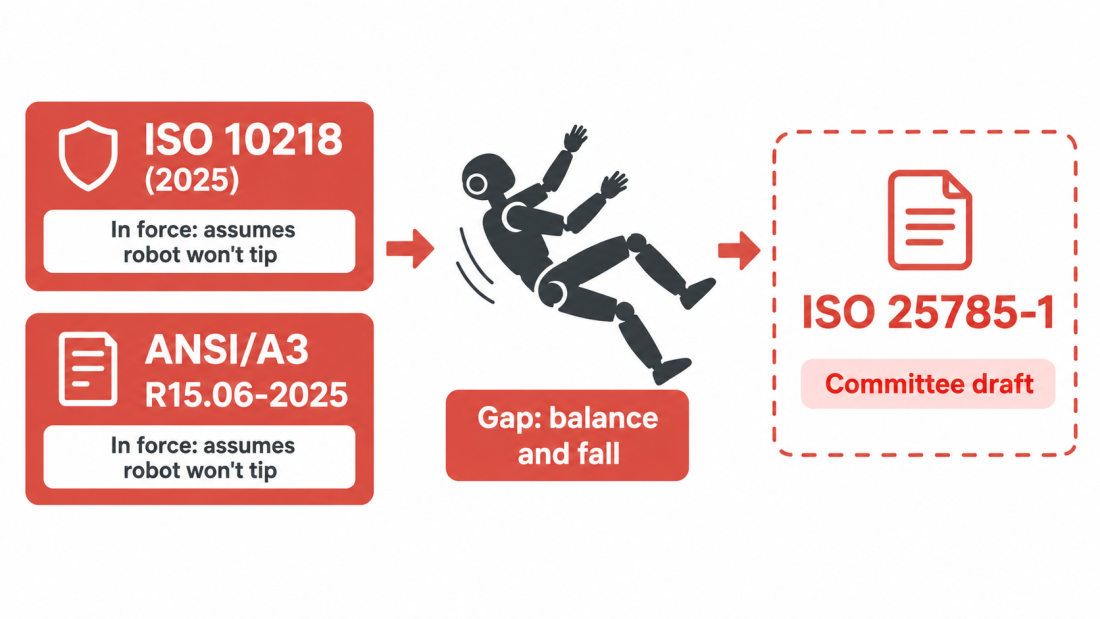
Humanoid robot safety standards are incomplete. The first international standard written for robots that stay upright only through active balancing, ISO 25785-1, is still a committee draft as of October 2026. Until it is published, humanoids are assessed against older standards for industrial robots, such as ISO 10218 and its US adoption ANSI/A3 R15.06-2025, which assume a robot that will not fall over.
That gap matters for buyers. A vendor saying a humanoid is “built to standards” may mean arms, not balance. The questions that protect you are about failure: what the robot does when power, a sensor or an actuator fails, and what evidence backs the answer.
Humanoids are leaving safety cages. Forbes reports Boston Dynamics says its production Atlas supports “fenceless guarding,” and Agility Robotics says Digit 5 is built to work near people. Yet the same report finds no certifying body named and no existing certification process for humanoids. Understanding humanoid robot safety standards is therefore a procurement skill, not a footnote.
What Exists Today
ISO 10218, revised in 2025, covers industrial robots and now covers the safety of the complete collaborative application, with the contact-force limits once in ISO/TS 15066 folded into ISO 10218-2:2025, according to i-SCOOP. Its US counterpart is ANSI/A3 R15.06-2025. ISO 13482 covers personal care robots outside industrial settings, and ISO 3691-4 excludes these robots. In the US, OSHA’s General Duty Clause, Section 5(a)(1), still applies to any employer.
The weakness is the shared assumption. Dr David Brandt, CTO of Teradyne Robotics (NASDAQ: TER), argues ISO 10218-1 requires single-fault tolerance but does not address risks from a humanoid’s own mobility. A collaborative arm on a wheeled base is statically stable: its safe response to a fault is to cut power and brake. A legged humanoid is not.
May 2025 | Oct 2025 | Committee draft
First working draft of ISO 25785-1; the working group’s Barcelona session; its status in the October 2 Forbes report and Teradyne’s September commentary. No publication date is confirmed. Sources: i-SCOOP; Forbes; Drives & Controls.
Humanoid Robot Safety Standards: What ISO 25785-1 Targets
i-SCOOP describes ISO 25785-1 as the first international safety standard for industrial mobile robots with actively controlled stability, covering humanoids, quadrupeds and balancing wheeled platforms. Its key concepts include fall risk and controlled descent, power-loss behavior including the “zero energy pose” some makers use, and zoning into collaborative, restricted, exclusion and dynamic zones. The US delegation leading the working group includes the Association for Advancing Automation, Agility Robotics and Boston Dynamics.
The timeline is uncertain. i-SCOOP estimated 18 to 36 months to ratification from early 2026. Since the standard was still at committee-draft stage in October, my inference is that 2027 is the likelier publication year; that is a judgment, not an announced date. See our analysis where we explain how NVIDIA’s Halos humanoid robot safety system works, which aims to help partners prepare for third-party certification.
“Any standard will need a common core plus domain-specific tests.”
— Erikk Cass, VP of autonomous mobility, iMerit (via Forbes)
Image Suggestion
Alt text: Humanoid robot safety standards map showing ISO 10218 and R15.06 in force, ISO 25785-1 still in draft, and the gap for balancing robots.
Generation prompt: Clean standards-map infographic on a white background with orange-red (#d9534f) accents. Left: solid boxes “ISO 10218 (2025)” and “ANSI/A3 R15.06-2025” labeled “In force: assumes robot won’t tip”. Right: a dashed box “ISO 25785-1” labeled “Committee draft”. Between them, a humanoid silhouette falling with a red label “Gap: balance and fall”. Style: flat vector, minimal text, readable on mobile.
Failure Is the Real Test for Humanoid Robot Safety Standards
Brandt’s core point is that most humanoid safety work targets perception, detecting people and avoiding collisions, which assumes the robot still controls itself. A battery fault can disable all actuators and sensors at once, and a humanoid then needs reserve power just to lower itself to a stable position. Making actuators, sensors and battery management redundant is costly, he says; the alternative is accepting higher risk than with conventional industrial robots.
Vendor claims about humanoid robot safety standards are worth reading carefully. See our analysis where we explain why the Digit 5 humanoid’s 20-hour day depends on a charging dock, and why Agility’s safety claims, including being designed for field evaluation against OSHA standards, are company statements. Maintenance and testing also drive risk. See our analysis where we explain the industrial AI safety concerns for 2026.
Scale raises the stakes. Forbes cites Counterpoint at about 22,000 humanoids shipped in H1 2026 and IDC at 25,000, with the figures differing. See our analysis where we explain why the 50,000-unit humanoid production claim is hard to verify. Jeff Burnstein of the Association for Advancing Automation has said one early accident could halt the market, per Forbes.
Deployments are heading to the floor anyway. See our analysis where we explain Hyundai’s Atlas humanoid robot factory deployment.
⚠️ Hypothetical scenario: A Lagos bottling plant buys a humanoid whose brochure says it meets “international robot safety standards.” During a grid cut the robot loses power mid-step and falls beside a technician. The insurer asks which humanoid robot safety standards the unit was certified against. The vendor can only point to the arm standard, and the claim is disputed.
💡 CreedTec Analyst’s Note by Daniel Ikechukwu
Strategic Impact
Humanoid robot safety standards lag the hardware. Until ISO 25785-1 is published, buyers carry certification risk the standard will later assign to vendors. Pilots will happen in fenced or zoned areas, with fall zones and exclusion rules decided site by site.
Stop / Start / Watch
- Stop: accepting “complies with standards” without naming the standard and scope.
- Start: asking what happens on battery, sensor or actuator failure, and requesting stability and reliability data (Brandt’s checklist).
- Watch: ISO 25785-1’s move from committee draft to a Draft International Standard, and any third-party certification scheme.
ROI Outlook
Safety shapes cost. Fenced deployment, redundancy and insurer scrutiny all add to the real price of a humanoid. For buyers in Nigeria and Southeast Asia, where power is less stable, power-loss behavior should be a contract term, not a brochure line. Treat the interim as a period to pilot, not to scale.
— Daniel Ikechukwu


1 comment on “Humanoid Robot Safety Standards: What Exists and What Is Still Draft”
Useful overview of the standards gap for balancing humanoids. For teams drafting safety or compliance copy, ReWords AI helps rewrite technical text clearly while keeping meaning.