Fast Facts
The Omron OnLogic acquisition, announced October 13 for $675 million, pairs Omron’s controllers and sensors with OnLogic’s rugged industrial PCs. The industrial PC market is projected to grow 20% by 2028 to ¥310 billion. The strategic logic: process equipment data locally on factory-floor computers instead of round-tripping it through the cloud — cutting latency, reducing defects, and keeping confidential data on-site. The Omron OnLogic acquisition is a bet that physical AI needs an edge computer, not just a smarter controller.
Omron OnLogic acquisition landed on October 13, 2026, when the Japanese automation manufacturer announced it would buy OnLogic’s parent company, Interlogic, for approximately $675 million (¥100 billion) in cash through a reverse triangular merger. The deal is expected to close around January 2027.
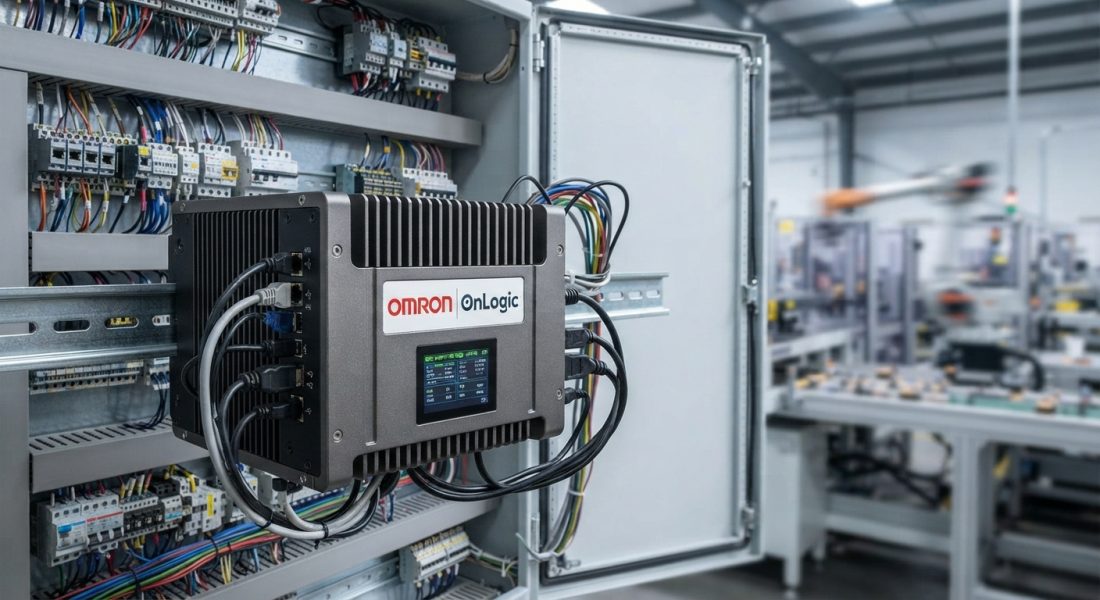
OnLogic, founded in 2003 and headquartered in Vermont, makes industrial computers designed for 24-hour continuous operation. These machines control factory equipment, process data, and withstand temperature swings, vibration, and shock that would destroy a standard office PC. As factories push toward automation, demand for this category is growing.
Why Omron Is Buying a PC Maker
Omron’s stated goal is to build physical AI infrastructure that drives machinery and robots autonomously. President Junta Tsujinaga said at a Tokyo press conference that the company will “expand customers mainly in Europe and America” and pursue results from the data-services M&A strategy outlined at its May earnings briefing.
The logic is straightforward. When production equipment generates data and processes it on a factory-floor computer, communication latency from cloud transmission drops. Analysis results feed back into equipment control faster, reducing defect rates. And confidential data never has to leave the facility.
That last point matters for procurement. Factories running high-value manufacturing processes — semiconductor fabrication, precision machining, pharmaceutical production — cannot send sensitive operational data to a third-party cloud. Edge computing solves that by keeping the intelligence local.
| Metric | Detail |
|---|---|
| $675M | Cash purchase price for Interlogic, OnLogic’s parent company |
| January 2027 | Expected deal close date |
| ~20% | Projected growth in the global industrial PC market by 2028 vs. 2024 |
| ¥310B | Forecast global industrial PC market size by 2028 |
The Industrial PC Market Nobody Prices In
Fuji Keizai, the Japanese market research firm cited in the Nikkei report, projects the global industrial PC market will grow 20% from 2024 levels to reach ¥310 billion by 2028. Major manufacturers include Germany’s Siemens, Taiwan’s Advantech, and Japan’s NEC and Fujitsu.
That growth is being driven by the same trend Omron is betting on: factories need local compute to run AI models on equipment data. A cloud-only architecture introduces latency that matters when a robot needs to adjust its path in real time, and it exposes data that some manufacturers cannot legally or competitively afford to share.
The Omron OnLogic acquisition positions Omron to compete in that edge compute layer alongside the industrial PC incumbents — but with a critical advantage: Omron already sells the controllers and sensors that generate the data. Adding the computer that processes it creates a tighter integration between the physical equipment and the intelligence running on it.
What This Means for Industrial Buyers
For procurement teams evaluating factory automation systems, the Omron OnLogic acquisition signals a shift in how automation vendors will price and bundle their offerings. The controller, the sensor, and the edge computer are becoming one purchase instead of three.
⚠ Fiction—composite scenario, not a real event: A Lagos bottling plant upgrades its filling line with Omron controllers and OnLogic edge computers. Because the equipment data is processed locally, the plant’s operations team gets real-time anomaly alerts without waiting on a cloud connection that drops during peak demand. The vendor’s integrated stack reduces integration work by one vendor relationship. The plant’s IT team no longer has to manage data residency compliance for the operational data, because it never leaves the facility.
The same week as the Omron announcement, Rockwell Automation launched its CompactLogix 5390 controller with built-in cybersecurity aligned to IEC 62443-4-2 and readiness for the EU Cyber Resilience Act. Schneider Electric, meanwhile, cited Omdia research showing closed automation systems cost mid-sized industrial companies $11.28 million annually — 7.5% of revenue — through downtime, inefficiencies, and compliance workarounds.
Three separate signals from three major automation vendors, all pointing the same direction: the factory edge is being repriced. Omron bought a PC maker. Rockwell built cybersecurity into the controller. Schneider is arguing that closed systems are the expensive option.
Global Implications
For manufacturers in emerging markets, the Omron OnLogic acquisition offers a template for edge-first automation. A facility that cannot rely on consistent cloud connectivity can still run AI-driven quality inspection, predictive maintenance, and anomaly detection — as long as the compute sits on the factory floor. OnLogic’s ruggedized hardware is built for exactly those conditions.
The deal also signals that industrial PC manufacturers are becoming acquisition targets. Omron paid approximately $675 million for a company founded in 2003. As physical AI deployment accelerates, the hardware that runs AI models at the edge becomes more strategically valuable than the models themselves.
💡 CreedTec Analyst’s Note — Daniel Ikechukwu
Strategic Impact: The Omron OnLogic acquisition consolidates the edge compute layer into the automation stack. Buyers evaluating factory AI deployments should treat the industrial PC as part of the automation purchase, not a separate IT procurement.
Stop: Evaluating controllers and industrial PCs as separate procurement categories with separate vendor pools.
Start: Asking automation vendors whether their edge compute hardware is proprietary or sourced, and how firmware updates and security patches are delivered.
Watch: Whether Siemens, Advantech, or Rockwell respond with their own edge compute acquisitions, which would confirm this is a market-wide consolidation rather than one company’s strategy.
ROI Outlook: Local processing of equipment data reduces cloud transmission costs, cuts latency-related defects, and eliminates data residency compliance overhead. The payback period shortens when the same edge computer runs multiple AI workloads across production lines.
Sources:
- Reuters via The Star, “Japan’s Omron to buy US industrial PC firm Onlogic for $675 million in physical AI push,” October 13, 2026
- Nikkei via Yonhap, “Omron to acquire US industrial computer manufacturer OnLogic for 100 billion yen,” October 13, 2026
- Schneider Electric / Omdia, “Open vs. Closed: The $11.28M Question for Industrial Leaders,” October 13, 2026
Further Reading:
- Edge Computing Cuts IIoT Latency by 87%
- Teltonika’s Oxa Just Made the Embedded Industrial IoT Gateway a Component, Not a Box
- Why the Industrial Edge Processor Supply Commitment Matters More Than Qualcomm’s Specs
- Industrial Edge AI Networking: Why Rajant-Nokia Just Collapsed the IIoT Stack
- Cognex RealSense Deal Prices the Factory’s New Edge Layer
Subscribe to CreedTec’s weekly briefing—industrial IoT edge economics, vendor consolidation, and the procurement signals behind the hardware headlines.