Fast Facts: The redesigned Boston Dynamics Atlas hand has four fingers and 13 degrees of freedom, driven by 13 identical encapsulated actuators with no cables crossing the joints. Boston Dynamics, owned by Hyundai Motor Group (KRX: 005380), dropped the pinky and rejected a two-thumb layout. It says the hand is not stronger than the old one.
The design is built for reinforcement learning trained in simulation. It is not yet deployed across a fleet, and the company has not started testing at Hyundai’s robot application center. Read it as an engineering signal, not a shipping date.
Humanoid demos usually show walking and flipping. The harder commercial problem is picking, turning and placing real objects all day. The Boston Dynamics Atlas hand is the company’s answer to that, and The Robot Report’s October 9 coverage gives the clearest account of why it looks the way it does.
What Changed in the Boston Dynamics Atlas Hand
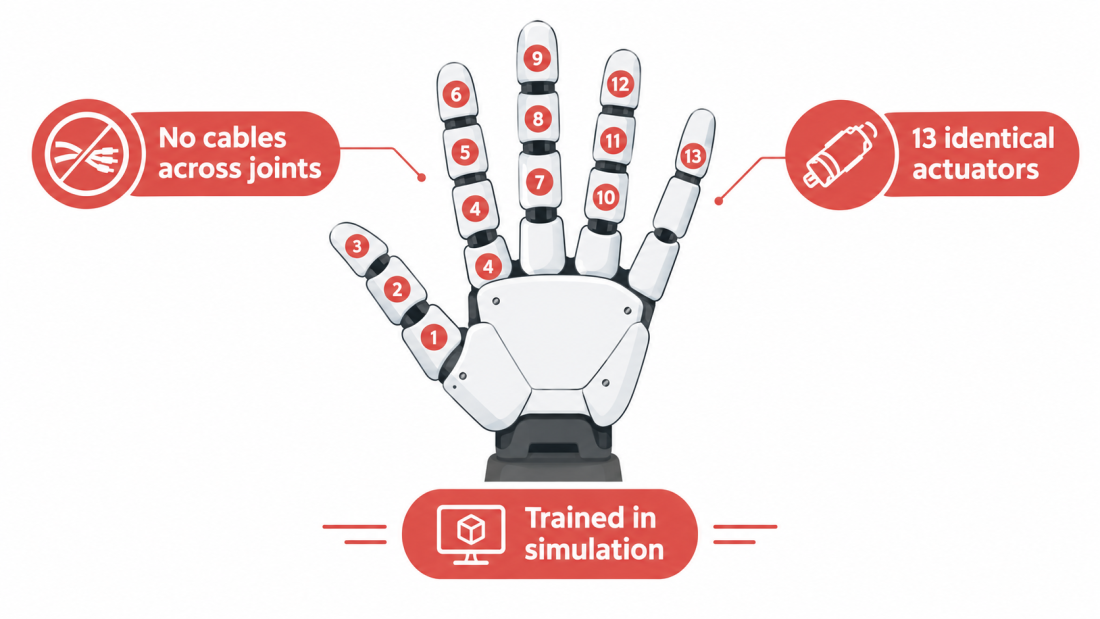
The new hand has four fingers instead of five. Each finger and the thumb draws on the same actuator design, 13 units in all, each encapsulated so no fragile cables cross a joint. Cables flexing at joints are a classic failure point in robot hands, so removing them targets durability rather than raw capability.
Boston Dynamics also looked at a two-thumb arrangement and turned it down. It did not increase grip strength over the earlier generation. Instead the team optimized for learnability: a hand whose behavior is regular enough that policies trained in simulation transfer to hardware. That is a trade of anatomy for trainability.
4 fingers | 13 DoF | 13 identical actuators
Configuration of the redesigned hand as reported by The Robot Report and Boston Dynamics. Strength was not increased, and fleet deployment has not begun.
Why Dexterity Is the Bottleneck
A World Economic Forum op-ed from robotics firm RLWRLD argued that inadequate hand dexterity remains the primary technological bottleneck to automation.
“The bottleneck is not in the legs. It is in the hands.”
— World Economic Forum op-ed
That framing explains why a hardware company is talking about fingers. Teaching a hand needs data, and the data comes from people and simulators. See our analysis where we explain why teleoperated robots are a data strategy, not a stopgap. A simpler hand lowers the cost of collecting that data, because fewer joints mean a smaller space to explore.
Software is the other half of the Boston Dynamics Atlas hand story. See our analysis where we explain why one brain across multiple robot bodies is a fixed-cost amortization play. A standardized hand makes that amortization easier, since one policy can serve every identical finger.
What Buyers Should Watch
A better hand does not by itself make a humanoid pay. Reliability, cost and the learned skills decide that. Boston Dynamics has not said when the redesigned unit reaches customers, and the Robot Report notes that testing at Hyundai’s application center has not begun. Generalization, doing many tasks rather than one, remains the open question across the industry.
Commercial structure matters as much as hardware. See our analysis where we explain which RaaS contract clauses decide whether leasing beats buying a robot; hand wear and replacement belong in that contract. Investors are also pricing the software side, as in the FieldAI robot brain’s $10 billion valuation, so the Boston Dynamics Atlas hand competes for attention with the models that will drive it.
Early lease deals show where this goes. See our analysis where we explain why the Agility Robotics and Toyota RaaS deal matters.
⚠️ Hypothetical scenario: A Lagos cold-chain operator pilots a humanoid for carton handling. In week three a finger actuator fails and the vendor ships a replacement from abroad, taking nine days through customs. The robot idles, and the lease clock keeps running. The operator realizes nobody asked how many hands a year a robot consumes.
💡 CreedTec Analyst’s Note by Daniel Ikechukwu
Strategic Impact
The Boston Dynamics Atlas hand shows the field shifting from spectacle to serviceability. Fewer, identical parts favor learning and spares. It also hints that the winning humanoid may be the one easiest to train, not the most human-looking.
Stop / Start / Watch
- Stop: judging humanoids by demo videos of walking.
- Start: asking vendors for hand actuator failure rates, replacement lead times and spares pricing in writing.
- Watch: when the hand reaches Hyundai application-center testing and whether independent hours-of-use data follows.
ROI Outlook
No price or deployment schedule is public, so no ROI figure is defensible. What can be priced is downtime: for buyers far from a vendor’s service hub, spare-part logistics can outweigh labor savings. Treat this as a design signal until field data exists.
— Daniel Ikechukwu
Humanoids are won in the hands, then in the service contract. Get the weekly robotics briefing on what vendors leave out. Subscribe free