Fast Facts
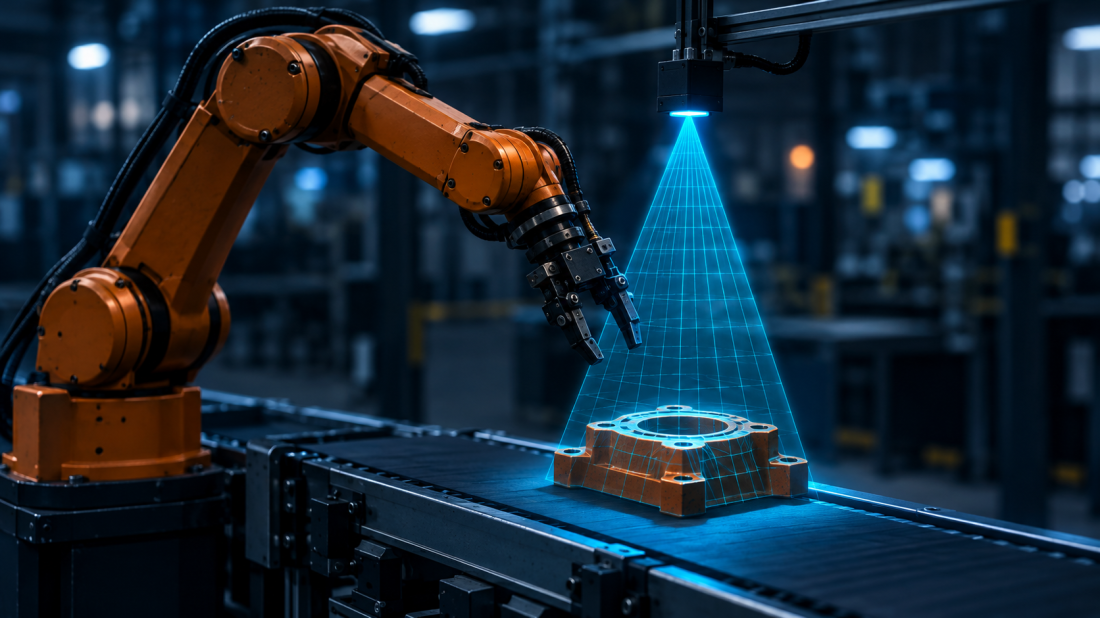
Inbolt raised $12.5 million on September 30 to expand its AI-powered 3D vision for industrial robots, bringing total funding to $34 million. The Paris-based company gives robots the ability to see, think, and adapt in real time—addressing the fact that most industrial robots are effectively blind. The industrial AI vision layer is where the money is moving: not into new robots, but into the software that makes the robots already on factory floors actually useful.
Industrial AI vision layer just attracted its clearest funding signal of the quarter. Inbolt announced $12.5 million in new funding on September 30, led by Shift4Good with participation from Bridges Climate Transition Partners, BNP Paribas Développement, and Ora Global. The round brings total funding to $34 million and will fund expansion in the US, where the company opened a Detroit office in 2026, plus entry into data centers and electronics manufacturing.
The company’s pitch is specific. Most industrial robots operating in highly automated factories are effectively blind. They cannot perceive part misalignment, tooling wear, or the small variations that occur naturally on every production line. When something shifts even slightly out of position, the robot either stalls, throws an error, or produces a defective part.
Inbolt’s answer is a combination of 3D vision and a hardware-agnostic AI software layer that gives robots the ability to perceive their environment and adjust their control loops in real time.
Why the Industrial AI Vision Layer Matters More Than the Robot
The industrial AI vision layer addresses the gap between a robot that works in a demo and a robot that works on a real production line. A robot that cannot see cannot adapt. A robot that cannot adapt requires human intervention every time a part arrives slightly off-center or a tool wears down.
Inbolt has deployed on over 200 robots across more than 100 factories on three continents, with clients including Bosch, Beko, Flex, Ford, Stellantis, and Toyota. Those are not pilot customers. They are production deployments at scale.
| Metric | Detail |
|---|---|
| $12.5M | New funding round led by Shift4Good (Sept 30, 2026) |
| $34M | Total funding raised to date |
| 200+ | Robots deployed across 100+ factories on three continents |
| 6 | Named tier-one customers including Bosch, Ford, Stellantis, Toyota |
| 2 | New sectors targeted: data centers and electronics manufacturing |
The Financial Logic Behind Vision Over Hardware
The industrial AI vision layer is a software play on hardware that already exists. A manufacturer with a fleet of blind robots does not need to replace them. They need to give them sight. That is a lower-cost intervention than a hardware refresh, and it extends the useful life of capital already deployed.
The AI in manufacturing market was valued at $11.31 billion in 2026 and is projected to grow at a 39.6% CAGR to $163.10 billion by 2034, according to Straits Research. Asia Pacific dominated with a 43.2% share, and software led the offering segment at 42.7%. The industrial AI vision layer sits squarely in that software segment—the fastest-growing part of the market.
⚠ Fiction—composite scenario, not a real event: A tier-one automotive supplier runs a welding line with six robots that have operated for eight years. The robots are reliable but rigid—any variation in part placement triggers a fault, and the line stops until a technician repositions the workpiece. The supplier evaluates two options: replace the robots at $400,000 each, or deploy a vision layer at a fraction of that cost. They choose the vision layer. Faults drop 70%, line stoppages fall, and the existing capital continues working. The robots did not change. What they could see did.
What the Investors Are Buying
Shift4Good, the lead investor, focuses on decarbonizing transportation and energy. Bridges Climate Transition Partners targets sustainable transition. BNP Paribas Développement and Ora Global are existing backers.
The climate angle is not decorative. A vision layer that prevents defective parts and reduces material waste is a sustainability play as much as a productivity one. Inbolt’s technology reduces scrap, rework, and energy consumed on failed production runs.
Julien Baumont, Partner at Shift4Good, framed the investment simply: “We have been impressed by the team’s ability to turn sophisticated technology into a robust solution already deployed across leading global manufacturers in automotive and beyond.”
The Broader Industrial AI Revenue Picture
The industrial AI vision layer funding lands the same week Micron reported record fiscal fourth-quarter revenue of $54.23 billion, up 379% year-over-year, driven by AI infrastructure demand. BofA raised its 2026-2030 AI data center market estimate from $1.8 trillion to $2.2 trillion, citing agentic AI adoption and limited chip supply.
Two different layers of the same market. Micron supplies the memory that AI models require. Inbolt supplies the vision that industrial robots require. Both are enabling layers—not the end product, but the components that make the end product work. That is where industrial AI revenue is concentrating.
Global Implications
For manufacturers in emerging markets, the industrial AI vision layer offers a path to automation that does not require replacing existing equipment. A facility in Nigeria or Southeast Asia with older robots can add vision capability rather than buying new hardware. That lowers the capital barrier to automation and extends the useful life of equipment already deployed.
The question for buyers is whether the vision layer is hardware-agnostic or tied to specific robot brands. Inbolt claims hardware-agnostic support, which means the same software can work across a mixed fleet. That matters for facilities that have accumulated robots from multiple vendors over years of incremental investment.
💡 CreedTec Analyst’s Note — Daniel Ikechukwu
Strategic Impact: The industrial AI vision layer is where capital is flowing because it solves a problem hardware cannot: making existing robots adaptable without replacing them. Buyers evaluating automation should ask whether a vision upgrade extends the life of their current fleet before budgeting for new hardware.
Stop: Assuming automation requires replacing robots. The vision layer unlocks capability in hardware already deployed.
Start: Asking robot vendors and integrators whether their systems support hardware-agnostic vision layers that work across mixed fleets.
Watch: Whether Inbolt’s expansion into data centers and electronics manufacturing produces the same deployment velocity as automotive, and whether competitors emerge with similar hardware-agnostic vision offerings.
ROI Outlook: A vision layer costs a fraction of a robot replacement and extends the useful life of existing capital. For facilities with high fault rates from part misalignment, the payback is measured in months, not years.
Sources:
- BusinessWire, “Inbolt Raises $12.5M to Bring Sight and Intelligence to Industrial Robots, From Stellantis and Toyota to Data Centers,” September 30, 2026
- Robotics Business News, “Inbolt Raises $12.5M to Bring Real-Time AI Vision to Industrial Robots,” October 1, 2026
- Straits Research, AI in Manufacturing Market Report, October 1, 2026
- Micron Technology, Record Fiscal Fourth-Quarter and Full-Year 2026 Results, September 30, 2026
- Yonhap Infomax, “Micron Delivers Earnings Beat as Wall Street Picks Semiconductor Winners,” October 1, 2026
Further Reading:
- Industrial AI Pilot Revenue Hides a Widening Production Gap
- Palladyne AI’s Embodied AI Revenue Just Hit Harvest Time
- Broadcom AI Semiconductor Revenue Just Crossed 56% of Total Sales
- CADDi’s $114M Raise Proves Manufacturing AI Revenue Needs a Data Layer Nobody Built
- How Industrial AI Revenue Really Gets Made
Subscribe to CreedTec’s weekly briefing—industrial AI revenue, robotics perception economics, and the procurement signals behind the funding headlines.