Fast Facts
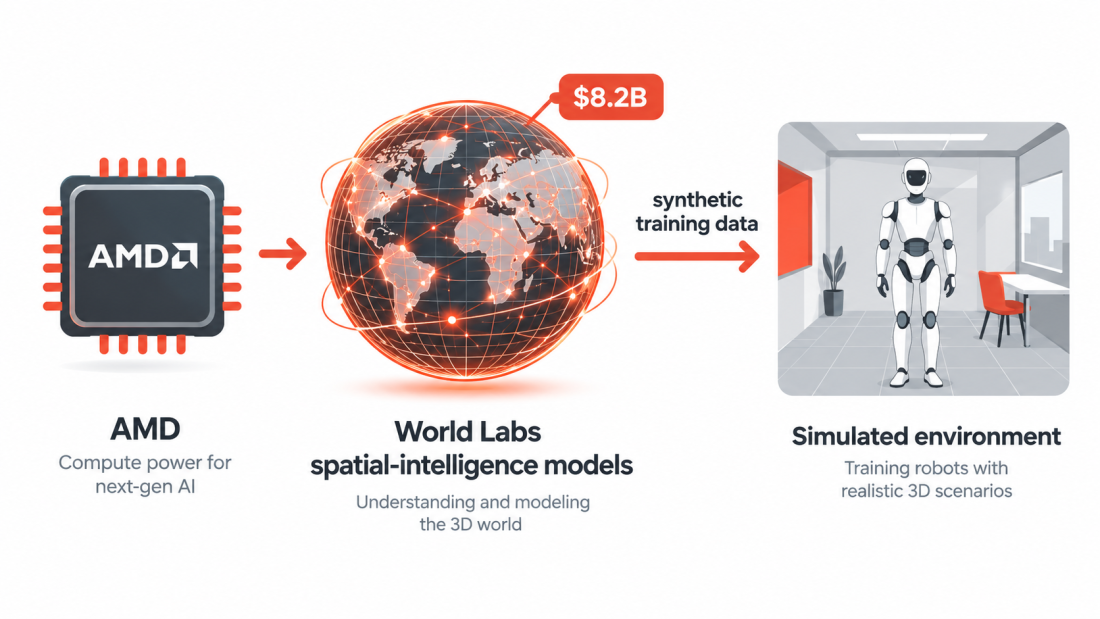
The AMD World Labs acquisition, announced September 28 for roughly $8.2 billion in stock, buys AMD a frontier “world model” lab whose entire pitch is generating and simulating 3D environments for robot training — not another chatbot company. World Labs quietly bought robotics-simulation startup SceniX in July, so the robot-training angle isn’t marketing language, it’s an existing asset now moving under AMD’s roof.
The deal price sits roughly 52-64% above World Labs’ own February funding round, in which AMD and its rival Nvidia both invested. For robotics teams, the real question isn’t the price tag; it’s whether the next generation of synthetic training-world tools gets tied to specific hardware.
The AMD World Labs acquisition is being read mostly as a talent and chip-roadmap story: AMD gets Fei-Fei Li, the Stanford scientist behind ImageNet, as EVP and Chief Scientist reporting to CEO Lisa Su. That framing misses where the product actually sits. Founded in 2024, World Labs builds spatial-intelligence models — AI systems that generate, reconstruct and simulate interactive 3D environments from text, images or video — and its own materials pitch the technology as directly for training robots, not just for entertainment demos.
The SceniX Acquisition Nobody Was Watching
The clearest evidence predates the AMD World Labs acquisition entirely. In July 2026, World Labs quietly bought SceniX, a robotics-simulation startup, giving it a direct path from generated 3D worlds to actual robot training pipelines. That deal barely registered outside trade press, but it shows World Labs was building simulation infrastructure before any chipmaker made an offer. See our analysis where we explain how generative AI is already self-generating robot training data.
Atlas and the Sparse-Reconstruction Claim
On September 1, weeks before the AMD World Labs acquisition was announced, World Labs launched Atlas, a model that builds persistent, explorable 3D worlds from a single photo. The company says Atlas solves sparse reconstruction, a long-standing computer-vision problem, by combining generative modeling with multiview geometry, outperforming specialized models built only for that task. Li has said interest spans reinforcement-learning environments for robotics, entertainment scene generation, and real-world reconstruction — a wider surface than Marble, World Labs’ first, entertainment-facing product. See our analysis where we explain why MIT SceneSmith attacks the real cost nobody discusses in robot training.
Verified numbers
| Stat | Detail |
|---|---|
| $8.2B | All-stock deal value behind the AMD World Labs acquisition — AMD’s second-largest ever, after ~$50B for Xilinx |
| ~52–64% | Premium over World Labs’ ~$5–5.4B valuation from its Feb 2026 funding round, just 7 months before the AMD World Labs acquisition |
| ~70 | World Labs employees reported moving to AMD once the AMD World Labs acquisition closes |
“We want to do everything we can to accelerate the future,” Fei-Fei Li wrote, announcing the deal on her Substack.
Why Nvidia Funded the Company AMD Just Bought
The awkward detail in the deal is the investor list. World Labs’ February 2026 round, which valued it at roughly $5-5.4 billion, included both AMD and its direct rival Nvidia, alongside Autodesk, Fidelity and Sea. Nvidia already ships its own open-weight world-model line, Cosmos, and has built the dominant simulation ecosystem in robotics through Omniverse and Isaac Sim.
By buying World Labs outright rather than just holding a board seat, AMD gets something Nvidia’s funding never bought it: an in-house team that builds and runs frontier world models, not just a cap-table entry. See our analysis where we explain why NVIDIA’s digital shipyard bet is really a simulation sales pitch and our breakdown of AgiBot’s open-source robotics simulation platform as the counter-model to owning a closed lab outright.
The Real Shortage This Deal Is Chasing
World models matter to robotics because real-world training data for general-purpose robots remains scarce and expensive to collect. A lab that can generate photorealistic, physically consistent 3D worlds on demand shortens that bottleneck for humanoid programs at Tesla and Figure, which is precisely why AMD frames the deal around robotics and physical AI rather than language models. See our analysis where we explain the 40% synthetic-training-data threshold undercutting a billion-dollar race and why teleoperated robots are a data strategy, not a stopgap.
⚠️ Hypothetical scenario (illustrative only, not a reported case)
A Southeast Asian robotics integrator licenses a World Labs-derived simulation tool in 2027 to generate training scenes for a warehouse-picking robot. Eighteen months later, the tool’s next major version requires AMD Instinct accelerators to run at full fidelity, and the integrator’s existing fleet of Nvidia-based training servers can only run a stripped-down mode. The integrator now faces a hardware refresh it never budgeted, tied to a simulation vendor decision made years earlier.
What Buyers Should Ask Before the Deal Closes
The AMD World Labs acquisition is expected to close by year-end, pending regulatory approval, with World Labs continuing as a research group inside AMD. Robotics teams evaluating its tools until then should ask two things: will Marble and Atlas stay hardware-agnostic, and will existing Nvidia-based pipelines keep first-class support once a rival chipmaker owns the research behind them. Neither has a public answer yet.
💡 CreedTec Analyst’s Note by Daniel Ikechukwu
Strategic Impact
This is the first time a major chipmaker has bought a frontier world-model lab outright rather than just funding it. If AMD ties Atlas-class simulation quality to its own silicon, robotics teams standardized on Nvidia’s Omniverse stack inherit a new vendor-dependency question they didn’t choose.
Stop / Start / Watch
- Stop: treating “world model” announcements as chatbot-adjacent news rather than robot-simulation infrastructure decisions.
- Start: asking any simulation-tool vendor which hardware their roadmap is optimized for, not just which one it runs on today.
- Watch: whether Nvidia, still holding equity exposure to a company AMD now owns, responds by accelerating its own Cosmos world-model line or restricting Omniverse integration.
ROI Outlook
Synthetic training-world generation is becoming a chip-vendor battleground, not a neutral tooling layer. Expect procurement teams to start scoring simulation vendors on hardware neutrality the same way they already score cloud vendors on portability.
— Daniel Ikechukwu, CreedTec
Tracking who controls robot-simulation infrastructure?
Get CreedTec’s weekly briefing on robotics training data, simulation vendors and hardware-dependency risk, written for teams building real deployments. Subscribe free.
Sources
- TechCrunch: “AMD will acquire Fei-Fei Li’s World Labs for $8.2B” (Sept 28, 2026)
- The Deep Dive: “AMD Buys AI Startup For $8.2B It Backed Just Seven Months Earlier” (Sept 2026)
- Startup Fortune: coverage of the Atlas launch and SceniX acquisition (Sept 2026)
- OfficeChai: “AMD Acquires Fei-Fei Li’s World Labs For $8.2 Billion” (Sept 2026)
- South China Morning Post: “AMD buys Li Fei-Fei’s World Labs for US$8.2b, escalating rivalry with Nvidia” (Sept 2026)