Fast Facts
- Alphabet’s robotics unit Intrinsic released Intrinsic Core, an open source robot simulation stack including a digital twin, calibration services, and physics-simulation tooling, under an Apache 2.0 license at ROSCon 2026 in Toronto on September 22.
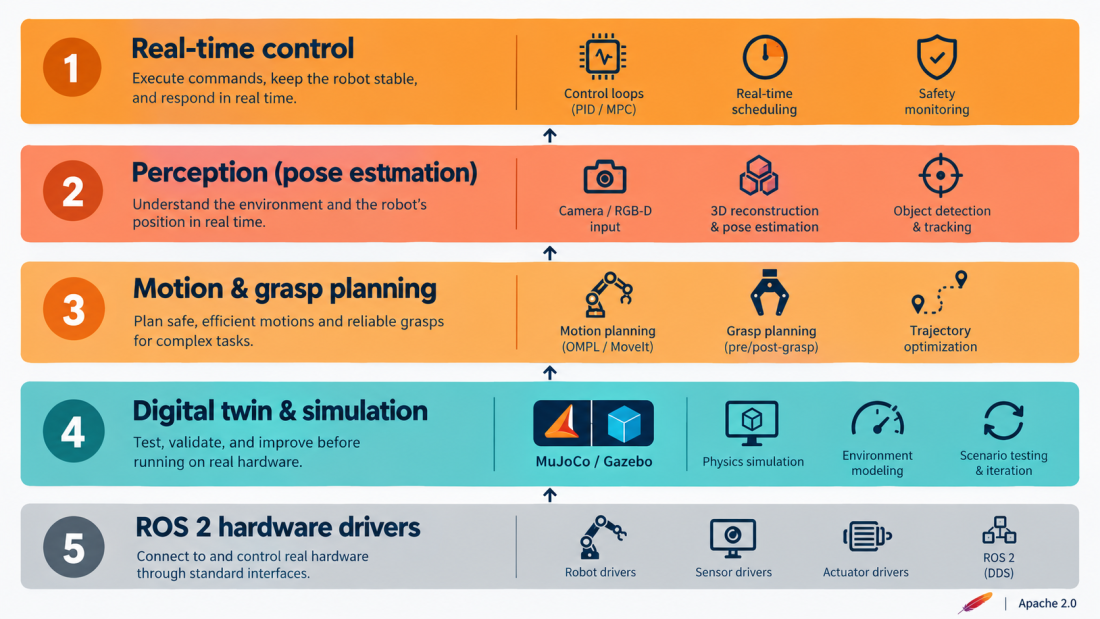
- The release also bundles a hardware-agnostic real-time control framework, NVIDIA FoundationPose-based perception, motion and grasp planning, and full ROS 2-compatible drivers — the same building blocks Intrinsic uses in its own commercial manufacturing deployments.
- A companion reference design, the Open Machine Tending Solution, runs on Universal Robots and FANUC arms and targets CNC shops, where Intrinsic says only 8% currently use any automation.
- Intrinsic CTO and ROS co-creator Brian Gerkey frames the release as filling specific gaps in the existing ROS ecosystem, not replacing it — a notable move given lingering community wariness about an Alphabet subsidiary controlling core open robotics infrastructure.
Alphabet’s Intrinsic used its ROSCon 2026 keynote in Toronto to release Intrinsic Core, an open source robot simulation stack that hands developers a digital twin, calibration tooling, and physics-simulation building blocks the company previously kept proprietary. The move puts real simulation and control infrastructure, developed for Intrinsic’s own industrial deployments, into the hands of any team building on ROS 2, for free, under Apache 2.0.
What’s Actually Inside the Robot Simulation Stack
At the center of the release is Intrinsic Control, a hardware-agnostic real-time control framework that can switch controllers mid-cycle using live sensor feedback, letting a robot adjust its path dynamically instead of executing a fixed trajectory. Around it sits a digital twin that connects simulators to kinematics models out of the box, NVIDIA FoundationPose-based pose estimation so robots can locate parts without rigid fixtures, collision-free motion planning, grasp planning that adapts to how an object actually sits, and a full set of calibration services and ROS 2 drivers.
Intrinsic engineers are also running technical sessions at ROSCon this week on integrating MuJoCo’s high-fidelity physics with Gazebo’s rendering and sensor simulation, demonstrated on gear meshing and humanoid walking — exactly the kind of contact-accuracy problem that has limited robot simulation stacks industry-wide.
Why the Simulation and Calibration Pieces Matter Most
Building a working robot simulation stack from scratch — the digital twin, the calibration pipeline, the physics engine integration — has historically been one of the largest hidden costs in robotics development, and CreedTec has covered that cost repeatedly as teams rediscover it the hard way. Intrinsic Core doesn’t eliminate that work, but it gives teams a maintained, production-tested starting point instead of building the same infrastructure from zero, which is the part of this release most relevant to anyone specifically working in robotics training and simulation rather than robotics hardware itself.
📊 The Numbers That Matter
- Apache 2.0 — the permissive license Intrinsic Core is released under
- Sept 22, 2026 — announced at ROSCon 2026 in Toronto
- 8% — share of US/European CNC shops Intrinsic says currently use any automation, its target market for the Open Machine Tending reference design
- 2021 — year Intrinsic was founded (spun out of Alphabet’s X); folded into Google proper in February 2026
- 2 — robot arm platforms (Universal Robots, FANUC) supported by the initial reference design
“Judge us by what we do.”— Brian Gerkey, CTO, Intrinsic, co-creator of ROS
The Trust Question Nobody’s Answered Yet
Intrinsic’s relationship with the open robotics community has been complicated since December 2022, when it acquired Open Source Robotics Corporation, the commercial arm of the nonprofit behind ROS, Gazebo, ROSCon, and TurtleBot. Gerkey, who co-created ROS and ran Open Robotics before joining Intrinsic as CTO, inherited a community that was openly nervous about an Alphabet subsidiary gaining that much influence over shared infrastructure.
Releasing a real robot simulation stack under Apache 2.0, rather than keeping it proprietary, is Intrinsic’s clearest answer yet to that concern — though Intrinsic itself notes the code “is not an officially supported Google product,” meaning production users still need to validate hardware compatibility, real-time behavior, and safety architecture on their own before relying on it.
What This Means for Robotics Training and Simulation Work
A free, maintained robot simulation stack changes the cost calculus for teams that have been building calibration and physics-simulation infrastructure in-house — see our analysis of the physics simulation bottleneck that has slowed robot training pipelines industry-wide, and our analysis of how MIT’s SceneSmith research exposed the real cost hiding in robot training environments, the scene-asset pipeline rather than compute time. Intrinsic isn’t the only company betting that open infrastructure accelerates adoption faster than proprietary tooling — see our analysis of AgiBot’s own open source robotics simulation platform pursuing a similar strategy from a different market.
The physics engine question underneath all of this keeps resurfacing too — see our analysis of NVIDIA’s Newton 1.0 physics engine, a direct point of comparison for the MuJoCo-Gazebo integration Intrinsic is demonstrating this week. And the broader shift away from physical prototyping keeps accelerating — see our analysis of how robotics simulation is now replacing physical prototyping across the industry.
Quick Questions
Is Intrinsic Core free to use commercially?
Yes — it’s released under the Apache 2.0 license, which permits commercial use, modification, and redistribution, though Intrinsic notes it isn’t an officially supported Google product, so production deployments should independently validate safety and real-time behavior.
Which robots work with the initial reference design?
The Open Machine Tending Solution currently supports Universal Robots and FANUC arms, targeting CNC machine-tending applications in shops that haven’t yet automated.
Does this replace ROS or Gazebo?
No — Intrinsic Core is designed to interoperate with the existing ROS 2 ecosystem and fill specific gaps in it, not replace it, according to Intrinsic CTO and ROS co-creator Brian Gerkey.
💡 CreedTec Analyst’s Note by Daniel Ikechukwu
Strategic Impact: A free, production-tested robot simulation stack from a company with Intrinsic’s manufacturing deployment experience lowers the barrier to entry for smaller robotics teams and integrators who could never justify building calibration and digital-twin infrastructure from scratch on their own.
Stop
- Assuming every robot simulation stack requires building simulation, calibration, and control infrastructure in-house before any application work can start.
Start
- Evaluating Intrinsic Core against whatever in-house or vendor simulation tooling your team currently maintains, given it’s free and production-tested.
Watch
- Whether Intrinsic expands Apache 2.0 releases beyond Core, and whether competing robotics platforms respond with their own open source pushes.
ROI Outlook: Adopting an open source robot simulation stack instead of building one in-house can turn a multi-quarter infrastructure project into a procurement decision — the real ROI question is whether “not an officially supported Google product” is an acceptable risk for a given production line, not whether the software itself is capable.
— Daniel Ikechukwu
Sources
- Intrinsic — Introducing Intrinsic Core: An Open Source Approach to Physical AI
- SiliconANGLE — Google’s Robotics Unit Intrinsic Open-Sources Its Foundational Infrastructure
- The Robot Report — Intrinsic Open Sources Key Parts of Its Platform for Easier Development
- Forbes — Google Is Giving Away ‘The Android Of Robotics’
- AiCybr — Intrinsic Core Open-Sources a Local ROS 2 Runtime for Industrial Robotics