Fast Facts
- Humanoid robot cost ranges from under $6,000 for an entry-level Chinese unit to over $250,000 for a proven commercial platform, and the gap tells you more about the market than any spec sheet does.
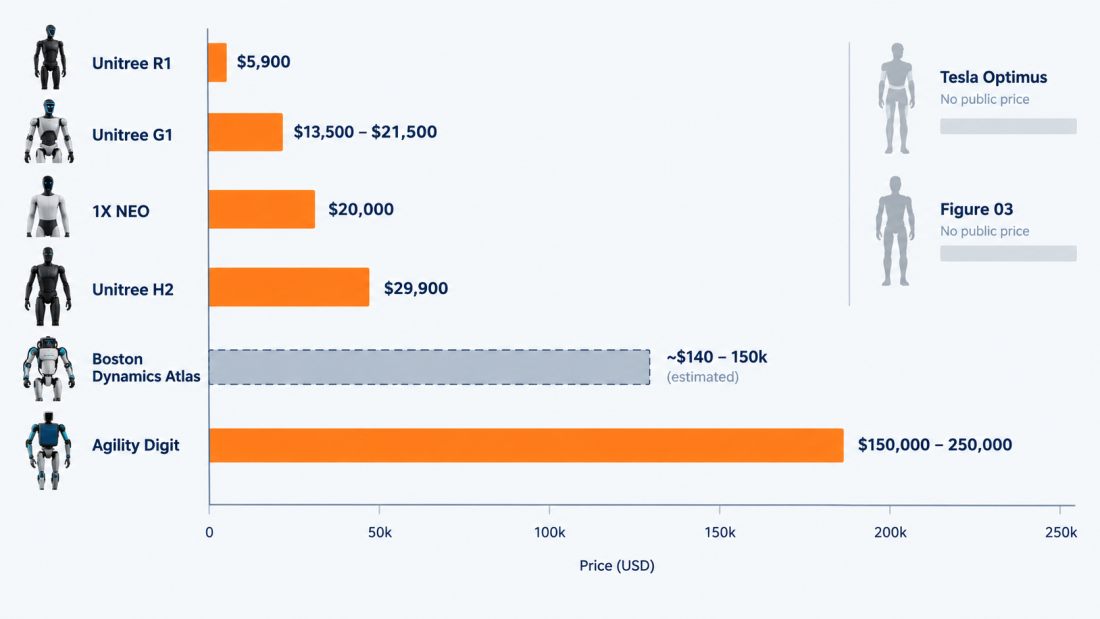
- Unitree’s lineup dominates the affordable end: the R1 starts around $5,900, the G1 around $13,500–$21,500, and the flagship H2 around $29,900, with SDK-enabled EDU versions running $43,900–$73,900.
- The three most famous humanoid robots in the world — Tesla Optimus, Figure 03, and Boston Dynamics Atlas — have no public purchase price at all; Optimus targets $20,000–$30,000 at volume production, and Figure bills BMW roughly $25 per robot-operating-hour instead of selling units.
- Agility Robotics’ Digit is the clearest proof humanoids pay for themselves in production today, priced around $150,000–$250,000 to buy or roughly $100,000 a year plus a deployment fee under a robots-as-a-service contract.
Every time a humanoid robot video goes viral, the comments fill with the same question: how much does it actually cost, and can a business actually buy one? For most of the famous names, the honest answer is still no. Humanoid robot cost in 2026 splits cleanly into two categories — machines you can order today with a real price tag, and machines you can only read about.
The Robots You Can Actually Buy Today
Unitree owns the affordable end of humanoid robot cost this year. The R1 starts at about $5,900 (a lighter R1 AIR variant runs closer to $4,900), the G1 lists at $13,500 for a base unit with no SDK access, and standard configurations run $16,000–$21,500. Buyers who need the full Python/C++/ROS2 developer kit and an NVIDIA Jetson Orin board pay $43,900–$73,900 for the EDU version instead. Unitree’s H2 replaced the older H1 line this year at roughly $29,900, with the H2 Plus variant reaching up to $100,000. Unitree shipped more than 5,500 units in 2025 alone — more than every other humanoid maker combined.
Why the Famous Names Don’t Have Price Tags
This is where humanoid robot cost data gets genuinely confusing for buyers. Tesla Optimus, Figure 03, and Boston Dynamics’ electric Atlas are the three most-covered humanoid robots on the planet, and none of them can be purchased at any price today. Optimus is targeting $20,000–$30,000 once Tesla reaches volume production, a figure that remains a stated goal rather than an order-form price. Figure doesn’t sell its 03 model outright either — its pilot deployment on BMW’s largest assembly plant bills at roughly $25 per robot-operating-hour, converting the purchase into a service fee. Atlas is in enterprise pilot testing at Hyundai’s Georgia plant, with analysts estimating a $140,000–$150,000 price once, or if, it reaches commercial sale.
📊 The Numbers That Matter
- $5,900 — Unitree R1, the cheapest humanoid robot on the market with a public price
- $13,500–$21,500 — Unitree G1 base-to-standard configuration range
- $20,000 — 1X NEO’s upfront consumer price (or $499/month), with 10,000+ preorders
- $150,000–$250,000 — Agility Robotics Digit’s purchase price, or ~$100,000/year via robots-as-a-service
- $0 — the public purchase price of Tesla Optimus, Figure 03, or Boston Dynamics Atlas; all three remain unavailable for direct sale
The Business Model Hiding in the Price List
The pricing pattern itself is the real story: Chinese manufacturers sell hardware and hit real order volumes doing it — UBTech’s Walker S2 has booked more than 800 million yuan (roughly $112 million) in orders deploying on BYD and NIO assembly lines. American and hype-heavy platforms increasingly sell time or outcomes instead of machines, whether that’s Figure’s per-hour billing or Agility’s robots-as-a-service contract. For a buyer, that split is a decision framework, not just a pricing quirk: humanoid robot cost comparisons only make sense once you know whether you’re comparing a capital purchase, a lease, or a service contract, because the three aren’t interchangeable line items on a budget.
What the Sticker Price Doesn’t Include
None of these figures are total cost of ownership. A $13,500 Unitree G1 with no SDK access isn’t doing useful factory work out of the box — see our analysis where we explain why the industrial robot cost guides everyone’s reading still assume you pay US wages, which skews the payback math for buyers in lower-wage markets. And a robot that’s cheap to buy isn’t necessarily cheap to run — see our analysis where we explain how the robot maintenance cost model most procurement teams build gets the depreciation curve wrong from year one.
How to Actually Use These Numbers
The unit count matters as much as the price tag. UBTech, AgiBot, and Unitree accounted for the overwhelming majority of humanoid shipments in 2025, and the manufacturers with real order books are almost never the ones generating headlines — see our analysis where we explain how China’s humanoid robot mass-production race is actually being decided by factory contracts most Western coverage never mentions.
Claims about hitting huge unit counts in a single year deserve the same scrutiny as any other number in this market — see our analysis where we explain why the 50,000-unit humanoid production claim nobody has independently verified keeps getting repeated anyway. For a genuine ROI case, start with what a platform is proven to do in production today, not what a company says it will cost once volume arrives — see our analysis of the five reasons humanoid robot ROI actually drives adoption decisions in 2026.
Understanding Humanoid Robot Pricing Models
Every quoted number in this guide is a humanoid robot price, but “price” means something different depending on the vendor. A capital purchase, a monthly robots-as-a-service subscription, and a per-hour billing arrangement like Figure’s are three separate financial instruments dressed up as the same line item on a spec sheet. Before comparing any two numbers, a buyer evaluating humanoid robot cost across the current humanoid robot market needs to know which of the three they’re actually looking at — a mistake here doesn’t just skew a spreadsheet, it changes who signs off on the purchase, since a capital expense and a service subscription usually route through completely different approval chains in robot procurement.
Quick Questions
What’s the cheapest humanoid robot you can actually buy?
The Unitree R1, starting around $5,900 (about $4,900 for the lighter R1 AIR variant), is the least expensive humanoid robot currently available with a public price.
Why don’t Tesla Optimus or Figure 03 have a price?
Neither is available for direct commercial purchase yet. Optimus is targeting $20,000–$30,000 at volume production, while Figure bills its BMW pilot deployment by the hour rather than selling units.
Is robots-as-a-service cheaper than buying a humanoid robot outright?
It depends on utilization, and it’s one of the more overlooked parts of humanoid robot cost math. Agility’s Digit runs roughly $100,000 a year plus a deployment fee under RaaS versus $150,000–$250,000 to purchase outright — RaaS tends to win for shorter or uncertain deployments, a direct purchase for sustained, multi-year use.
What’s the total cost of ownership beyond the sticker price?
Humanoid robot price alone excludes integration labor, maintenance, downtime, and software licensing — all of which can add 30–50% to the first-year total cost of ownership on top of the purchase or subscription figure quoted by the manufacturer.
💡 CreedTec Analyst’s Note by Daniel Ikechukwu
Strategic Impact: Humanoid robot cost is bifurcating into two completely different markets — cheap, real, shippable Chinese hardware and expensive, largely theoretical Western platforms — and buyers who don’t separate the two end up comparing numbers that were never meant to be compared.
Stop
- Comparing a manufacturer’s target price, like Optimus’s $20,000–$30,000 goal, against a competitor’s actual invoice price as if any humanoid robot cost figure means the same thing across vendors.
Start
- Asking any humanoid robot vendor for the difference between list price, EDU/developer price, and fully integrated deployed price before budgeting a pilot.
Watch
- Whether Tesla or Figure publishes an actual commercial sale price in the next two quarters, or whether both stay locked in pilot/hourly billing indefinitely.
ROI Outlook: The manufacturers actually generating revenue right now — Unitree, UBTech, AgiBot — are also the cheapest on any humanoid robot cost comparison, which should reset expectations about where near-term ROI is coming from: high-volume, lower-cost hardware in structured settings, not the six-figure platforms getting the press coverage.
— Daniel Ikechukwu
Sources
- Robot Price Index — How Much Does a Humanoid Robot Cost in 2026? Real Prices
- AI Business — Unitree vs Tesla Optimus vs Figure: What a Humanoid Robot Actually Costs in 2026
- TechStoriess — Humanoid Robot Cost Enterprise 2026: Full Commercial Guide
- LumiChats — Humanoid Robots 2026: Tesla Optimus vs Figure AI vs Unitree
- RoboZaps Blog — 38 Best Humanoid Robots in 2026 (Evidence-Ranked)