Fast Facts
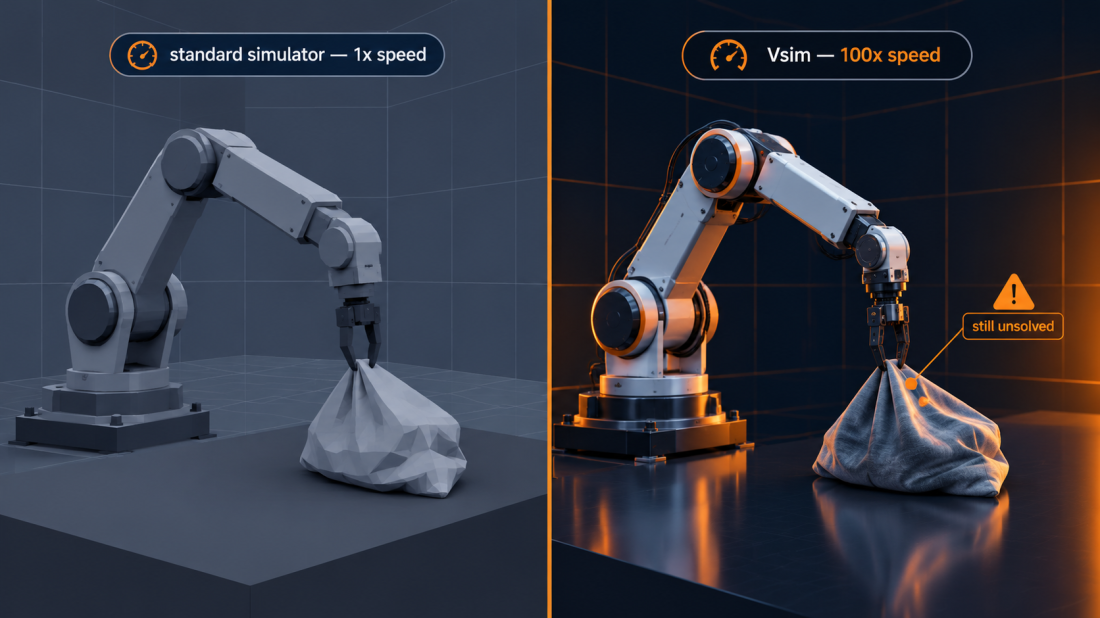
- Robot simulation speed has become robotics’ favorite marketing number, with UK startup Vsim claiming its physics engine trains robots up to 100x faster than standard simulators.
- Vsim, founded by ex-NVIDIA engineers Michelle Lu and Kier Storey, raised $21.5 million in seed funding at roughly a $100 million valuation to build the technology.
- Independent researchers, including Cambridge’s Rika Antonova, confirm the speed gains are real, but flag the same industry-wide limitation: deformable objects and cutting still don’t simulate accurately.
- For procurement teams, the real question isn’t how fast a simulator runs — it’s whether faster training produces a policy that survives contact with a physical robot.
Ask any robotics simulation vendor what they’re selling this year and the pitch converges on one number: robot simulation speed. Manchester-based Vsim says its physics engine can accelerate robot training by up to 100x over standard simulators, and it isn’t alone — NVIDIA and a handful of well-funded startups are chasing the same claim. What the pitch decks leave out is what that speed is actually buying.
What Vsim Is Actually Claiming
Vsim was founded in 2022 by Michelle Lu and Kier Storey, two engineers who spent years building physics simulation tools at NVIDIA before starting their own company. Vsim raised $21.5 million in seed funding led by EQT Ventures in 2024, on top of an earlier $2.5 million round, bringing total funding to roughly $24 million at close to a $100 million valuation. Its pitch centers on robot simulation speed: a physics framework the company says can run robotics training up to 100x faster than conventional simulators by better exploiting multi-core hardware.
The Limitation Every Vendor Runs Into
Cambridge associate professor Rika Antonova, who has worked in robotics since 2015 and isn’t affiliated with Vsim, backs up the raw speed claim. Fast simulation, she says, means a robot’s control policy can be adjusted almost as it’s being tested, instead of waiting hours for a training run to finish. But she draws a hard line around what any simulator, fast or not, can currently represent.
“There are certain things that are hard to model in simulation, like highly deformable objects and cutting.”— Rika Antonova, Associate Professor, Department of Computer Science and Technology, University of Cambridge
That gap is exactly why raw robot simulation speed numbers can mislead buyers evaluating a platform. This isn’t the first time a simulation vendor’s headline figure has needed unpacking — see our analysis where we explain how ABB and NVIDIA’s 99% sim-to-real accuracy claim left out exactly this kind of caveat.
📊 The Numbers That Matter
- $21.5M — Vsim’s 2024 seed round, led by EQT Ventures
- $24M — total funding raised to date
- ~$100M — approximate valuation at seed stage
- 100x — Vsim’s claimed training-speed acceleration vs. standard simulators
- 2022 — year Vsim was founded, by ex-NVIDIA engineers Lu and Storey
Why Buyers Should Ask “Faster At What”
A simulator that trains a grasping policy 100x faster is only useful if that policy transfers to a real gripper handling a real object — and the categories where simulation still struggles, like deformable materials and fine contact dynamics, are exactly the tasks most manufacturing floors need automated. Teams evaluating a simulation platform for procurement should ask which task categories a speed claim was benchmarked against, not just the headline multiplier. The cost math already breaks down in ways that go beyond speed — see our analysis where we explain how the physics simulation bottleneck quietly inflates robot training budgets long before deployment.
The Second Robot Is the Real Test
Vsim’s answer to the fidelity question is a physical validation loop: a robot named Freddo already runs on the platform, and co-founder Michelle Lu says a second robot, Nacho, is coming online to further close what she calls “reduced approximation” — simulations accurate enough that robots perform in reality the way they did in training. That’s a materially different claim than raw robot simulation speed, and it’s the one worth verifying before a purchase order goes out. Vendors chasing the same speed number without a hardware validation loop deserve more scrutiny, not less — see our analysis where we explain why the sim-to-real transfer breakthrough claiming 66% better robot performance still needed real-world confirmation before the number held up.
Faster simulation should, in theory, lower the cost of generating the synthetic data these systems train on, but cost and quality don’t move in lockstep. See our analysis where we explain why the industry’s synthetic robot training data threshold sits at 40%, below which sim-only training reliably underperforms in the field, and why MIT’s SceneSmith research found the real cost hiding in robot training sims is the scene-asset pipeline, not compute time.
Quick Questions
Does faster robot simulation always mean better training outcomes?
No. Robot simulation speed determines how many training iterations a robot can run through, not whether the simulated physics match real-world behavior — those are separate problems vendors often blur together.
What tasks are hardest to simulate accurately today?
Deformable objects, cutting, and fine-contact manipulation remain the categories where even fast, well-funded simulators still fall short of real-world fidelity, according to independent researchers.
How should procurement teams evaluate a vendor’s speed claims?
Ask which specific tasks the benchmark covered, and whether the vendor has validated trained policies on physical hardware rather than simulation-only results.
💡 CreedTec Analyst’s Note by Daniel Ikechukwu
Strategic Impact: Robot simulation speed is becoming a commodity marketing claim across the sector, and it will keep multiplying as more startups compete for the same training-infrastructure budget. Buyers who can’t separate speed from fidelity end up paying for iteration counts that never translate into deployable robots.
Stop
- Treating a “100x faster” simulation claim as a proxy for training quality without asking which task categories it was benchmarked against.
Start
- Requiring vendors to show physical-hardware validation results, not just simulation-only benchmarks, before signing a platform contract.
Watch
- Whether Vsim’s second validation robot, Nacho, produces published sim-to-real transfer numbers, or the physical-validation claim stays anecdotal.
ROI Outlook: Faster training cuts compute cost per iteration, which is real money at scale — but only if the resulting policy needs fewer real-world correction cycles after deployment. A platform that’s fast but fidelity-poor just moves the cost from the simulator to the factory floor.
— Daniel Ikechukwu
Sources
- TechCrunch — Vsim, Founded by Nvidia Alums, Raises $24M for Robotics Simulation Tech
- EQT Ventures — Vsim Company Profile
- Concept Ventures — Vsim Raises $21.5M to Propel Robotics to New Heights
- BBC News — Robotics: Firms Race to Improve Robot Training Systems
- NVIDIA Blog — NVIDIA Research Advances Robotics From Simulation to the Real World