Fast Facts
Palladyne AI told investors at the Jefferies Global Industrials Conference on September 9 that Q2 2026 revenue rose 63% sequentially to $5.8 million, with $13 million in new contracts and a $25 million backlog. CEO Ben Wolff called it “harvest time”—a signal that the company’s two-and-a-half-year pivot to embodied AI revenue is converting into commercial traction. Full-year guidance of $24–27 million implies a significant second-half ramp. The business is using only about 30% of its manufacturing capacity.
Embodied AI revenue stopped being a pitch-deck concept for Palladyne AI this quarter. Speaking at the Jefferies Global Industrials Conference 2026, CEO Ben Wolff described the company’s position plainly: “We are an embodied AI company. That is really central to everything that we do”. The label matters because it explains the business model shift. Palladyne spent two and a half years moving from a diversified portfolio to a focused strategy where software runs on machines rather than in the cloud.
That shift is now showing up in the numbers.
The Q2 Figures That Matter
| Metric | Value |
|---|---|
| Q2 revenue | $5.8 million (+63% sequentially) |
| New contracts | $13 million |
| Contractual backlog | ~$25 million |
| Full-year 2026 guidance | $24–27 million |
| Manufacturing capacity used | ~30% |
| Trailing 12-month growth | 172% |
The backlog figure is the one procurement teams should note. Management said it includes only binding legal commitments, not pipeline estimates. The revenue mix is shifting toward higher-margin software and services, which should help operating leverage as sales grow.
Why “Embodied AI Revenue” Is the Right Frame
Embodied AI revenue is not the same as cloud AI revenue. Cloud AI runs in data centers and charges per API call or subscription. Embodied AI runs on machines—drones, robots, industrial equipment—and charges for the software that lets those machines observe, reason, and act on their own.
That distinction has procurement implications. A cloud AI vendor can be swapped by changing an API endpoint. An embodied AI vendor is embedded in the hardware. Switching costs are higher. The relationship is longer. Embodied AI revenue is stickier than its cloud counterpart because the software and the machine become one system.
Palladyne’s approach lets it work across different hardware systems while remaining vendor-neutral, serving both as a defense prime and as a subcontractor. That flexibility is part of why the company says inbound interest now outpaces outbound business development.
The Defense and Industrial Split
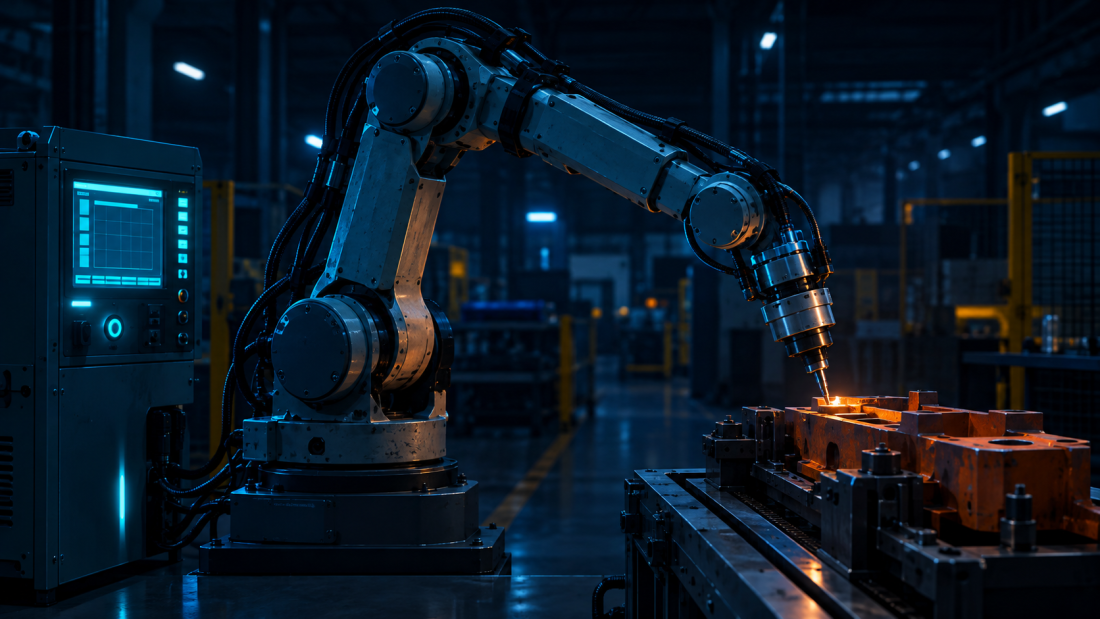
Palladyne’s embodied AI revenue comes from three businesses: autonomous swarming software for drones, industrial robotics software, and precision manufacturing components for defense.
The defense side completed demonstrations with the U.S. Army across multiple exercises and with the U.S. Air Force. In one test, a single soldier with little drone experience controlled heterogeneous swarms from four different manufacturers after about 30 minutes of training. The industrial side includes a partnership with Israel Aerospace Industries and a new deal with Fanuc.
The Fanuc partnership is the one to watch for industrial buyers. Fanuc is one of the largest industrial robot manufacturers in the world. A software partnership with Palladyne signals that embodied AI revenue in industrial robotics is moving from pilot to platform.
⚠ Fiction—composite scenario, not a real event: A plant manager evaluates two robotics software vendors. One sells a cloud-based analytics dashboard. The other sells software that runs directly on the robot controller. The cloud vendor quotes a lower per-seat price. The robot-embedded vendor quotes higher, but the software keeps working when the network drops and doesn’t require sending production data to a third-party cloud. The plant manager chooses the higher quote because the total cost of ownership is lower once downtime and data governance are counted.
Global Implications
For industrial buyers in emerging markets, the shift toward embodied AI revenue matters because it changes what a robot purchase includes. Software that runs on the machine doesn’t depend on reliable connectivity to a distant cloud. A factory in Nigeria or Southeast Asia with inconsistent network access can run the same AI capabilities as a facility in Germany, as long as the compute is local.
Palladyne’s guidance implies a strong second-half ramp. The company is using only 30% of its manufacturing capacity, leaving room to grow without major new capital spending. If the ramp materializes, embodied AI revenue becomes the proof point that machine-embedded AI is a commercial model, not just a technology category.
💡 CreedTec Analyst’s Note — Daniel Ikechukwu
Strategic Impact: Palladyne’s Q2 results show embodied AI revenue converting from strategy to sales. The 63% sequential revenue growth and $25 million backlog are binding commitments, not pipeline. For procurement teams evaluating robotics software, the distinction between cloud-hosted and machine-embedded AI is now a contract question, not a technical detail.
Stop: Evaluating robotics software vendors on per-seat pricing alone, without factoring in connectivity dependency and data governance.
Start: Asking vendors whether their AI runs on the machine or in the cloud, and what happens to functionality when the network drops.
Watch: Whether the Fanuc partnership produces commercially deployed industrial robots running Palladyne software within the next 12 months.
ROI Outlook: Machine-embedded software carries higher upfront cost but lower operating dependency. For facilities with unreliable connectivity, the payback is faster because the system keeps running when the cloud doesn’t.
Sources:
- Investing.com, “Palladyne AI at Jefferies Global Industrials Conference 2026: growth builds,” September 9, 2026
Further Reading:
- Skild AI Robotics Manufacturing Foundation Model
- AI Startups Industrial Monetization Strategies
- Industrial AI Revenue Generation: Where the Money Actually Comes From
- Performance-Linked Pricing in Industrial AI
- Outcome-Based Pricing Is the Model That Survives the Compute Trap
Subscribe to CreedTec’s weekly briefing—industrial AI revenue, embodied AI economics, and the procurement signals behind the earnings calls.