Fast Facts
On September 7, 2026, Unitree achieved the world’s first fully autonomous humanoid robot combat, with its UnifoLM-X2-1.0 model demonstrating real-time decision-making and dynamic interaction without human control. The breakthrough validates that world-model-driven humanoids are ready for large-scale deployment. Two days earlier, China’s PLA Daily called for accelerating robotic “combatants” for military use, while Reuters identified over 100 Chinese military procurement notices, academic studies, and patents focused on battlefield humanoids. Unitree autonomous combat is no longer a lab experiment—it’s a live capability with immediate procurement implications for both industrial and defense buyers.
Unitree autonomous combat arrived on September 7, 2026, when the Chinese robotics company released video of its humanoid robot engaging in fully autonomous combat for the first time. The breakthrough is powered by UnifoLM-X2-1.0, a world-action model that shattered previous bottlenecks in instantaneous planning, decision-making, and dynamic interactive execution.. The robot achieved high-dynamic, strongly interactive, real-time future prediction and planning—executing combat maneuvers without any human control.
The demonstration validates what the industry has been waiting for: Unitree autonomous combat proves that world-model-driven humanoids are ready for large-scale deployment. The question is no longer whether the technology works—it’s who deploys it first, and for what purpose.
The Technical Breakthrough: What UnifoLM-X2-1.0 Actually Does
The UnifoLM-X2-1.0 model achieves what Unitree calls “instantaneous planning, decision-making, and dynamic interactive execution”. That technical language describes a system that can predict, plan, and adapt in real time—the exact capabilities that separate a demo robot from a deployable asset.
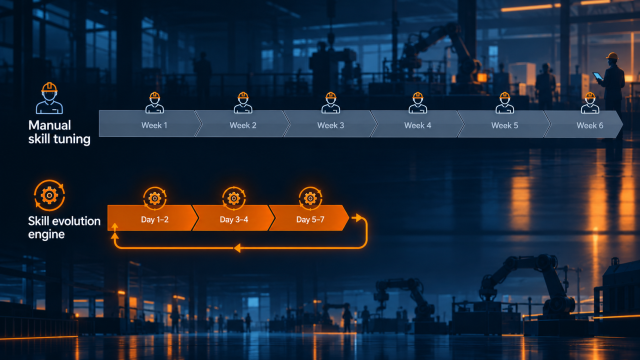
For procurement heads, the key detail is world-model-driven deployment readiness. A world model is a robot’s internal simulation of physics, causality, and spatial relationships. When a robot can predict future states and plan accordingly, it no longer needs to be programmed for every specific scenario. That’s the difference between a robot that works in one factory and a robot that can be deployed across many environments with minimal retraining.
Unitree autonomous combat is the proof point. If a robot can fight autonomously—adapting to an opponent’s movements in real time—it can certainly adapt to a changing warehouse floor or a production line with variable inputs.
The Military Context: Why the PLA Is Watching
Two days before Unitree’s announcement, the People’s Liberation Army Daily published a call to action: accelerate the transfer of cutting-edge technologies from laboratories to military training grounds for robotic “combatants”. The timing was not coincidental.
Reuters reviewed more than 100 Chinese military procurement notices, academic studies, patents, official publications, government records, and defense-company materials. The findings show that China’s defense establishment is accelerating research into humanoids’ military uses and planning for their eventual wartime deployment.
The PLA has already developed a vision for how humanoid robots could be used in urban warfare: six “combat robots”—humanoids, robot dogs, or unmanned vehicles—would be split into two assault teams, working with ground troops to clear enemy-occupied buildings floor-by-floor and room-by-room.
Unitree autonomous combat fits directly into this vision. A robot that can fight autonomously—making split-second decisions without human control—is a robot that can clear a building, infiltrate enemy lines, or provide cover fire while human soldiers stay out of harm’s way.
The Procurement Signal: What This Means for Buyers
For industrial and defense buyers, Unitree autonomous combat signals three things:
| Signal | Implication |
|---|---|
| World models are production-ready | The same technology that enables autonomous combat enables autonomous warehouse operations, manufacturing, and logistics |
| Chinese robotics is accelerating faster than Western competitors | Unitree shipped more than 5,500 humanoids in 2025 and is now demonstrating capabilities that were previously considered years away |
| Deployment timelines just shortened | If the technology works in combat, it works in factories. Procurement cycles need to accelerate accordingly |
The global humanoid market is dominated by Chinese manufacturers, who accounted for about 95% of global humanoid shipments in 2025. China has now developed more than 400 complete humanoid robot products and shipped more than 40,000 humanoids in the first half of 2026 alone, accounting for 97 percent of global shipments.
Unitree autonomous combat is not an isolated R&D milestone. It’s the leading edge of a national strategy.
⚠ Fiction—composite scenario, not a real event: A logistics operator in Southeast Asia watches the Unitree combat video and realizes that the same world-model technology could enable robots to navigate their chaotic, high-variability warehouse without months of reprogramming. The operator’s competitor, who already deployed Unitree’s commercial humanoids, is six months ahead in real-world data collection and model training. The gap widens with every demo.
What the Industry Is Saying
Dennis Hong, a professor of mechanical and aerospace engineering at UCLA, told Reuters: “Going where we don’t want humans to go is one of the most compelling reasons to develop robots in the first place. If losing a robot means avoiding the loss of a human life, then the robot can become expendable”.
Aaron Johnson, a professor of mechanical engineering at Carnegie Mellon University, offered a cautionary note: battlefield environments pose many variables and challenge robots’ abilities in unpredictable ways. The same caution applies to industrial environments—but the gap between lab and deployment is closing faster than most procurement cycles can track.
The Competitive Landscape
Unitree autonomous combat lands in a week when the robotics industry is already moving at speed:
- Tesla is reportedly placing thousands of Optimus unit orders with core suppliers, with full-year shipments anchored at 10,000-20,000 units and a non-linear acceleration expected starting in Q4.
- OpenAI confirmed it is working on its own humanoid robot.
- Korean AI humanoid KAIROS V0.7 was unveiled on the same day as Unitree’s combat announcement, demonstrating traditional mask dancing.
- Xiaomi’s CyberOne achieved a 98% success rate in a factory trial.
Unitree autonomous combat raises the bar for what “capable” means. A robot that can fight autonomously is a robot that can handle unpredictable environments—which is exactly what procurement heads need for real-world industrial deployment.
💡 CreedTec Analyst’s Note — Daniel Ikechukwu
Strategic Impact: Unitree autonomous combat is a deployment milestone disguised as a spectacle. The world-model technology that enables autonomous combat is the same technology that enables autonomous factories. Buyers who treat this as a military curiosity are missing the industrial signal.
Stop: Assuming humanoid robotics is still years away from practical deployment. Unitree just proved otherwise.
Start: Evaluating your own deployment timelines against the accelerating capability curve. The gap between “demo” and “deployment” is narrowing faster than most procurement cycles are designed to handle.
Watch: Whether Western competitors announce comparable autonomous capabilities in the next 6-12 months. The race is no longer about who builds the best robot—it’s about who deploys the most capable one first.
ROI Outlook: Early adopters of world-model-driven humanoids will capture the learning advantage. Each deployment generates real-world data that trains the next generation of models. The laggards will face a widening gap they cannot close with hardware alone.
Sources:
- 163.com
- Reuters via TBS News, “From dance floor to war: China readies humanoid robots for combat,” September 7, 2026
- Herald Business, “Korean AI humanoid robot KAIROS wows crowd with traditional mask dance,” September 7, 2026
- ABC News, “Humanoid Robots – Behind The News,” September 7, 2026
- China Daily, “A more modern reality is changing global perceptions,” September 7, 2026
Further Reading:
- CJ Logistics’ Humanoid Robot Deployment Is the First Real Test of Physical AI Economics
- Boston Dynamics Atlas Beats Tesla Optimus to Production
- Unitree’s TIME Cover Hides a 9% Industrial Deployment Problem
- Humanoid Robot Production Numbers: The 50,000-Unit Claim Nobody Can Verify
- The Industrial Robot Cost Guides Everyone’s Reading Assume You Pay US Wages
Subscribe to CreedTec’s weekly briefing—robotics economics, deployment data, and the procurement signals behind the hardware headlines.