Fast Facts
World Labs,Fei-Fei Li’s spatial-intelligence company, published results this week showing robot policies trained with zero real-world data via sim-to-real transfer, then operated autonomously on physical hardware for a full hour without human intervention. The headline is the zero-data claim. The real story is what this does to the cost structure of robot training — converting a hardware-time expense into a compute expense, which is the same shift that made cloud computing cheap.
World Labs published early results from its Real-to-Sim-to-Real (R2S2R) engine on July 28, showing robot policies trained entirely in simulation — with zero real-world training data — transferring directly to physical robots and operating autonomously for extended periods without failure or human intervention, according to the company’s own technical blog post. Tasks spanning cable routing, box packing, test-tube transfer, and object singulation from clutter ran on five different robot platforms — ALOHA, RB-Y1, YAM, Flexiv, and xArm — for a full hour each, unattended.
The technology behind it arrived through a July 21 acquisition: World Labs bought SceniX, a robotics simulation company that had been building systems to turn real robots, environments, and interactions into reusable simulations for policy training.
Why Sim-to-Real Transfer Changes the Cost Structure, Not Just the Capability
Zero Real-World Data
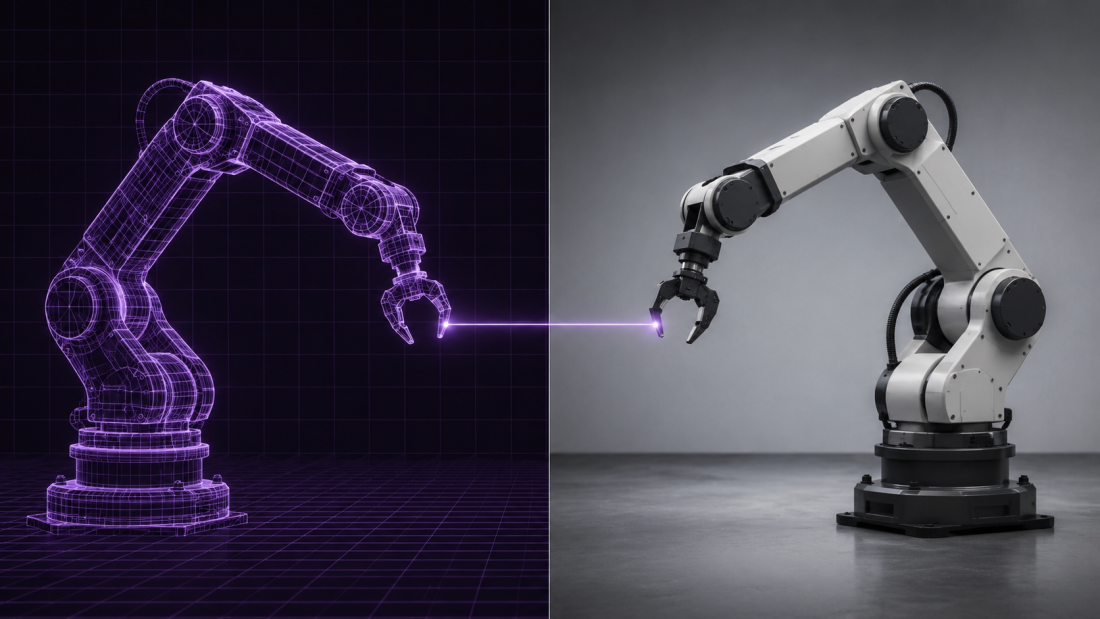
Policies for bimanual box packing, cable manipulation, and object singulation were trained entirely in simulation and transferred directly to real robot hardware, then ran autonomously for one hour without intervention.
Source: World Labs, “Building Worlds That Train Robots,” July 28, 2026
Robot experience is expensive in a way language-model training data never was. Every training iteration on physical hardware consumes staff time to reset objects, recover from failures, and maintain the equipment — a cost that scales linearly with the number of trials, not the number of insights gained. World Labs describes this as the field’s central bottleneck: not architecture, but the sheer expense of collecting experience at scale. See our earlier coverage of MIT SceneSmith’s attack on this same cost problem, where a different lab targeted the identical bottleneck from a different angle.
Sim-to-real transfer breaks that linear relationship. Simulated trials are parallelizable and cheap; hardware trials are sequential and expensive. Converting training from a hardware-time expense into a compute expense is structurally the same shift that made cloud computing cheap relative to on-premise servers — you’re trading a fixed, scarce resource for an elastic, purchasable one.
The Evaluation Problem Nobody Outside Robotics Talks About
Training isn’t the only cost R2S2R attacks. Robot development iterates far more slowly than software because policy evaluation stays tied to physical hardware — every checkpoint has to be tested on a real robot to know if it’s actually better. World Labs’ evaluation results show simulated performance reliably predicts hardware performance: across policy architectures and training configurations, checkpoints that scored higher in simulation also scored higher in reality, evaluated across 2,000 simulated trials and 100 real-world trials per checkpoint.
“The economic implication of this technology is enormous.”— World Labs, “Building Worlds That Train Robots”
That prediction reliability is what actually unlocks the cost savings. If simulated results didn’t track hardware results, teams would still need to validate every checkpoint physically, and sim-to-real would only save training cost, not evaluation cost. Because the ranking holds, teams can screen out weak checkpoints in simulation and reserve expensive hardware time only for the most promising candidates. See our analysis of why one-brain, multiple-embodiments is a fixed-cost amortization play, where the same logic of spreading a fixed investment across many downstream uses shows up in a different part of the robotics stack.
⚠ Fiction — composite scenario, not a real event: A robotics startup spends eight months and $2 million collecting hardware training data for a warehouse-picking task, only to discover the policy fails on a new object shape. A competitor using sim-to-real infrastructure regenerates thousands of simulated variations overnight, retrains by morning, and validates on hardware by lunch. The first company’s hardware investment becomes a sunk cost the moment simulation makes the same experience nearly free to generate.
Global Implications
If sim-to-real infrastructure becomes the industry default, it structurally favors companies that build reusable simulated worlds over companies that keep re-collecting hardware data per task — a task reconstructed once, per World Labs, can support new models and hardware over time, turning each simulation into reusable infrastructure rather than a one-off cost.
For robotics teams in Nigeria, West Africa, and Southeast Asia without access to large hardware fleets, that shift is a genuine opportunity: a small team with limited physical robots can potentially train and validate policies in simulation before ever touching expensive hardware, narrowing a gap that used to be purely about capital access. See our coverage of China’s robot hands winning the volume war for how hardware-scale advantages have dominated robotics competition until now.
💡 CreedTec Analyst’s Note — Daniel Ikechukwu
Strategic Impact: Sim-to-real transfer converts robot training from a capital-intensive, hardware-bound process into a compute-bound one. Companies that control reusable simulation infrastructure gain a compounding cost advantage over those still paying for hardware-hours per task.
Stop: Assuming robot training costs scale primarily with hardware fleet size going forward.
Start: Evaluating robotics vendors on whether their simulation-to-hardware transfer is validated with published prediction accuracy, not just demo footage.
Watch: Whether other robotics labs — Physical Intelligence, Skild AI, NVIDIA’s Isaac ecosystem — publish comparable zero-data transfer results, or whether World Labs’ R2S2R engine becomes a licensing bottleneck the rest of the industry has to build around.
ROI Outlook: Early adopters of sim-to-real infrastructure reduce marginal cost per new task dramatically, but the upfront investment in building an aligned, reusable simulation is nontrivial. The payoff compounds with every additional task and robot embodiment layered on top of the same simulated world.
Robot learning has always been bottlenecked by how much of the physical world a team could afford to touch. Sim-to-real transfer doesn’t remove that bottleneck — it just makes touching the physical world the last step instead of the only one.
Subscribe to CreedTec’s newsletter — it tracks which robotics labs are actually cutting hardware costs with simulation, and which ones are still burning cash one physical trial at a time.
Sources
- World Labs — “Building Worlds That Train Robots,” original technical results
- World Labs — SceniX acquisition announcement
- World Labs — “A Functional Taxonomy of World Models”
- Fei-Fei Li — “From Words to Worlds: Spatial Intelligence”
- arXiv — “World Action Models are Zero-shot Policies”
Further reading: MIT SceneSmith Attacks the Cost Nobody Talks About in Robot Training · One Brain, Multiple Embodiments: A Fixed-Cost Amortization Play · China’s Robot Hands Are Winning the Volume War · The Physics Simulation Bottleneck · Embodied World Models for Robotics Training