Fast Facts
Your factory’s zombie AI projects are costing more than the ones that failed outright. MIT’s NANDA initiative found 95% of generative AI pilots fail to deliver measurable P&L impact, despite $30–40 billion invested. But outright failure isn’t the expensive part — it’s the “zombie” pilots that never officially die: still funded, still staffed, still consuming budget years after they stopped delivering value. Killing them requires kill criteria written before launch, not evaluated mid-flight, because nobody wants to admit their own project didn’t work.
- 95% — generative AI pilots failing to deliver measurable P&L impact, per MIT NANDA
- $30–40B — enterprise capital already invested in those pilots
- 45% — professionals carrying at least one “zombie” project into 2026, per Atlassian survey of 8,000 workers
- 90% — of those zombie-project holders say it actively complicates their other work
- 60–87% — range of AI projects that never reach production, across cited industry studies
The Failure Everyone Already Expects
A pilot that fails fast and gets cancelled is a normal, healthy part of experimentation — nobody loses political capital over a project designed to test an idea that didn’t pan out. The real danger isn’t the projects that obviously fail — it’s the ones that look alive from the outside while already dead inside, still holding a green status on a dashboard nobody has updated honestly in months.
“The real question is: how fast can you tell the difference between a winner and a zombie, and act on it?” — Innovation Cloud, on Pilot Purgatory
Why Nobody Wants to Pull the Plug
Zombie projects survive because killing them has a personal cost. A recent Atlassian survey of 8,000 professionals found 45% entered 2026 carrying at least one project everyone privately knows is going nowhere, but leadership still calls “active.” Admitting a pilot failed means admitting the champion who pitched, staffed, and defended its budget was wrong — a reputational cost most people avoid by letting the project quietly drift instead of formally ending it.
What ARC’s Research Shows Separates Winners From Zombies
ARC Advisory Group’s 2025 Industrial Artificial Intelligence Pacesetter Survey found a significant share of industrial AI projects get scaled back, postponed, or scrapped — often due to foundational issues rather than a failure of the AI technology itself. The companies ARC classifies as “pacesetters” separate themselves with structural discipline: 63% consider building an Industrial Data Fabric critically important, precisely because reusable data lets one AI project’s output feed the next, instead of every pilot starting from zero.
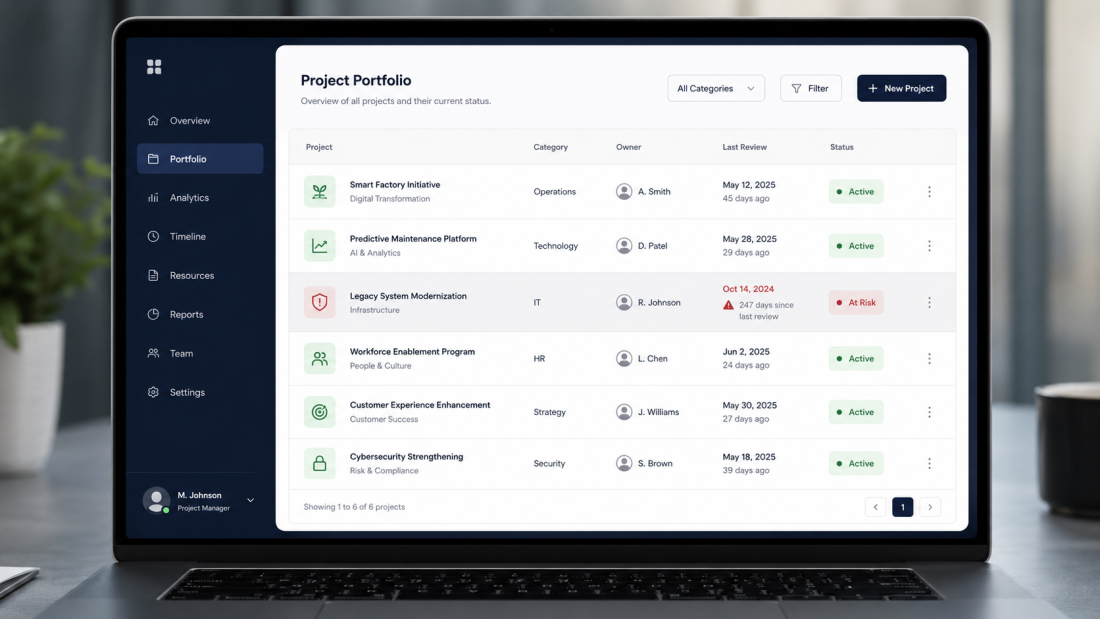
⚠ Illustrative scenario (fictional): A manufacturer launches a predictive-maintenance AI pilot with strong initial results on one line. Eighteen months later, it’s still labeled a “pilot,” has never been evaluated against a kill or scale decision, and nobody wants to be the one to ask whether it’s actually saving money — because the engineer who championed it is now the one managing it, and ending it would mean admitting eighteen months produced nothing measurable.
Global Implications: The ROI Mandate Travels Everywhere
Budget scrutiny on AI spend isn’t a US or European phenomenon — it’s a global shift toward demanding measurable impact before further investment. For manufacturers in emerging markets with tighter capital constraints than large multinationals, the zombie-project risk is proportionally worse: every dollar tied up in an undead pilot is a dollar that couldn’t fund a project with a clear path to either scale or shutdown.
💡 CreedTec Analyst’s Note — Daniel Ikechukwu
Strategic Impact: The costliest AI failures aren’t the ones that die fast — they’re the ones nobody has the political will to formally end.
Stop: Launching AI pilots without written kill criteria and a named business owner accountable for the P&L outcome.
Start: Running a quarterly audit asking each active pilot: when was the last stop/continue/pivot decision actually made?
Watch: Whether Industrial Data Fabric adoption becomes the dividing line between pacesetters and everyone else this year.
ROI Outlook: Strong for organizations willing to kill underperforming pilots on schedule; poor for those that let sunk cost dictate continuation.
A pilot with no kill date isn’t a pilot — it’s a permanent budget line. Subscribe to CreedTec’s newsletter for the ROI discipline most AI programs skip.
Further reading on CreedTec:
The Industrial AI Market Size Nobody Can Agree On · Google’s TPU Push Is Chasing Inference Money, Not Nvidia’s Crown · Oracle’s Warning on Industrial AI Investment ROI Challenges · Bain’s Industrial Automation AI Revenue Hourglass Model for 2030 · The 2026 Analyst’s Guide to Industrial AI Revenue Growth in Emerging Markets