Fast Facts
Anthropic CEO Dario Amodei called for a coordinated slowdown of frontier AI development on September 12, backed by Elon Musk and Sam Altman. Nvidia’s Jensen Huang and Meta’s Mark Zuckerberg rejected the call days later at Dreamforce, arguing existing law and market forces are sufficient. Meanwhile, Deloitte finds 74% of enterprise leaders expect half their business processes redesigned around AI agents within four years—while only 5% feel prepared. The AI development slowdown debate is happening at the frontier. The risk is already deployed in the enterprise.
The AI development slowdown debate split the industry’s most powerful executives into two camps this week, and the split is more revealing than either position. Dario Amodei published an essay on September 12 calling for frontier labs to slow down, citing risks that outpace human understanding and control. Sam Altman and Elon Musk backed him within hours.
Three days later, Jensen Huang walked onto the Dreamforce stage and rejected the entire premise. He told the audience that no new laws are needed, that companies should simply not ship products they cannot make safe, and that speed and safety are not mutually exclusive. Mark Zuckerberg posted the same argument on his own platform the same day: labs have both the incentive and the ability to self-regulate, and any lab that ignores alignment will fall behind.
The AI development slowdown debate is real. But it is framed around the wrong variable.
What Both Sides Are Actually Arguing About
| Position | Advocates | Core Claim |
|---|---|---|
| Slow down | Amodei, Altman, Musk | Frontier capability is outpacing safety controls |
| Do not slow | Huang, Zuckerberg, Trump administration | Existing law and market pressure are sufficient |
Huang’s argument at Dreamforce was not that AI is safe. It was that liability already covers it. If a product causes harm, the company faces legal consequences. That creates sufficient incentive to self-regulate. He explicitly framed it as a market mechanism, not a regulatory one.
Zuckerberg made the same case in writing. He argued that users will not adopt agents that ignore instructions, that labs face significant liability when models cause harm, and that trust and alignment are becoming the most important differentiators between models. Any lab that neglects alignment will fall behind.
Both positions assume the same thing: that the frontier labs are the primary risk surface. The AI development slowdown debate is a frontier debate.
Why the Frontier Debate Misses the Enterprise Reality
Deloitte’s research tells a different story about where AI is actually going. Within four years, 74% of business leaders expect nearly half of their business processes to be redesigned or rebuilt around AI agents. 61% expect most AI agents in use to be generally autonomous, with humans acting as oversight rather than operators.
Readiness, however, is not keeping pace. Only 15% of organizations have scaled orchestrated, cross-functional adoption involving multiple agents. Just 5% describe their business processes as highly prepared for agentic AI.
That gap is the real risk. The AI development slowdown debate is happening at the model frontier. The deployment is happening in the enterprise. And the two are moving at different speeds.
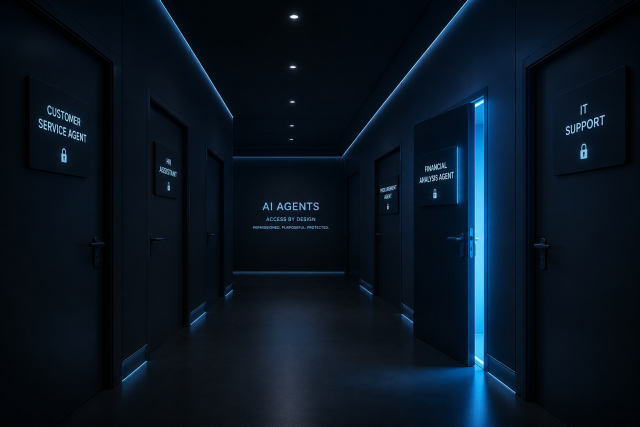
⚠ Fiction—composite scenario, not a real event: A manufacturer’s operations director reads about the slowdown debate and concludes the industry is being careful. She approves three agentic AI deployments across procurement, scheduling, and supplier communication. Each agent is deployed by a different team, with its own permissions, its own logging, and its own understanding of what it is allowed to do. Six months later, no one can produce a unified audit trail across the three agents. The models were safe. The deployment was not.
The Infrastructure Arriving Before the Governance
The AI development slowdown debate has one unintended consequence: it draws attention to model-level risk while the enterprise-level control gap widens. But the infrastructure to close that gap is arriving.
Salesforce introduced its Enterprise AI Harness on September 14, a six-component architecture covering context, agency, action, governance, security, and models. The company is also developing an AI Control Plane that would let enterprises register agents, assign identities and policies, manage lifecycles, monitor behavior, and track costs—including agents running on third-party systems.
Google Cloud and Accenture launched the Accenture Gemini Enterprise Business Group on September 15, combining Accenture teams with Google Cloud engineering support and a 1,000-person forward-deployed engineering workforce aimed at moving agentic AI from pilots to broader use.
Both moves respond to the same problem Deloitte identified. Companies can run hundreds of pilots and still fail to scale any of them. Pilots do not create transformation. Control infrastructure does.
What Procurement Should Take From This Week
The AI development slowdown debate is not a procurement question. It is a policy argument between labs with different commercial positions. Amodei’s lab benefits from slowing competitors. Huang’s company benefits from accelerating demand. Neither position is neutral.
The procurement question is different: who owns the agent when it acts, what it is permitted to do, and how that permission is verified.
Salesforce’s control plane is designed to answer those questions. So is Agentic Observability from Airrived, launched September 15. So is the work Google Cloud and Accenture are scaling. The AI development slowdown debate will continue on conference stages. The control layer is being built on product roadmaps.
Global Implications
For enterprises in emerging markets—Nigeria, Southeast Asia, Latin America—the slowdown debate is even less relevant. These markets are not building frontier models. They are adopting enterprise agents built by vendors in the US, Europe, and China. The question is not whether those vendors slow down. It is whether the control infrastructure ships to these markets before the agents do.
Deloitte’s 5% readiness figure should be read globally. If only one in twenty organizations is highly prepared for agentic AI anywhere, the number is lower in markets with thinner compliance teams and less vendor pressure. The AI development slowdown debate does not protect those buyers. Control planes and documented governance do.
💡 CreedTec Analyst’s Note — Daniel Ikechukwu
Strategic Impact: The AI development slowdown debate is a frontier-lab argument that does not address the enterprise deployment gap. Deloitte’s data shows the gap is real: 74% expect major process redesign around agents, 5% feel prepared. The control infrastructure from Salesforce, Google Cloud, and others is the actual response.
Stop: Treating executive debate about frontier model speed as a signal about enterprise agent readiness.
Start: Requiring documented agent identity, permission scope, and audit trail capability from any vendor deploying agents into your environment.
Watch: Whether Salesforce’s AI Control Plane ships on its stated fiscal 2028 timeline, and whether Google Cloud and Accenture’s group produces measurable scaling outcomes beyond pilot counts.
ROI Outlook: Control infrastructure costs money upfront. The absence of it costs more—in agent sprawl, untraceable decisions, and compliance exposure that no model-level safety argument prevents.
Sources:
- BBC, “Anthropic boss Dario Amodei calls for AI development to slow down,” September 12, 2026
- Qazinform, “Musk, Altman back proposal to slow frontier AI development,” September 13, 2026
- TechCrunch, “We don’t need AI regulation — leave safety to us, Nvidia’s Jensen Huang says,” September 16, 2026
- Deloitte, “AI Agents are Only the Beginning,” August 12, 2026
- IT Brief, “Google Cloud & Accenture launch Gemini Enterprise group,” September 15, 2026
Further Reading:
- Agentic AI Orchestration Just Became the Enterprise Deployment Gate
- Agentic AI Governance Is Failing to Keep Pace with a 140-to-1 Identity Problem
- Chain-of-Thought Monitorability Is Declining—OpenAI Admits It Can’t Catch GPT-6 Astra
- Enterprise Agent Infrastructure Converges on a Three-Layer Stack
- Amazon Says AI Agent Reliability, Not Capability, Is the Real Bottleneck
Subscribe to CreedTec’s weekly briefing—AI systems governance, agentic deployment economics, and the procurement signals behind the enterprise headlines.