TL;DR:
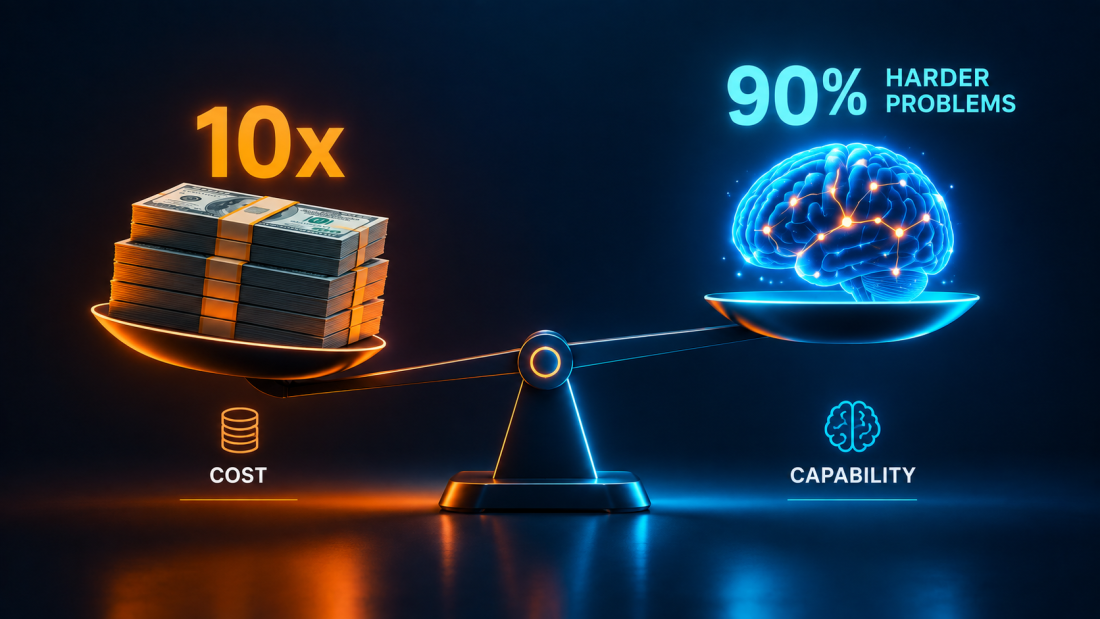
- Reasoning models like OpenAI o1/o3 achieve 74%+ accuracy on math benchmarks vs. 12% for standard models. The cost: 10–15x higher per request and 25–60 seconds latency instead of 1–3 seconds.
- Routing 70% of queries to fast budget models ($0.06/M tokens) and 30% to reasoning models ($15–600/M) yields blended cost of $3.00/M instead of $15/M across-the-board.
- Reasoning models excel at architecture decisions, security reviews, and complex debugging. They waste money on lookups, summaries, and classification.
- DeepSeek-R1 at $0.14/M tokens open-weights is forcing OpenAI and Anthropic to cut reasoning pricing by 40–60% in Q4 2026.
- The 2026 truth: intelligent routing saves 60–70% vs. using expensive reasoning as default.
Reasoning models are the most misunderstood AI category in 2026. Reasoning models don’t replace standard models. They complement them by trading speed for accuracy on problems that matter. According to Taskade’s reasoning model breakdown for 2026, o1 scores ~74% on AIME math benchmarks versus ~12% for GPT-4o. That’s compelling. But here’s what procurement teams miss: routing every query to o1 costs 10–15x more and guarantees users wait 25–60 seconds for answers to questions that should take 1 second.
Why Reasoning Models Cost More Than They Seem
The math on reasoning models looks simple. OpenAI o1 outputs cost $60 per million tokens. GPT-5.5 costs $6. That’s 10x. But the real cost multiplier compounds because reasoning models generate internal “thinking tokens” before returning an answer. Finout’s cost breakdown analysis shows o1-pro output tokens cost $600 per million—a 100x premium over budget models. You’re paying for hidden reasoning compute, not just output tokens.
That cost structure creates the procurement question: Which problems actually need reasoning? See our analysis where we explain how safety and reasoning complexity correlate in AI systems. Architecture decisions, security code review, and malicious input detection benefit from reasoning. Chatbot responses, data lookups, and classification tasks do not.
10–15x cost premium for reasoning models vs. standard models on per-request basis, with o1-pro reaching $600/M output tokens (verified Finout pricing analysis, September 2026).
74% AIME benchmark accuracy for o1 vs. 12% for GPT-4o—reasoning closes the accuracy gap on complex multi-step problems that standard models fail on.
The Routing Strategy That Actually Saves Money
Intelligent model routing is the only way to afford reasoning models at scale. Default to fast budget models for 70% of queries (GPT-4.1 Nano at $0.06/$0.40 or Gemini 3 Flash at $0.05/$0.15). Route 30% to reasoning when complexity signals require it (multi-step math, code architecture review, adversarial analysis). See our analysis where we explain vendor lock-in risk when you build routing strategies into one provider’s ecosystem.
Reasoning models stand on three building blocks: chain-of-thought prompting, test-time compute allocation, and internalized reasoning traces. The value is in solving problems that cascade—where one wrong step compounds into failure. Use reasoning for multi-step planning. Use standard models for everything else.— Taskade Reasoning Models Guide, 2026
The cost math is concrete. A team running 100,000 API calls daily: 70,000 budget model calls at $0.06 = $4.20/day. 30,000 reasoning calls at $15 = $450/day. Blended cost: $454.20/day = $3.00 per million tokens, not $15/M if you used reasoning across-the-board. Over a year, that’s $165K saved.
Why DeepSeek-R1 Is Breaking Reasoning Pricing
Open-weights reasoning models are forcing vendor pricing down faster than expected. DeepSeek-R1 achieves ~80% AIME accuracy at $0.14/M tokens input, a fraction of OpenAI’s o1 pricing. By Q4 2026, OpenAI cut o1-preview pricing by 40%, and Anthropic introduced reasoning features in Claude Opus at no price increase. See our analysis where we explain how open-weights reasoning models are reshaping vendor economics.
That pricing pressure creates a procurement inflection: Should you self-host DeepSeek reasoning (lower cost, higher infrastructure burden) or use cloud APIs (higher cost, managed uptime)? The answer depends on call volume. Above 1M calls/month, self-hosting economics favor open-weights. Below that, cloud APIs win.
⚠ Fiction — illustrative scenario: A legal tech firm processes 10,000 contract reviews monthly. Early 2026: routing 100% to o1-preview at $0.30 per review = $3,000/month. Mid-2026: routing 30% to o1-preview ($90) and 70% to GPT-4.1 Nano ($21) = $111/month. Late 2026: routing through DeepSeek self-hosted ($18/month operations) vs. Anthropic Claude reasoning ($135/month). The choice isn’t technical—it’s financial.
The Actual Use Cases Where Reasoning Wins
Stop using reasoning models for customer service, content generation, or lookups. Use them for: security code review (5–10% of codebase), architecture decisions (2–3 per sprint), malicious input detection on sensitive workflows, and complex debugging. Those are the 2–5% of queries where reasoning accuracy matters more than speed.
See our analysis where we explain how domain-focused models often outperform reasoning models on task-specific accuracy without the latency penalty. Specialized models trained on codebases, security standards, or domain data often match reasoning-model accuracy on task-specific problems at a fraction of the cost.
💡 CreedTec Analyst’s Note — Daniel Ikechukwu
Strategic Impact: Reasoning models are no longer a binary choice. They’re an escalation tier. Default to fast models; route complex tasks to reasoning only when speed-accuracy tradeoff favors accuracy.
- Stop: Using reasoning as your default model tier. Benchmark your query distribution first. If 90%+ of queries are simple (lookups, summaries, classification), reasoning is waste.
- Start: Implementing intelligent routing that classifies query complexity and routes accordingly. Libraries like Anthropic’s Batch API and routing frameworks automate this decision.
- Watch: DeepSeek-R1 and open-weights reasoning adoption. By Q1 2027, open-source reasoning models will force another 30–50% price cut from cloud vendors, shifting economics toward self-hosting for high-volume users.
ROI Outlook: Intelligent routing typically reduces blended model costs by 60–70% versus using reasoning across-the-board. High-complexity workflows (security, architecture, debugging) see 3–5x ROI when reasoning is correctly scoped. Enterprises deploying routing strategies in Q4 2026 report payback within 2–3 months through cost reduction alone.
Get CreedTec’s AI vendor decision guide. Benchmark reasoning model costs across OpenAI, Anthropic, Google, and DeepSeek—plus routing frameworks that automate the choice.
Subscribe to CreedTec
Sources
- Taskade, “AI Reasoning Models Explained: Test-Time Compute (2026),” June 2026
- Finout, “AI Model Cost Breakdowns: The Complete 2026 Comparison Guide,” July 2026
- Cerebras, “The Economics of AI Reasoning,” June 2026
- DevToolLab, “AI Reasoning Models in 2026: o3 vs Claude vs Gemini Deep Think,” June 2026
- AI Superior, “LLM Inference Cost 2026: Complete Pricing Guide,” March 2026