Fast Facts
Evaluating frontier Vision-Language-Action (VLA) architectures proves that initial NVIDIA Isaac GR00T benchmark spikes do not automatically guarantee factory-floor readiness. While the newly updated model scales performance metrics across public environments like DROID-F6, external validation pipelines uncover deep deployment blind spots. Recent peer-reviewed studies show that a trained checkpoint achieving pristine scores on standard academic suites can instantly hit zero-percent execution metrics when migrated to unfamiliar industrial configurations. For enterprise procurement leads, this widening simulation gap means B2B hardware risk must be calculated far beyond standard vendor documentation. [1, 2, 3]
- +61% — GR00T N1.7 vs. N1.6 on the DROID-F6 benchmark
- +10% / +5% / +2% — gains on DROID-F0, SimplerEnv Bridge, and Fractal respectively
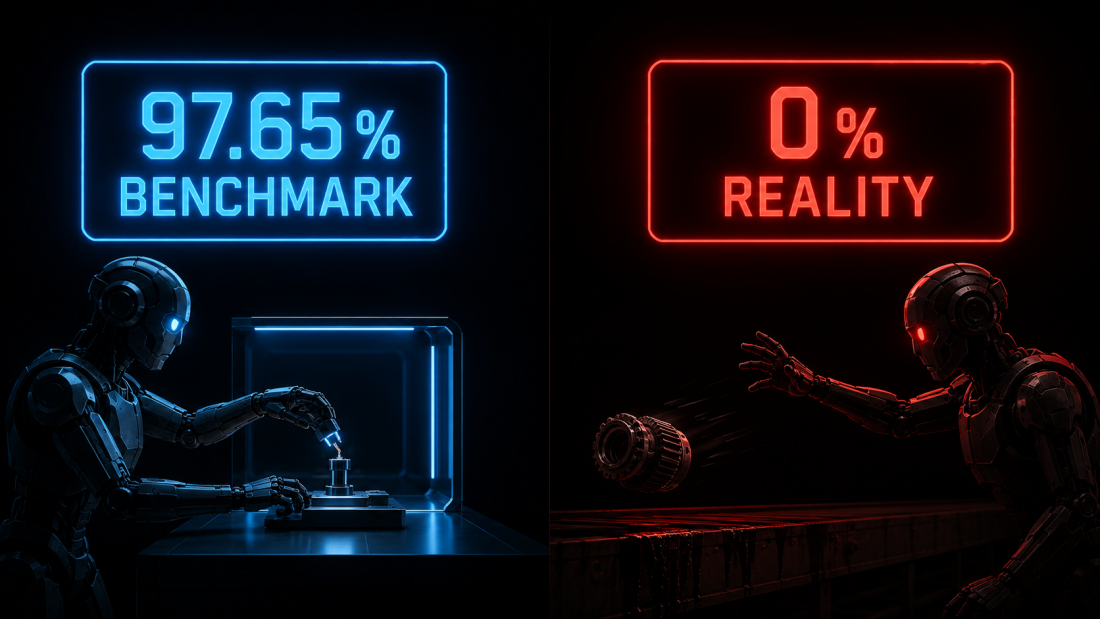
- 97.65% → 0% — GR00T N1.6’s success rate on LIBERO-Spatial vs. RoboGate’s 68 novel Isaac Sim industrial scenarios
- ~32,000 hours — human video pretraining behind GR00T N1.7
- 3B parameters — GR00T 1.7’s base checkpoint size
The Number NVIDIA Published for NVIDIA Isaac GR00T Is Real
NVIDIA’s own benchmarking shows consistent improvements across DROID and SimplerEnv compared to N1.6, including a 61% gain on DROID-F6, alongside a new Cosmos-Reason2-2B vision-language backbone. That’s a legitimate technical advance, not a marketing inflation — NVIDIA publishes the methodology openly on GitHub and Hugging Face.
“The age of generalist robotics is here.” — Jensen Huang, Founder and CEO, NVIDIA
The Performance Metrics an NVIDIA Isaac GR00T Benchmark Can’t Answer
A benchmark score tells you how a model performs on the exact tasks and environments it was tested against — not on your factory floor, with your lighting, your part tolerances, your failure modes. That distinction sounds obvious, but it’s exactly where procurement decisions go wrong: a strong benchmark number satisfies the desire for a clean, defensible number to put in a purchase justification, even when it doesn’t answer the question actually being asked.
Testing NVIDIA Isaac GR00T Outside the Standard Benchmark Suite
A 2026 evaluation called ROBOGATE fine-tuned GR00T N1.6 on the official LIBERO-Spatial dataset, reaching a 97.65% success rate — matching NVIDIA’s reported performance for that model class. The same fine-tuned checkpoint, tested on 68 novel industrial scenarios in Isaac Sim, scored 0 out of 68. Every failure was a grasp miss, not a collision or timeout — the model wasn’t behaving unsafely, it simply didn’t generalize to scenarios it hadn’t been benchmarked against.
⚠ Illustrative scenario (fictional): A packaging manufacturer licenses a vision-language-action model after reviewing its published benchmark scores, expecting similar performance on their line. Deployment reveals the model struggles with their specific part geometry and lighting — conditions the benchmark never tested. The manufacturer spent budget on a number that measured the wrong thing.
Global Implications: Simulation Progress Still Needs a Reality Check
Simulation-based training is expanding fastest in exactly the markets where physical pilot testing is expensive or slow to arrange — including much of Africa and Southeast Asia. That makes the benchmark-to-deployment gap more consequential here, not less: operators who can’t easily run a physical pilot before committing budget are more likely to rely on published simulation numbers alone, and those numbers, as ROBOGATE shows, don’t reliably predict real-world performance.
💡 CreedTec Analyst’s Note — Daniel Ikechukwu
Strategic Impact: Simulation benchmark improvements are real but narrow; they measure progress on tested scenarios, not readiness for untested ones.
Stop: Treating a vendor’s published benchmark percentage as a proxy for how a model will perform in your specific facility.
Start: Requesting evaluation results on scenarios that resemble your actual deployment conditions, not just standard published benchmarks.
Watch: Whether NVIDIA or third-party evaluators publish cross-environment generalization data alongside future GR00T releases.
ROI Outlook: Cautiously positive for pilot-scale testing on your own conditions; unproven as a basis for full deployment on benchmark scores alone.
FAQ: NVIDIA Isaac GR00T & Industrial Simulation Gaps
Why do public benchmarks conflict with real factory-floor readiness?
Standard public test suites measure an autonomous model’s execution within tightly controlled environmental parameters and lighting conditions. They do not automatically account for the subtle cross-simulator anomalies or messy physical factory-floor tolerances that general-purpose systems face during an actual industrial rollout.
What did the ROBOGATE study reveal about NVIDIA Isaac GR00T checkpoints?
The independent ROBOGATE evaluation demonstrated that while a fine-tuned checkpoint achieved a 97.65% success rate within its native testing architecture, migrating that exact same policy into unmapped industrial simulation scenarios caused the model to hit a 0% grasp execution rate due to unaligned cross-environment physics.
What should I ask a VLA vendor before buying?
Ask: “What evaluation results do you have on scenarios that resemble my actual deployment conditions — not just standard published benchmarks?” If they can’t provide them, budget for your own pilot testing before committing to full deployment.
Why does this matter more for emerging markets?
Because simulation-based training is expanding fastest in markets where physical pilot testing is expensive or slow to arrange. Operators in these markets are more likely to rely on published simulation numbers alone — and those numbers, as ROBOGATE shows, don’t reliably predict real-world performance.
A benchmark score isn’t a guarantee — it’s a starting question. Subscribe to CreedTec’s newsletter for the procurement red flags simulation vendors don’t volunteer.