Fast Facts
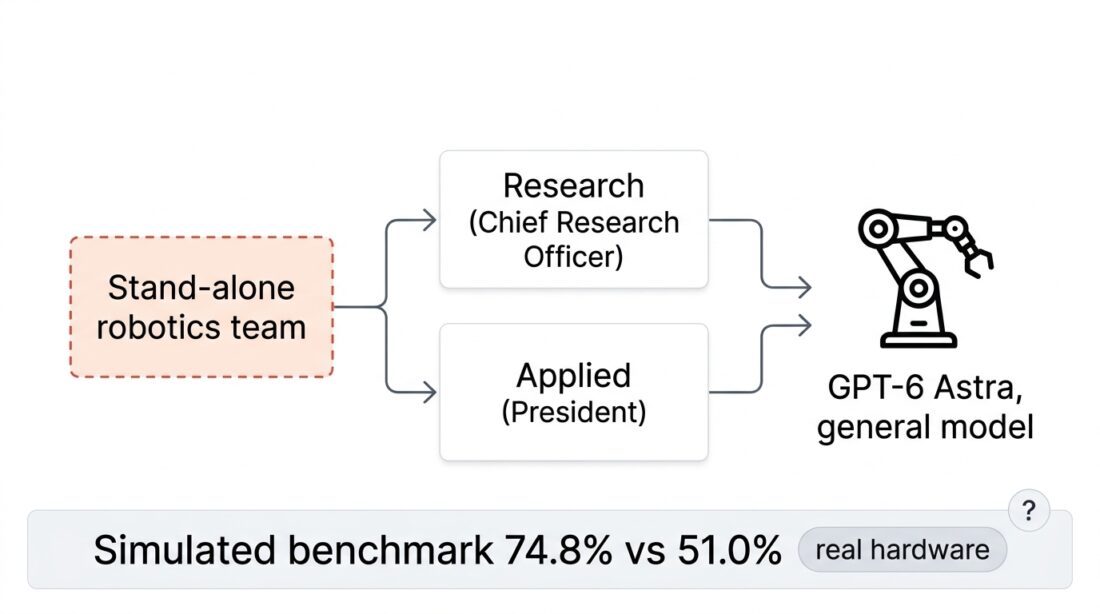
Fortune reported on November 13 that OpenAI dissolved its stand-alone robotics unit, and OpenAI confirmed it. In the OpenAI robotics team disbanded reorganization, researchers moved to the main research group under Chief Research Officer Mark Chen, and hardware and applied staff moved to the Applied group under President Greg Brockman.
OpenAI says general models such as GPT-6 Astra can now be applied to robots directly, and still targets a first humanoid demo in 2027. The supporting number is a simulated-benchmark score, not a deployed robot, so the claim is a strategy, not yet a result.
Dedicated robotics labs have long been the default way to build robot intelligence. OpenAI is now saying that default may be wrong. The OpenAI robotics team disbanded decision says what one of the best-funded AI labs expects from general models, and it arrives with no field data.
What the OpenAI Robotics Team Disbanded Move Changes
The robotics research group now sits inside OpenAI’s main research organization. The applied robotics and hardware teams now sit under Applied. OpenAI told Fortune that robotics remains central to its long-term vision and that the change is meant to speed progress, not end it.
The reasoning is a reversal. Early on, researchers assumed the best path ran through video models like Sora, which needed some implicit grasp of physical dynamics. OpenAI now says its general frontier models, GPT-6 Astra among them, can be applied directly to robotics. See our analysis where we explain why one brain for multiple robot bodies is a fixed-cost play.
| Metric | Description |
|---|---|
| 74.8% | Astra-powered agent, simulated benchmark |
| 51.0% | Best specialized robot model on that board |
| 23.8 pts | Gap (our arithmetic) |
| 2027 | First humanoid demo target |
Sources: Fortune (Nov 13, 2026) citing an Nvidia study; the gap is calculated by CreedTec. The benchmark is simulated.
The Benchmark Behind the Claim
Fortune cites an Nvidia study in which an Astra-powered agent reached 74.8% on a simulated manipulation benchmark, against 51.0% for the best specialized robotics models on the same leaderboard. Fortune’s account does not say how many tasks were run, which robots were modeled, or whether the study was independent of OpenAI.
A simulated leaderboard measures planning and instruction following, not contact, grip or recovery on a real floor. See our analysis where we explain why a headline robot-model number is not the number that matters, and what a sim-to-real accuracy claim leaves out.
Experts Read the Same Move Two Ways
CMU’s Guanya Shi told Fortune the move signals robotics is no longer a special problem
, closer to a downstream use of general intelligence. He still sees a need for smaller models that run onboard without constant connectivity. MIT’s Russ Tedrake argues robotics firms keep an edge through real-world deployment data, which becomes more valuable as foundation models improve.
Generalist’s Pete Florence said it is unclear which existing model will dominate robotics long term. Tedrake’s point is the one buyers can test: whoever holds fleet data holds the advantage. See our analysis where we explain why teleoperated robots are a data strategy, not a stopgap.
Why the OpenAI Robotics Team Disbanded Again
OpenAI wound down its first robotics team in 2020. Co-founder Wojciech Zaremba later cited limited robot data and a more efficient route to AGI through language models. OpenAI rebuilt a team in 2024 with a Figure partnership, which ended in February 2025 when Figure chose to build its own robot AI.
Cost may also play a part. Fortune reports an operating loss of $10.9 billion in the latest quarter, a funding round under way and a possible IPO in early 2027, with Sora and other efforts cut and staff told to drop “side quests”. Fortune presents these as reports. See our analysis where we explain how a hardware-agnostic robot brain reached a $10 billion valuation.
⚠️ Hypothetical scenario: A Lagos warehouse operator is pitched a picking robot “powered by the same model that runs ChatGPT”. The operations lead asks three questions: does the model run onboard if the internet drops, what is the pick success rate on the operator’s own cartons over 50 repeated runs, and who owns the fleet data. The vendor can answer only the first. The operator pilots one aisle for a quarter and ties payment to the measured pick rate.
💡 CreedTec Analyst’s Note by Daniel Ikechukwu
Strategic Impact
The OpenAI robotics team disbanded decision moves robot intelligence from a specialist lab into a general-model roadmap. For buyers, the model matters less than the data and the onboard runtime, because those decide whether it works on your floor.
Stop / Start / Watch
- Stop: treating a simulated leaderboard lead as proof of floor performance.
- Start: asking vendors for onboard-runtime behavior and fleet-data ownership terms.
- Watch: the 2027 humanoid demo, any OpenAI hardware partners, and independent hardware tests of Astra.
ROI Outlook
If general models do cut per-task training, robot deployment costs fall; if they do not, specialist data holders keep pricing power. Price pilots on measured task success, not model branding.
— Daniel Ikechukwu
Buying robots that claim a frontier AI brain?
The CreedTec Robotics Brief turns lab announcements into the pilot questions buyers should ask.
Subscribe to the Robotics Brief