Fast Facts
Physical AI in factories means robots that sense variation, adapt their movements and learn tasks from demonstration or simulation instead of following fixed programmed paths. The International Federation of Robotics (IFR) defines it as hardware and software that simulate real-world environments so robots learn through experience. IFR president Jane Heffner said on October 26: “Physical AI and that shift, that’s real now.”
The public evidence is thinner than the slogans. The ASSEMBLY episode that carried her remarks named no manufacturer deployments and gave no statistics, and the IFR expects wide adoption over five to ten years. This guide separates the layers and gives five tests to apply before buying.
Every robot vendor now says “physical AI.” The phrase covers real advances and plain relabeling. Understanding physical AI in factories starts with asking which AI technique is doing which job, because the answer decides the risk, the cost and the proof you should demand.
What Physical AI in Factories Actually Means
The IFR’s February position paper, covered by The Robot Report, lists the AI types in use. Deep learning handles vision and defect detection. Supervised learning supports inspection and predictive maintenance. Sensor fusion and SLAM guide navigation. Reinforcement learning drives grasping and adaptive control through trial and error. Generative AI can write robot code from natural language, and language processing lets robots follow spoken commands.
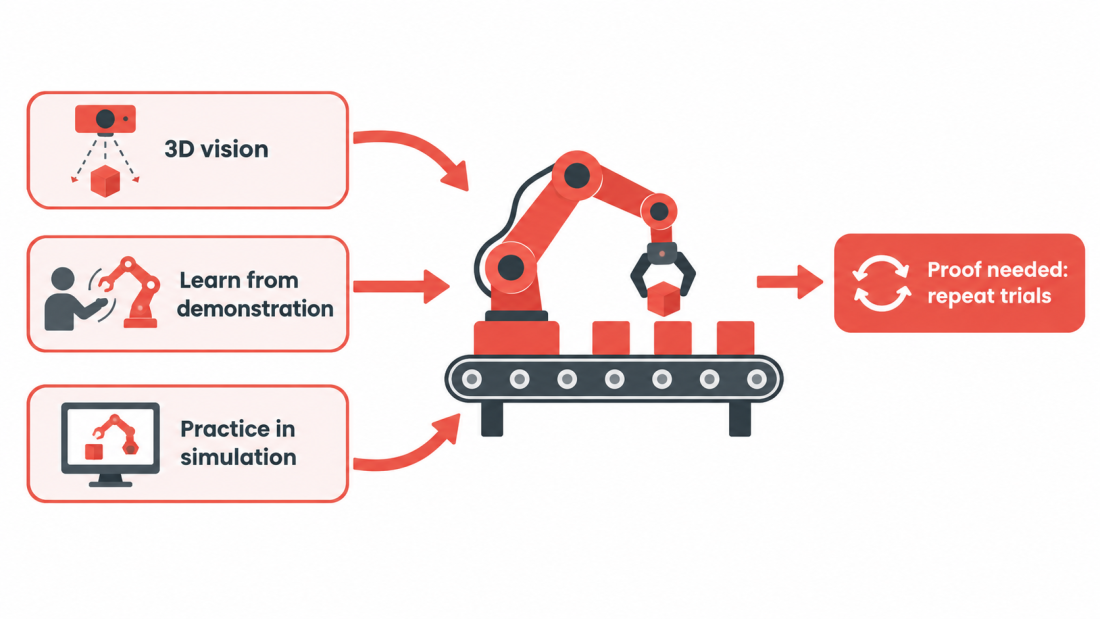
ASSEMBLY adds two practical pieces. 3D vision lets robots locate parts and correct their paths in real time, including on moving lines. Learning from demonstration uses foundation models and vision-language-action models so a robot can pick up a task from a single demonstration, not months of programming, according to Heffner.
1 demonstration vs months | 5–10 years to wide adoption
Left: Heffner’s claim in ASSEMBLY, not a measured result. Right: the IFR’s expected timeframe for wide AI adoption in robotics.
“Physical AI and that shift, that’s real now.”
— Jane Heffner, IFR President, to ASSEMBLY
Where Physical AI in Factories Helps and Where It Stalls
The clearest fit is high-mix, less structured work that used to need frequent human intervention. See our analysis where we explain why industrial robot installations hit a record 542,000 units as buyers split into two camps. The IFR’s 2026 trends list also warns that humanoids must meet industrial standards for cycle times, energy use and maintenance costs, and that AI autonomy makes testing and validation harder. It notes that black-box deep learning models are hard to explain and that liability remains legally unclear. See our analysis where we explain what humanoid robot safety standards exist and what is still draft.
Data is the other bottleneck. Generative Bionics’ CEO Lorenzo Pucci told The Robot Report that “a robot is not only vision and is not only language,” as his Genoa company plans a physical AI data factory in Italy, targeted for Q4 2027. See our analysis where we explain why teleoperated robots are a data strategy, not a stopgap.
Five Tests Before You Buy Physical AI in Factories
1. Which layer is AI? Ask whether the AI is in vision, planning, learning or code generation. A vision upgrade is a proven, narrow claim. A learning claim needs more evidence.
2. How many demonstrations, and what success rate? One demonstration is a headline. Ask for success over repeated trials, on your parts, on a shift. See our analysis where we explain how to read a humanoid robot spec sheet.
3. How much variation can it absorb? Define part pose, lighting, new product variants and what triggers retraining.
4. What is the safety case? The IFR says AI-driven systems need design and certification under ISO standards and clear liability frameworks. Ask who carries it.
5. What are the data and running costs? The IFR notes robots collect sensitive video, audio and sensor data, and that cyberattacks on controllers and cloud platforms are rising. See our analysis where we explain the robot maintenance cost model every procurement team gets wrong.
⚠️ Hypothetical scenario: A Lagos packaging plant sees a demo where a robot learns a new carton from one demonstration. On site, the warehouse lighting differs and the cartons are slightly crushed, and success drops sharply. Nobody had written a variation range into the contract. The buyer discovers that physical AI in factories is only as good as the conditions it was tested under.
💡 CreedTec Analyst’s Note by Daniel Ikechukwu
Strategic Impact
Physical AI in factories is real in vision and early in learning. The IFR expects wide adoption over five to ten years, so most 2026 purchases are bets on narrow, proven capabilities. Buyers who separate layers will avoid paying learning prices for vision features.
Stop / Start / Watch
- Stop: accepting “physical AI” as a single capability in a quote.
- Start: requiring repeat-trial success rates, variation limits and a named safety standard.
- Watch: named manufacturer deployments with published uptime, which ASSEMBLY’s episode did not provide.
ROI Outlook
The IFR promises faster ROI than non-AI systems over time but gives no figures. Model programming time saved only after validating success rates on your own parts. Treat any ROI number without trial data as a forecast.
— Daniel Ikechukwu