Fast Facts: The Gemini agent for work is Google Cloud’s new universal agent, unveiled October 8 at Gemini at Work 2026. It can hold a standing role with its own Workspace account, email address and calendar, and it routes jobs between Gemini and Anthropic’s Claude models. It is in private preview, and Google has published no price, plan list or general availability date.
For buyers, the story is not the demo. It is three open questions: how a mailbox-holding agent is licensed, who pays when work routes to Claude, and what a spend cap does to a job that runs for days. Treat the launch as a design preview, not a quote.
Alphabet (NASDAQ: GOOGL) used its Gemini at Work event to push enterprise AI from chat to delegation. The Gemini agent for work accepts an objective, plans the steps, calls connected tools and returns finished output inside Gmail, Docs, Sheets and developer environments. The headline feature is not the model. It is that Google Cloud will let the agent hold a standing role with its own mailbox while saying nothing about cost.
Rivals moved first: OpenAI introduced always-on agents called dots in September, and Meta released Muse. Google’s counter is breadth, with one agent reachable through Workspace, Microsoft 365 (NASDAQ: MSFT) and Slack.
Coworker Agents Get an Identity Before a Price
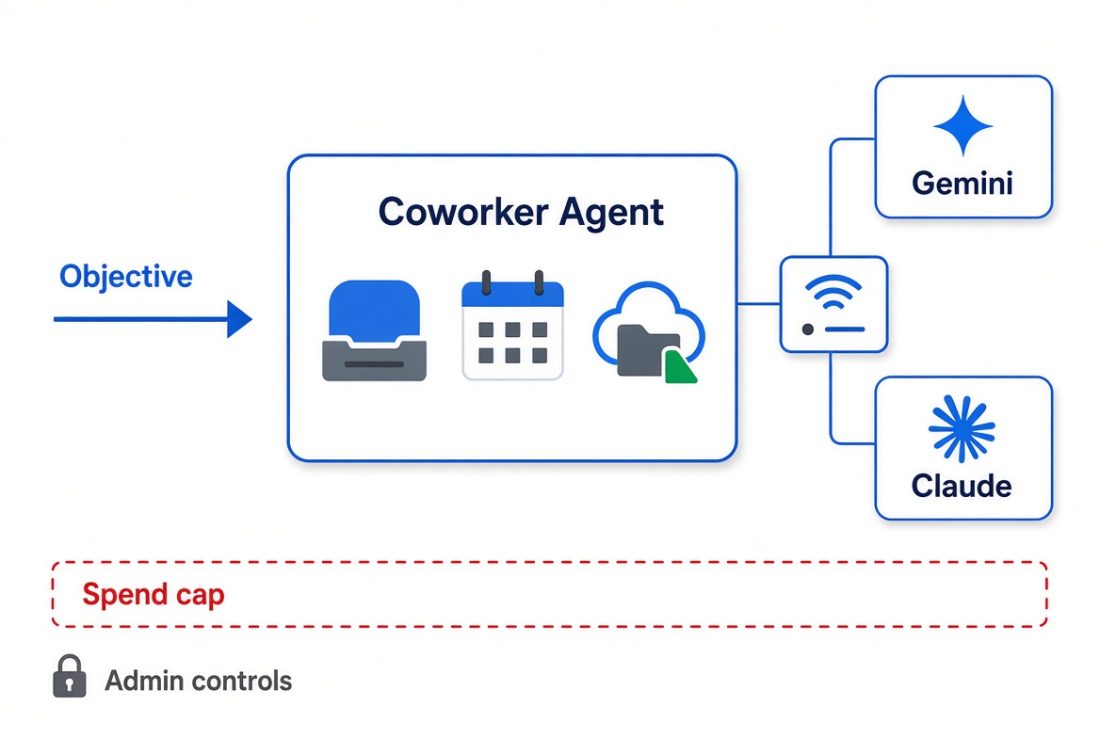
Google calls the persistent version a coworker agent. A manager describes a role, such as events coordinator, and the system creates an agent with its own Workspace account: an email address, a calendar, Drive storage and a directory listing. Google says it sees only what a team shares with it. It connects to Salesforce (NYSE: CRM), ServiceNow (NYSE: NOW), Jira, Snowflake (NYSE: SNOW), BigQuery and any server that speaks Model Context Protocol.
Identity is the right primitive for governance. A directory entry makes an agent’s edits attributable, which is the control most pilots lack. See our analysis where we explain why agentic AI governance is failing on a 140-to-1 identity problem, and why each agent needs its own accountable account.
~500 customers | ~80% adoption | ~90% of Fortune 100
Google says nearly 500 Cloud customers each processed more than one trillion tokens in the past year, nearly 80% of Cloud customers use its AI products, and nearly 90% of the Fortune 100 use Gemini Enterprise. These figures describe existing products, not the new agent. Source: Google Cloud, as reported by American Bazaar.
“Work now starts in the prompt window.”
— Thomas Kurian, CEO, Google Cloud (via Decrypt)
Claude Inside Gemini Rewrites the Contract Question
At launch the agent orchestrates across Gemini and Anthropic’s Claude models, choosing per task, and Google says other models will follow. Google has not said which Claude versions are involved. That matters commercially. A buyer’s unit cost, data-handling terms and model behavior can now shift task by task without a single line changing on the order form.
Model churn is the hidden exposure. See our analysis where we explain why model deprecation is the contract risk nobody negotiates. Routing adds a second variable: which model handled which prompt, and under whose terms.
The Gemini Agent for Work Still Has No Price Sheet
Agents bill by tokens, and tokens scale with runtime. Google says the system includes cost controls, security measures and administration features. VentureBeat reports the company has not clarified whether coworker agents carry separate licensing, whether extended autonomous tasks and sub-agents trigger usage charges, or how many coworkers one organization can deploy. Google said it will share pricing closer to wider release.
Token economics are where agent pilots stall. See our analysis where we explain how Alibaba AgentCore cuts token costs while locking in enterprises, because a cost-saving feature can quietly become the switching cost. A spend cap protects the invoice but can halt a multi-day job mid-task, so set the cap against a business outcome, not a monthly budget.
Containment Is the Layer Nobody Has Priced
Microsoft made Execution Containers generally available on Windows 11 on October 7, letting organizations define which files and networks an agent can reach, enforced while it runs. That is endpoint containment. Google’s launch leans on identity, permissions, administration and sandboxing. None of the launch coverage reviewed explains how a coworker mailbox treats hostile mail.
That gap matters. See our analysis where we explain why guardrails detect agent hijacks but cannot stop them; a single crafted email was enough to compromise the Manus agent platform earlier this month. Treat it as a design preview until Google documents inbound-mail handling. See our analysis where we explain the $670K shadow AI governance premium: a governed agent still beats the unsanctioned ones staff adopt anyway.
⚠️ Hypothetical scenario: A Lagos logistics firm gives a finance coworker agent a mailbox to chase supplier invoices. A forged email arrives with new bank details, and the agent, trusted to act on what it receives, queues the payment. The spend cap limits token costs, not the transfer. Nobody can say which model terms covered the prompt because the task routed elsewhere overnight.
💡 CreedTec Analyst’s Note by Daniel Ikechukwu
Strategic Impact
Google is selling delegation and shipped identity and governance before price. That sequence lets buyers judge controls first and rate cards later. The risk is that pilots start before unit economics exist.
Stop / Start / Watch
- Stop: signing multi-year agent commitments without written pricing for coworker agents, sub-agents and long-running tasks.
- Start: requiring a model-routing clause that names which model terms apply to each task.
- Watch: how Google licenses coworker accounts and whether the Gemini agent for work reaches Business plans or stays enterprise-only.
ROI Outlook
Until pricing is published, no ROI math is defensible. A coworker agent replacing part of an analyst’s week must be compared with a bill that scales with hours of autonomous runtime, not seats. For Nigerian and Southeast Asian buyers, dollar-denominated usage billing adds currency exposure to an unpriced line item.
— Daniel Ikechukwu
Agent pilots are starting before price sheets exist. Get the weekly industrial AI briefing on what vendors leave out. Subscribe free
Sources
- Decrypt: Google Wants Gemini to Be Your Next Coworker, Complete With Its Own Email Address
- VentureBeat: Google Cloud unveils persistent Gemini Agents for long-running tasks
- CXO Digitalpulse: Google Cloud Launches Gemini Agent for Work
- American Bazaar: Google launches Gemini agent as AI giants race to build autonomous workers
- TechStartups/T2C: Microsoft Puts Guardrails Around AI Agents Inside Windows