Fast Facts
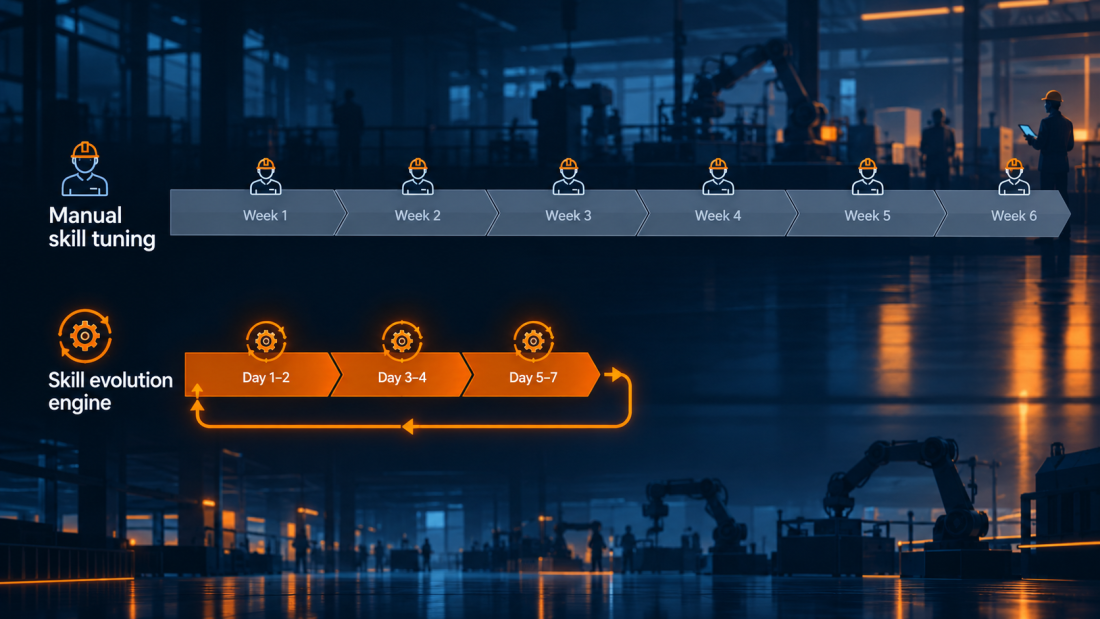
- Robot skill development is the bottleneck most factories hit after buying an industrial robot, and Shenzhen-based Lumos Robotics says its new NexCore platform cuts that process from weeks to days.
- Lumos, founded in 2024 by ex-Dreame Technology humanoid lead Yu Chao, has raised hundreds of millions of yuan across two funding rounds led by Mitsubishi Electric’s (TYO: 6503) smart manufacturing unit.
- The platform combines world models with Vision-Language-Action joint training and a Mixture-of-Experts architecture, feeding a “body-less data collection” pipeline instead of running every scenario on physical hardware first.
- Lumos already has skin in the game: a flexible-inspection system with Mitsubishi Electric has been in trials at Chinese factories since June 2025, and the company counts COSCO Shipping and JD.com (NASDAQ: JD) among its partners.
Buying an industrial robot and getting useful work out of it are two different purchases. The gap between them is robot skill development — the weeks of custom engineering it typically takes to get a delivered robot reliably performing one specific factory task. Shenzhen-based Lumos Robotics launched a platform this week aimed squarely at that gap, claiming it cuts the process to days.
What Lumos NexCore Actually Does
Lumos NexCore is described by the company as a “skill evolution engine” — software that sits between a general embodied-AI model and a specific factory task, handling the last-mile tuning that normally requires an in-house AI engineering team. Under the hood, it combines world models with Vision-Language-Action joint training, an industrial visual-attention layer, and a Mixture-of-Experts architecture built for efficient deployment rather than raw capability. The goal is robot skill development that doesn’t require a customer to build its own robotics research team just to get a delivered machine doing something useful.
The Data Problem Underneath the Pitch
Every embodied-AI platform promising faster robot skill development eventually runs into the same wall: robots don’t have an internet-scale dataset the way language models do. Lumos’s answer is what it calls “body-less data collection,” gathering training signal without running the physical robot through every scenario, feeding a data-model flywheel the company says accelerates how fast a new skill can be verified and deployed.
Robots already running on the NexCore engine feed data back into the system continuously, which is the mechanism actually doing the work behind the weeks-to-days claim — see our analysis where we explain how generative AI is being used to self-generate the training data physical robots still can’t collect fast enough on their own. Lumos isn’t the only vendor treating data collection as the real product here — see our analysis where we explain why teleoperated robots are best understood as a data strategy, not a stopgap, for exactly this reason.
📊 The Numbers That Matter
- 2024 — year Lumos Robotics was founded, by Yu Chao (ex-Dreame Technology humanoid lead)
- Hundreds of millions of yuan — combined A1/A2 funding, led by Mitsubishi Electric
- June 2025 — Mitsubishi Electric partnership began, already in factory trials in China
- Weeks → days — claimed reduction in new robotic skill development time
- 2 — flagship product lines (LUS and MOS series), plus joint modules and grippers
⚠️ Fictional scenario: A contract electronics manufacturer in Suzhou buys a mobile-manipulation robot to handle flexible quality inspection across three circuit-board lines. Under the old workflow, its automation team spends six weeks per line hand-tuning vision models and grip parameters before the robot hits acceptable accuracy. With a skill-evolution layer handling the last-mile tuning automatically, the same rollout compresses to a few days per line, freeing the team to move on to the next line instead of re-solving the same integration problem three times over.
Why the Backers Matter More Than the Software
Mitsubishi Electric’s (TYO: 6503) smart manufacturing unit didn’t just invest in Lumos — it led both funding rounds and has been running a joint flexible-inspection system on Chinese factory floors since June 2025, which is a stronger signal than any benchmark Lumos could publish itself. COSCO Shipping and JD.com (NASDAQ: JD) round out a customer list built around structured industrial settings rather than open demos, the same pattern seen in how leading humanoid mass-production plans in China increasingly hinge on named factory partners rather than headline unit counts — see our analysis where we explain how China’s humanoid robot mass-production race is really being decided by procurement contracts, not press releases.
The Procurement Read
For a buyer comparing embodied-AI platforms, the number that matters isn’t the funding total or the technical acronym stack — it’s whether robot skill development on a given platform has already survived a paying customer’s factory floor, the way Mitsubishi Electric’s inspection system has.
Platforms selling a general-purpose “one brain” story deserve the same scrutiny applied to any fixed-cost amortization pitch — see our analysis where we explain why the “one brain, multiple embodiments” framing is really about spreading R&D cost across customers, not proven versatility. The same logic applies to any vendor claiming a headless deployment model without published integration timelines — see our analysis where we explain what’s actually required to get a robot running on a factory floor without a dedicated on-site engineering team.
Quick Questions
What is Lumos NexCore?
A “skill evolution engine” from Shenzhen-based Lumos Robotics designed to shorten how long robot skill development takes for a deployed industrial robot — from roughly weeks to days, according to the company.
Who backs Lumos Robotics?
Mitsubishi Electric’s smart manufacturing unit led both of the company’s A1 and A2 funding rounds; COSCO Shipping and JD.com are also named industrial partners.
Has the technology been tested outside the lab?
Yes — a joint flexible-inspection system with Mitsubishi Electric has been running trials in Chinese factories since June 2025, ahead of NexCore’s public launch.
💡 CreedTec Analyst’s Note by Daniel Ikechukwu
Strategic Impact: The real bottleneck in industrial robotics adoption has shifted from hardware to the software layer that turns a delivered robot into a useful one, and Lumos is one of a growing number of vendors building specifically for that gap rather than for the robot itself.
Stop
- Evaluating an embodied-AI platform primarily on its model architecture buzzwords (world models, MoE, VLA) without asking for a deployed customer reference.
Start
- Asking any robot skill development vendor for a named factory partner and a timeline, the way Mitsubishi Electric’s 2025 trial gives Lumos.
Watch
- Whether Lumos publishes concrete before/after timelines from its Mitsubishi deployment, or keeps the “weeks to days” claim at the marketing level.
ROI Outlook: A platform that genuinely compresses robot skill development timelines shifts cost from a company’s own AI engineering headcount to a vendor’s platform fee — a good trade if the vendor’s claims hold up against a real factory floor, and an expensive lesson if they don’t.
— Daniel Ikechukwu
Sources
- Gasgoo — Lumos Robotics Unveils Next-Generation Embodied AI Development Platform
- Gasgoo — Lumos Robotics Completes a Financing Round of Several Hundred Million Yuan
- Dealroom — Luming Robotics Technology Company Profile
- World Robot Conference — Lumos Robotics Technology Exhibitor Profile
- Robotics & Automation News — Lumos Robotics Launches New Simulation Environment