Fast Facts
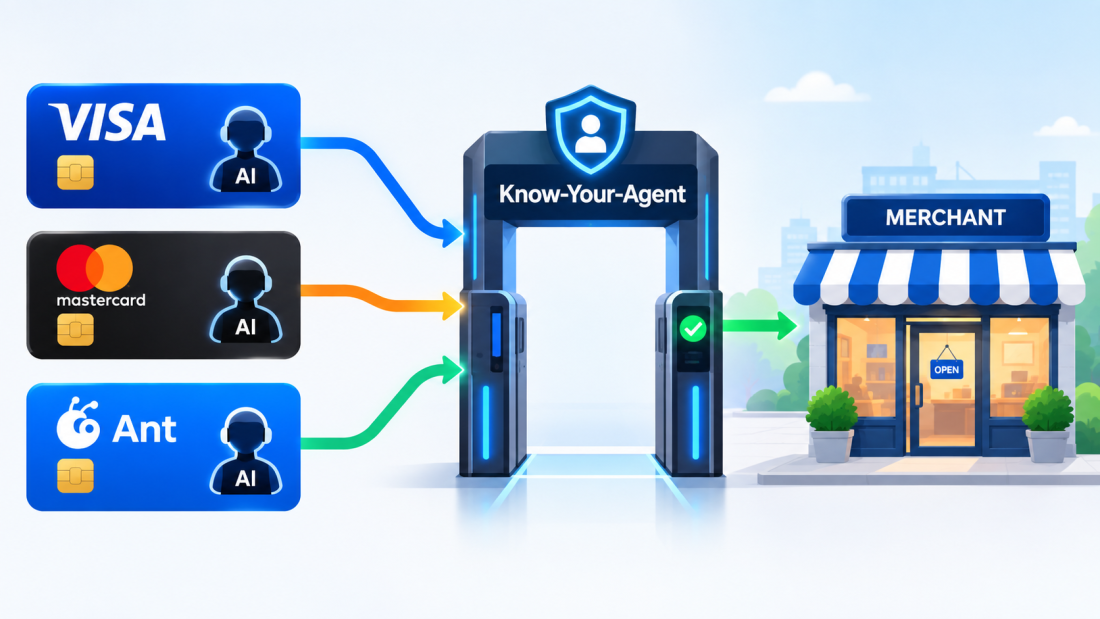
Visa, Mastercard, and Ant International announced on September 9, 2026 that they will align their three separate AI-agent verification systems, Visa’s Trusted Agent Protocol, Mastercard’s Verifiable Intent, and Ant’s Agentic Mobile Protocol, into a shared Know-Your-Agent framework. AI agents are projected to orchestrate $3 trillion to $5 trillion in global consumer commerce by 2030. The announcement describes a framework under development, not a technical standard already deployed across any of the three networks.
The Know-Your-Agent framework just gave the card networks a shared name for a problem each of them had already started solving separately, and separately was becoming the problem. Ant International, Mastercard, and Visa announced their collaboration in São Paulo on September 9, 2026, aiming to help card networks, digital wallets, agent platforms, and marketplaces recognize trusted AI agents across previously incompatible systems, according to the companies’ joint announcement. Each network will continue applying its own verification and decision-making process underneath the shared framework.
Three Protocols Built Before the Problem Had a Name
Each company had already shipped its own answer to a question nobody had agreed on terminology for yet. Visa introduced its Trusted Agent Protocol to pass identity and purchase-intent information from approved agents to merchants, Mastercard built Verifiable Intent to carry evidence that an agent is acting within a user’s actual instructions, and Ant International launched its open-source Agentic Mobile Protocol in April, already piloting with both companies, according to TechNode Global’s coverage. The Know-Your-Agent framework exists specifically because a developer building one shopping agent previously had to integrate with all three separately, a real cost multiplying across every agent platform trying to reach global commerce.
$3-5 trillion — projected global consumer commerce orchestrated by AI agents by 2030.
3 — separate proprietary agent-verification protocols the Know-Your-Agent framework aims to make interoperable.
Interoperability across Know-Your-Agent frameworks is essential to making agentic commerce work at scale.— Pablo Fourez, Chief Digital Officer, Mastercard
What “Announced” Doesn’t Mean Yet
The most important sentence in this story isn’t in most of the headlines covering it: this is a framework under development, not a technical standard already deployed across the three payment networks, according to TechNode Global’s reporting. The Know-Your-Agent framework targets cross-network operator traceability, shared certification requirements, and continuous transaction monitoring, but bridging three genuinely distinct proprietary protocols is described by outside analysts as the hard part still ahead, not a solved technical problem being formally ratified. See our analysis where we explain why Cloudflare’s AI agent payment infrastructure is arriving faster than the governance around it.
⚠ Fiction — illustrative scenario: A merchant’s engineering team reads the Know-Your-Agent announcement and deprioritizes a planned integration with a fourth, smaller agent-identity vendor, assuming the new tri-party framework will cover every agent that matters within the quarter. Six months later, the framework is still in working-group development, unpublished as a technical spec, and the merchant is turning away legitimate agent traffic it could have accepted through the smaller vendor’s already-shipping integration. The framework wasn’t a false promise. It just wasn’t a shipped product yet.
Why the Companies Are Moving Now, Not Later
AI agents are evolving from making recommendations to completing purchases on a user’s behalf, and that shift is what makes the Know-Your-Agent framework urgent rather than aspirational: unverified automated purchases introduce real chargeback and fraud exposure for merchants who can’t yet tell a trusted shopping agent from a malicious scraper, according to ITDigest’s analysis. The three companies plan to work through BuildFin.ai, a platform convened by the Monetary Authority of Singapore, giving the Know-Your-Agent framework a neutral venue rather than housing it inside any single company’s infrastructure. See our related coverage of why AI agent permission sprawl is the industry’s real blind spot.
Global Implications
For merchants and platforms outside the US, Europe, and China, where these three networks concentrate most of their volume, a working Know-Your-Agent framework would matter disproportionately, since smaller markets typically lack the scale to negotiate custom agent-verification integrations with any single network on their own. See our analysis of why agentic AI governance is losing the identity race entirely and why chain-of-thought monitorability is declining right as agentic AI accelerates.
💡 CreedTec Analyst’s Note — Daniel Ikechukwu
Strategic Impact: The Know-Your-Agent framework signals that three of the world’s largest payment networks now agree agent identity verification needs a shared standard, but agreement on the need is not the same as a shipped technical specification.
- Stop: Deprioritizing existing agent-verification integrations on the assumption that the Know-Your-Agent framework will be production-ready within the next quarter.
- Start: Tracking BuildFin.ai’s working-group output for the first published technical specification, which is the real signal that this moves from agreement to deployment.
- Watch: Whether other major networks or wallet ecosystems outside Visa, Mastercard, and Ant join the Know-Your-Agent framework, which would strengthen its claim to becoming a true industry standard.
ROI Outlook: Merchants who build against open, documented agent-verification standards as they publish will adapt faster than those waiting for the full Know-Your-Agent framework to finalize before making any integration decisions.
Can merchants use the Know-Your-Agent framework to verify AI shopping agents today?
Not yet as a unified system. Each company’s individual protocol, Visa’s Trusted Agent Protocol, Mastercard’s Verifiable Intent, and Ant’s Agentic Mobile Protocol, is already live or in pilot, but the interoperable Know-Your-Agent framework connecting all three is still under development.
The Know-Your-Agent framework is a genuine signal that the payments industry has stopped treating AI shopping agents as a future problem. Whether it becomes real infrastructure or another well-intentioned working group depends entirely on what BuildFin.ai actually publishes next, not on this week’s announcement.
Get CreedTec’s next AI infrastructure briefing before your next agent-commerce integration decision.
Subscribe free
Sources
- Business Wire, “Ant International, Mastercard and Visa Initiate Collaboration on Know-Your-Agent Interoperability,” September 2026
- TechNode Global, “Ant, Mastercard and Visa develop KYA framework,” September 2026
- Forkast, “Ant International, Visa, and Mastercard Agree on Agent Identity Standard. Now Comes the Hard Part,” September 2026
- ITDigest, “Ant International, Mastercard, and Visa Unveil Know-Your-Agent Interoperability Framework,” September 2026
- PYMNTS, “Visa and Mastercard Team With Ant on Know Your Agent Framework,” September 2026