Fast Facts
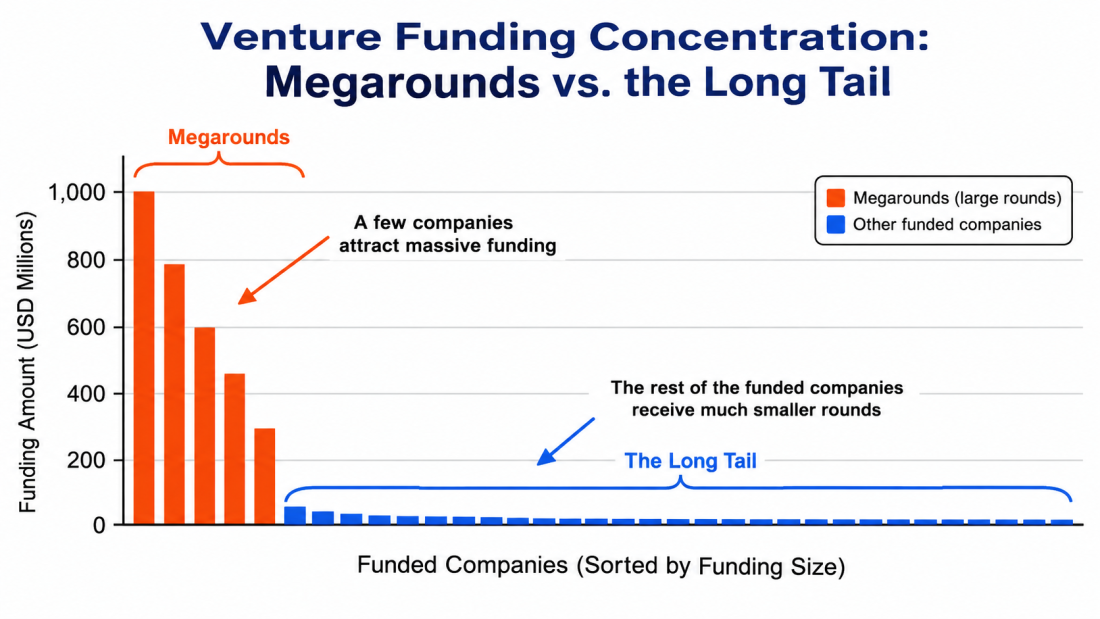
Pure-play industrial robotics companies raised $1.56 billion over the past 24 months, but the top five deals captured 80.58% of that capital. Strip out rounds above $50 million and disclosed funding drops to $151.75 million, revealing that most industrial robotics companies are competing for a fraction of the money the headline number suggests.
Industrial robotics funding looks abundant until you look at who’s actually getting it. Between August 2024 and July 2026, pure-play industrial robotics companies raised $1.56 billion in disclosed capital across 19 equity deals and 16 unique companies, according to a New Market Pitch funding analysis. The top deal alone represents 31.97% of that total. The top five deals together account for 80.58%.
What the Headline Number Hides
Remove rounds above $50 million from the dataset and disclosed capital falls from $1.56 billion to $151.75 million, according to the same analysis. That’s the real size of the market most industrial robotics companies are actually competing in. Industrial robotics funding at the top end is now dominated by a handful of platform bets large enough to make headlines on their own, while everyone else is raising within a much smaller, much more competitive band.
80.58% — share of disclosed industrial robotics funding captured by the top 5 deals over 24 months.
$151.75 million — total disclosed capital remaining once rounds above $50 million are excluded.
Capital is not moving toward early-stage experimentation.— New Market Pitch, Industrial Robotics Funding Trends, 2026
Why Investors Are Chasing Fewer, Bigger Bets
Follow-on rounds represented about 69% of deals and roughly 96% of capital in 2024, a maturity signal that shows investors reinforcing existing bets rather than backing new entrants. Mind Robotics illustrates the pattern directly: founded in 2025 by former Rivian executive RJ Scaringe, the company raised a $115 million seed round before closing a $500 million Series A co-led by Accel and Andreessen Horowitz, according to Business Wire’s coverage of the round. Industrial robotics funding of that size buys manufacturing capacity, field deployment teams, and integration support that a smaller, earlier-stage company simply can’t match on a $10 million seed round. See our analysis where we explain why the AI memory shortage is squeezing every buyer outside the largest contracts.
⚠ Fiction — illustrative scenario: A small industrial robotics startup pitches investors on strong pilot results and a clear path to revenue. The feedback is consistent: promising, but the check size they need doesn’t match what the fund typically writes anymore. The fund’s last three robotics investments were all follow-ons into companies already past $100 million raised. The pilot results were never really in question. The round size was.
What This Means for Smaller Vendors and Buyers
For buyers evaluating robotics vendors, funding size has become a rough proxy for staying power, fairly or not. A vendor sitting inside that $151.75 million pool of non-megaround industrial robotics funding faces real pressure to reach profitability faster, since a large follow-on round is statistically less likely than it was three years ago. That pressure can show up as service cuts or slower support response once a smaller vendor’s runway tightens. See our related coverage of why nobody can agree on the actual size of the industrial AI market and why zombie AI projects cost more than outright failures.
💡 CreedTec Analyst’s Note — Daniel Ikechukwu
Strategic Impact: Industrial robotics funding concentration means vendor selection now carries real financial due diligence, not just a technology evaluation.
- Stop: Assuming every well-known robotics vendor has comparable financial runway just because the sector’s total funding number looks large.
- Start: Asking smaller vendors directly about their last funding round size and date before signing a multi-year service contract.
- Watch: Whether 2026’s full-year data shows funding concentration deepening further, or whether more mid-sized rounds emerge as megaround companies mature into revenue.
ROI Outlook: Vendors backed by megarounds carry lower shutdown risk but less pricing flexibility. Smaller, leaner vendors may offer better terms but need closer financial monitoring over a multi-year contract.
Should buyers avoid smaller, less-funded robotics vendors entirely?
Not necessarily, but treat funding history as part of vendor risk assessment. Ask about runway and recent funding activity before committing to a long-term service agreement, especially with a vendor outside the top-funded tier.
Industrial robotics funding is real, and the sector’s growth is not a mirage. But the $1.56 billion headline number describes a market where a handful of companies are absorbing most of the capital, and everyone else is competing for what’s left.
Get CreedTec’s next industrial robotics vendor risk briefing before your next contract renewal.
Subscribe free
Sources
- New Market Pitch, “Industrial Robotics Startup Funding (2026),” July 2026
- New Market Pitch, “Industrial Robotics Funding Trends (2026),” July 2026
- Business Wire, “Mind Robotics Announces $500M Financing,” March 2026
- Crunchbase News, “Robotics Startups On Fire As Venture Funding Surges To Record Numbers In 2026,” June 2026