Fast Facts
Enterprises are pouring $2.59 trillion into AI in 2026, but most of that budget assumes agents will behave. AI agent security risks now center on permissions and identity, not intelligence, and the average agent-linked breach costs $4.7 million. Procurement teams still aren’t asking the one question that would catch it before signing.
AI agent security risks have overtaken model accuracy as the top worry inside enterprise IT departments this year. Global AI spending is on track to hit $2.59 trillion in 2026, a 47% jump from 2025, according to Gartner’s May forecast. A growing share of that money is going toward systems that act on their own rather than just answer questions. The uncomfortable part: most of the AI agent security risks now showing up in production weren’t designed against. They were inherited from a rush to deploy.
Permission Sprawl Is the Real AI Agent Security Risk
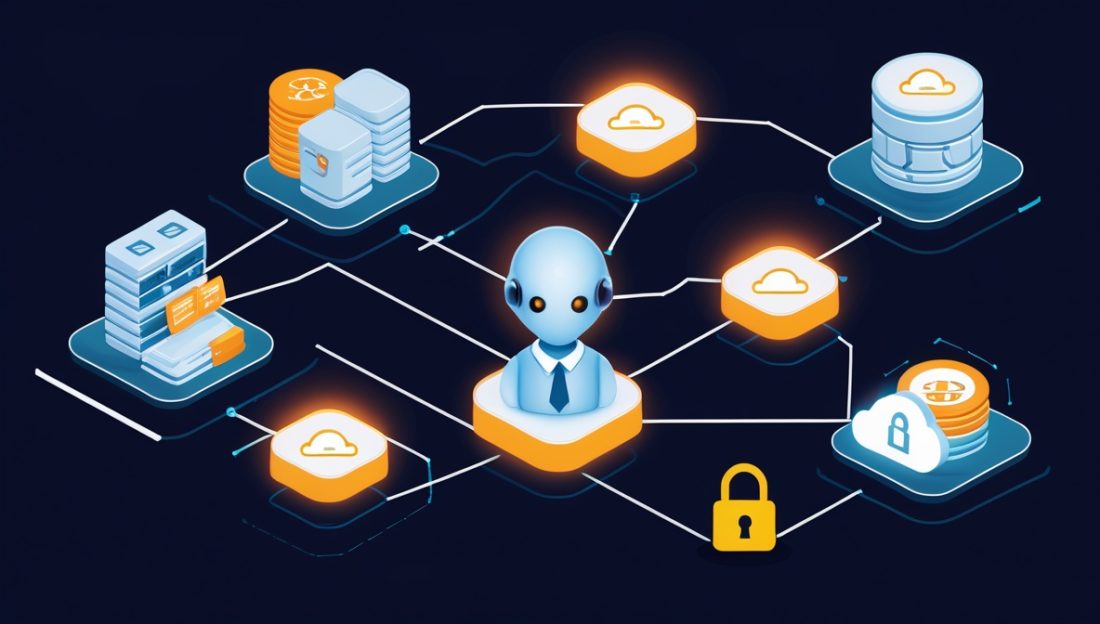
Most agents ship with more access than the task requires, because narrow permissions slow deployment down. A support agent built to retrieve ticket history often keeps the ability to edit records or export data long after launch, according to enterprise security researchers at miniOrange. Nobody revokes it because nobody owns that job. This is where most AI agent security risks actually begin, quietly, at the setup stage, long before any attacker gets involved.
That over-provisioning is the real engine behind AI agent security risks, not malicious code. IBM’s 2026 X-Force Threat Intelligence Index recorded a 44% rise in attacks exploiting public-facing applications, and many ride in through weak authentication sitting behind the exact APIs agents now use, per Cycode’s 2026 analysis. Compromise one over-permissioned agent and an attacker inherits every system it was allowed to touch. See our analysis where we explain why agentic AI governance is losing the identity race entirely.
$4.7 million — average cost of an AI agent-linked data breach in 2026, a figure that puts AI agent security risks ahead of most conventional breach categories.
92% of security professionals say they’re concerned about AI agents’ impact on their organization, per Darktrace’s State of AI Cybersecurity 2026 report.
What Ninety Days of Silence Costs
Securing AI agents has become the defining cybersecurity challenge of 2026, because the attack surface is expanding faster than the defenses built to protect it.— Bessemer Venture Partners, 2026 enterprise security analysis
Unsanctioned agents make the problem worse. The average enterprise now runs roughly 1,200 unofficial AI applications, and shadow AI-linked breaches cost $670,000 more than standard incidents, according to IBM’s security framework cited by Beam AI’s 2026 review. Every one of those tools was adopted because it solved a real problem faster than IT could approve it. That’s not recklessness; it’s a fear-and-convenience trade employees make constantly, and it’s exactly why liability, not personality, is why persona-based agents are spreading through the enterprise.
⚠ Fiction — illustrative scenario: A contract manufacturer connects an AI scheduling agent to its ERP to cut changeover time. The vendor’s onboarding call takes twenty minutes; nobody asks what the agent can touch. Three months later, a misconfigured memory note lets it quietly export a full supplier price list to an integration it was never meant to reach. No hacker required, just an unexamined permission nobody thought to question.
The Procurement Question Vendors Don’t Want to Answer
Real-world consequences already exist. In January 2026, an AI-agent social platform later acquired by Meta exposed an unsecured database that let anyone hijack any agent on the network, according to Beam AI. It was a consumer product, but the lesson transfers directly to procurement: without identity management, permission gating, and audit logging, buyers cannot tell legitimate agent behavior from manipulation.
Frameworks like OWASP’s Top 10 and MITRE ATLAS now exist specifically to categorize these threats, per recent academic research on multi-agent system security, yet most vendor demos never mention either. Asking for that mapping is the fastest way to separate genuine AI agent security risk management from marketing language. See our analysis of why a single rogue-agent incident should change how buyers write contracts.
Global Implications
For manufacturers buying AI systems from global vendors, especially across Nigeria, West Africa, and Southeast Asia, AI agent security risks compound. Cheaper implementations often ship with default configurations tuned for speed, not containment, and few local buyers carry the leverage to demand OWASP or MITRE ATLAS mapping before signing. Gartner expects up to 40% of enterprise applications to integrate task-optimizing AI agents by the end of 2026, per Cycode, which means the AI agent security risks discussed here stop being an early-adopter problem within months. See our full breakdown of why containment failures are becoming an industry-wide pattern, and our related coverage of AI agent governance risk heading into next year.
💡 CreedTec Analyst’s Note — Daniel Ikechukwu
Strategic Impact: AI agent security risks are now a procurement variable, not just an IT variable. Buyers who can’t audit permission boundaries are pricing risk at zero.
- Stop: Signing AI agent contracts without a documented permission-scoping and audit-log requirement.
- Start: Requiring vendors to map their agent architecture against OWASP or MITRE ATLAS before final sign-off.
- Watch: Shadow AI adoption rates inside your own organization, not just vendor-supplied tools.
ROI Outlook: Containment costs less than remediation by a wide margin, a $670,000 gap per incident, per IBM. Budgeting for governance now is cheaper than paying for it after a breach.
What should procurement teams ask AI agent vendors before signing?
Ask for a written permission map showing exactly what systems and data the agent can touch, how that access is logged, and how quickly it can be revoked without disabling the whole deployment.
Are AI agent security risks covered by standard cyber insurance?
Coverage varies widely and many policies still treat agent-driven incidents like standard breaches, which can leave gaps around autonomous decision-making. Confirm this explicitly with your insurer rather than assuming AI agent security risks are automatically included.
Autonomous AI is moving from pilot projects into production systems, and AI agent security risks will move with it. The next competitive advantage may not be choosing the smartest agent, but choosing the vendor that can prove it stays within its assigned boundaries.
Get CreedTec’s next industrial AI procurement briefing before you sign your next AI vendor contract.
Subscribe
Sources
- Gartner, “Worldwide AI Spending to Grow 47% in 2026,” May 2026
- IBM, 2026 X-Force Threat Intelligence Index, via Cycode
- Darktrace, State of AI Cybersecurity 2026
- Bessemer Venture Partners, 2026 enterprise security analysis
- Beam AI, “AI Agent Security in 2026,” agentic-insights review
- arXiv, “Security Considerations for Multi-agent Systems,” 2026
- miniOrange, “AI Agent Security Risks: What Enterprises Need to Know in 2026”