Fast Facts
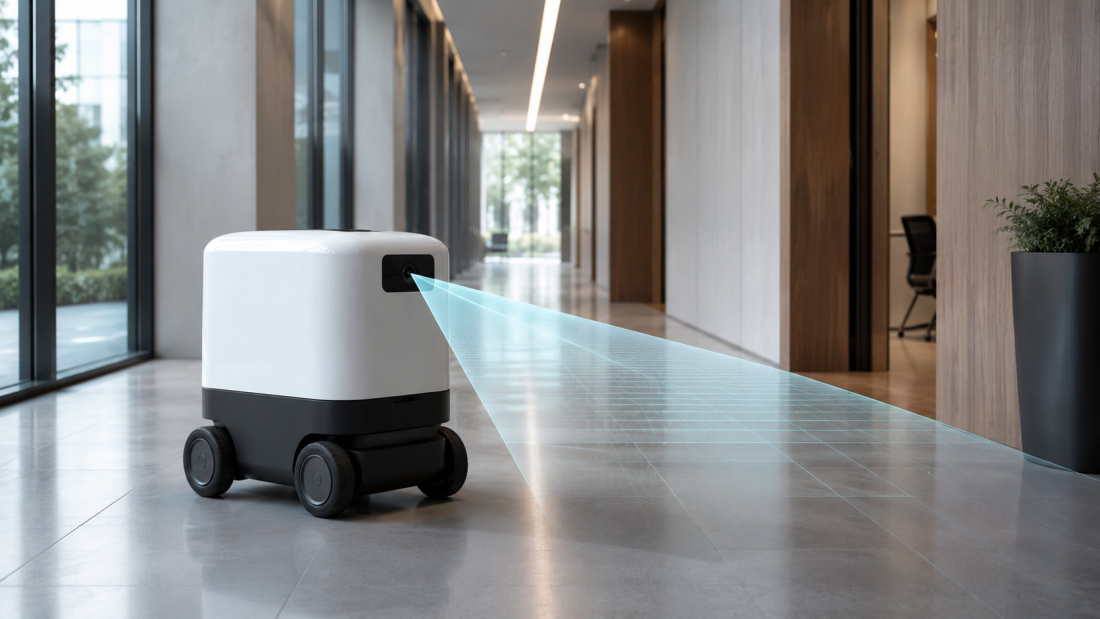
Robostral Navigate just questioned why robots need LiDAR at all. On July 8, 2026, Mistral AI released Robostral Navigate, an 8-billion-parameter embodied navigation model trained entirely in simulation, using only a single RGB camera — no depth sensor, no LiDAR. It scored 76.6% on the R2R-CE validation-unseen benchmark, beating the best depth or multi-camera system by 4.5 points. If that holds outside simulation, it removes a real line item from every mobile robot’s bill of materials.
- 76.6% — success rate on R2R-CE validation-unseen, single camera only
- +4.5 points — margin over the best depth or multi-camera navigation system
- +9.7 points — margin over the best prior single-camera system
- ~400,000 trajectories / 6,000 scenes — entirely simulated training data behind the model
- 22x — reduction in training token consumption from Mistral’s prefix-caching method
How Robostral Navigate Achieves Single-Camera Robot Navigation
Robostral Navigate uses only one ordinary RGB camera and no depth sensors, yet still achieves 76.6% on R2R-CE validation unseen — the benchmark for following language instructions in environments the model has never seen. Give it an instruction like “leave the lobby, walk through the corridor, enter the supply room, and stop to face the second shelf,” and it moves the robot on its own, generalizing across wheeled, legged, and flying platforms.
“Robostral Navigate demonstrates that state-of-the-art embodied navigation can be achieved with a compact model and a single RGB camera.” — Mistral AI
The Financial Impact: Eliminating LiDAR Sensors from AMR Fleets
Mobile robotics has operated for years on an assumption: vision alone is too fragile, so you add depth sensors, LiDAR, and multiple cameras as insurance against failure. Every one of those sensors is a line item multiplied across a fleet. A result like this argues a well-trained policy on a plain camera can close, and in this benchmark exceed, the multi-sensor gap — changing the bill of materials for a lot of warehouse and facility robots, if it holds up outside simulation.
Training Robostral Navigate: Prefix-Caching & Reinforcement Learning
Training a navigation model on 400,000 trajectories across 6,000 scenes would normally take months of compute. A prefix-caching method compressed each training episode into a single sequence, reducing token use 22x versus treating each timestep separately — collapsing training time from months to days. A subsequent reinforcement learning stage added another 3.2 percentage points, with Mistral describing the curve as still climbing, not plateaued, at launch.
⚠ Illustrative scenario (fictional): A warehouse robotics vendor budgets for a LiDAR-equipped navigation stack across a 200-unit fleet, treating the sensor cost as non-negotiable insurance. A camera-only navigation model matching or exceeding that performance would eliminate that line item entirely — assuming, critically, that simulation results transfer cleanly to the vendor’s actual warehouse conditions.
The Simulation-to-Deployment Gap in Vision-Language-Action Models
Every number in this story comes from a simulation benchmark. As one outlet covering the release put it, “the honest caveat is that these are simulation numbers” — R2R-CE tests generalization to unseen simulated environments, not a live warehouse with unpredictable lighting, moving people, and clutter a simulator never modeled. That’s the same benchmark-versus-deployment gap that has tripped up other vision-language-action models before, regardless of how impressive the underlying number is.
Global Implications: Cheaper Navigation Travels Well
Hardware-agnostic, single-camera navigation is precisely the kind of cost reduction that matters most in markets where a full LiDAR-equipped sensor stack was never affordable. If Robostral Navigate’s real-world performance approaches its simulation numbers, it lowers the entry cost for mobile robotics in exactly the environments — smaller warehouses, mixed-use facilities across Africa and Southeast Asia — where the multi-sensor version of this technology was priced out of reach.
💡 CreedTec Analyst’s Note — Daniel Ikechukwu
Strategic Impact: A camera-only navigation model matching multi-sensor systems would materially lower the hardware cost floor for mobile robotics fleets.
Stop: Assuming multi-sensor redundancy is a fixed, non-negotiable cost of reliable robot navigation.
Start: Tracking real-world validation of camera-only navigation before redesigning fleet hardware specs around simulation results alone.
Watch: Whether Mistral or independent researchers publish physical deployment results beyond the R2R-CE simulation benchmark.
ROI Outlook: Promising for future fleet cost reduction; premature to remove sensors from current deployments based on simulation results alone.
A benchmark number is a promise, not a delivery. Subscribe to CreedTec’s newsletter for the simulation-to-deployment gap vendors don’t lead with.
Further reading on CreedTec:
MIT’s SceneSmith Attacks the Cost Nobody Talks About in Robot Training · NVIDIA Isaac GR00T’s Headline Number Isn’t the Number That Matters · Robot Simulation Training Scene Assets · The Physics Simulation Bottleneck · Why Photorealistic Digital Twins Cut Robotics Training Costs