Fast Facts
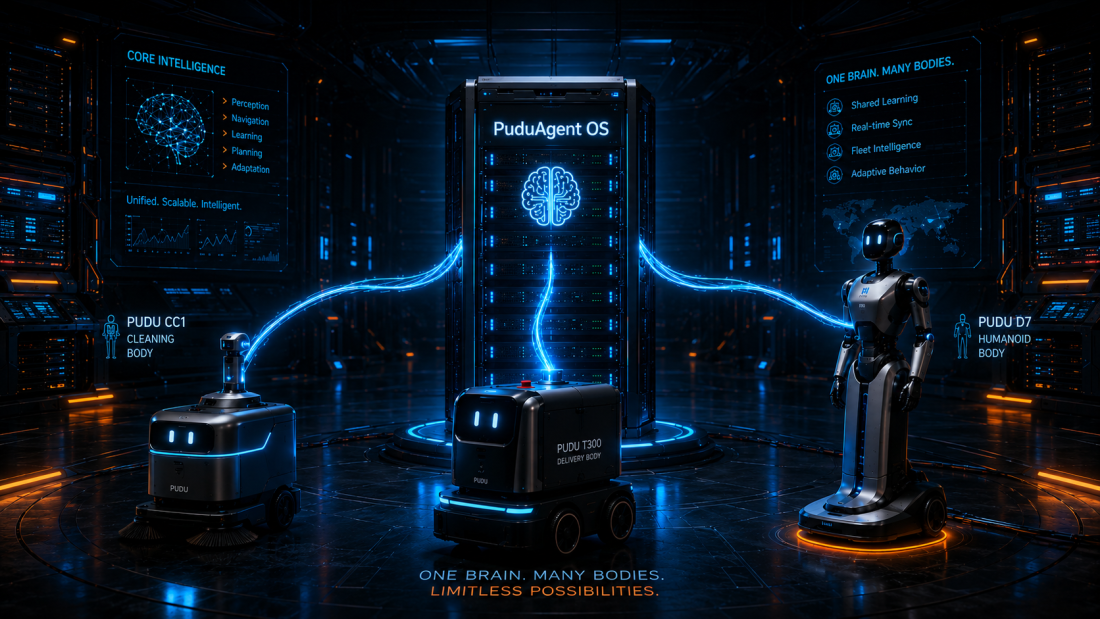
“One brain, multiple embodiments” is really a fixed-cost amortization play. At WAIC 2026 in Shanghai, Pudu Robotics showcased its “One Brain, Multiple Embodiments” architecture — a single AI system, PuduAgent OS, driving cleaning robots, delivery robots, a new semi-humanoid, and future humanoids off one foundation model. The elegant framing is technical. The real driver is financial: one expensive-to-train brain spread across an entire product line beats building a separate control system for every robot body.
- #1 globally — Pudu Robotics’ ranking in both revenue and shipment volume for commercial service robots
- 3 — robot form factors sharing one foundation model: specialized, semi-humanoid, humanoid
- PUDU D7 — the industrial-grade semi-humanoid shown publicly for the first time at WAIC 2026
- July 2026 — announcement timing, at the World Artificial Intelligence Conference, Shanghai
The Architecture Behind the Buzzword
Pudu’s PuduAgent OS connects models, skills, and robot bodies through a shared intelligence layer, using vision-language models, memory modules, and safety guardrails so different robot forms reuse the same underlying capabilities. Specialized robots handle high-frequency, standardized tasks; semi-humanoids like the new PUDU D7 operate in complex industrial settings; humanoids handle open-ended collaboration. One brain, three very different jobs.
“The industry’s next challenge is no longer developing more capable AI models, but building a continuous loop that connects technology, products, commercial deployment, and real-world data.” — Pudu Robotics, WAIC 2026 briefing
Why This Is a Balance Sheet Decision, Not Just an Engineering One
Training a capable foundation model for robot control is the expensive, fixed part of the equation — data collection, simulation infrastructure, and compute don’t get cheaper because you’re building a second product line. Academic researchers describe building a foundation model for “One Brain, Multiple Embodiments” as a core open challenge in robotics, not a solved problem — meaning Pudu is betting resources on exactly the frontier where the payoff, if it works, is spreading that fixed cost across every robot it sells rather than paying it per product line.
The Fear This Architecture Is Designed to Remove
Buyers evaluating robotics investments face real decision paralysis: commit to a mobile-base cleaning robot today, and a change in floor plan or task scope next year can strand that investment. A shared-brain architecture is a hedge against that fear — the same underlying intelligence, in theory, migrates to a different body if the task changes, without retraining a model from zero. Whether that promise holds in practice is the open question, but the incentive to solve it is squarely financial.
⚠ Illustrative scenario (fictional): A logistics warehouse buys a fleet of wheeled delivery robots, then later needs a semi-humanoid for a task requiring manipulation the wheeled units can’t perform. Under a one-brain architecture, the new robot could inherit navigation and safety behaviors already proven on the existing fleet, rather than starting the deployment learning curve over from scratch.
Global Implications: Cross-Embodiment Isn’t Only a Chinese Bet
Pudu isn’t alone here — NVIDIA’s GR00T N1 foundation model was explicitly built to generalize across robot embodiments, trained on real-robot trajectories, human videos, and synthetic data specifically to avoid retraining from scratch for every hardware platform. For operators anywhere evaluating multi-year robotics investments, cross-embodiment architecture is becoming a genuine vendor differentiator worth asking about directly: does a fleet expansion require a new model, or does it inherit from what’s already deployed.
💡 CreedTec Analyst’s Note — Daniel Ikechukwu
Strategic Impact: Shared-brain robotics architecture is fundamentally a cost-amortization strategy — spreading the expensive part of robot development across an entire product line rather than paying it per form factor.
Stop: Evaluating “one brain, multiple embodiments” claims as a pure technology feature disconnected from vendor R&D economics.
Start: Asking robotics vendors whether expanding your fleet to a new robot form factor requires retraining or inherits existing capability.
Watch: Whether Pudu’s PUDU D7 semi-humanoid ships commercially and how much of its capability genuinely traces back to the shared foundation model.
ROI Outlook: Promising for buyers planning multi-form-factor fleets over time; less relevant for single-task, single-robot deployments.
A robot fleet locked to one form factor is a bet you might regret next year. Subscribe to CreedTec’s newsletter for the architecture questions worth asking before you buy.
Further reading on CreedTec:
NVIDIA Isaac GR00T’s Headline Number Isn’t the Number That Matters · Top Robotics Companies Transforming the Industry in 2026 · China’s Robot Hands Are Winning the Volume War · Figure AI’s Helix-02 Just Ran 200 Hours Straight · MIT’s SceneSmith Attacks the Cost Nobody Talks About in Robot Training