Fast Facts
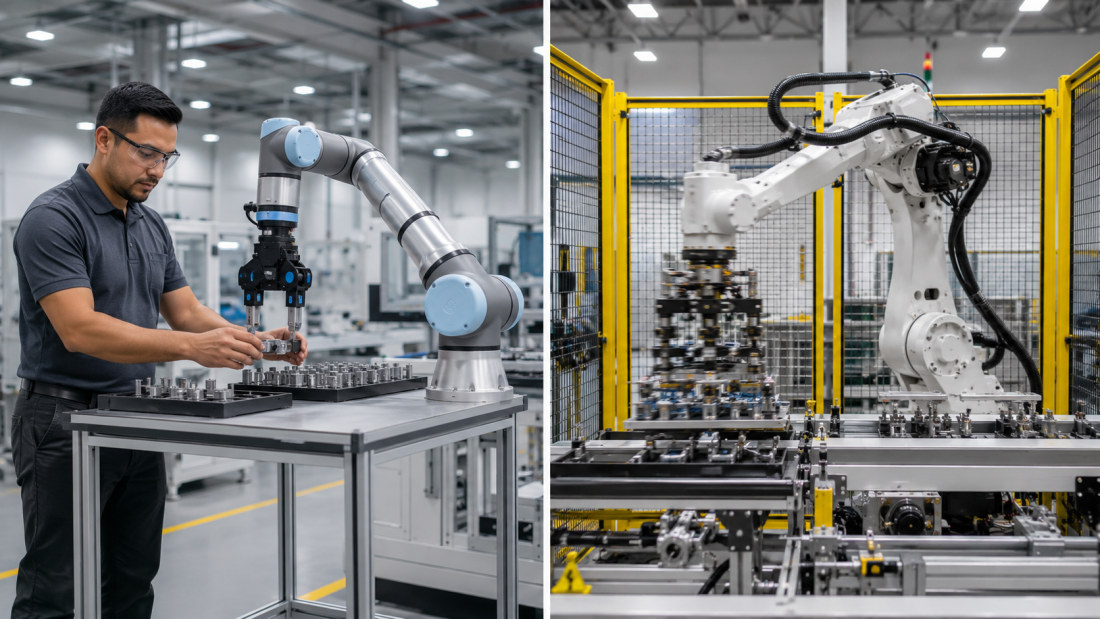
Search for a breakdown of industrial robots vs collaborative robots cost, and you’ll find credible sources contradicting each other: one says cobots cost less upfront, another says industrial robots do. Neither is wrong — they’re counting different things. A bare SCARA industrial arm can undercut a cobot arm, but once safety cages, fencing, and integration are added, the totals can flip entirely. The real decision variable isn’t the robot category — it’s your specific throughput and payload requirement.
- $17,500 vs. $150K–$500K — Starting price for a bare SCARA arm vs. the total deployed industrial system cost.
- $15,000–$90,000+ — Typical cobot arm price range, climbing based on payload and advanced specs.
- 35kg vs. 2,300kg — max payload, top cobot (FANUC CRX-25iA) vs. top industrial robot.
- 1,000mm/s vs. 2,000+mm/s — typical collaborative-mode speed vs. industrial-mode speed.
- ~12 months vs. under 18 months — average cobot ROI vs. 2-shift industrial robot ROI.
Two Credible Sources, Two Opposite Answers
One industry guide states plainly that industrial robots tend to cost less upfront than collaborative robots. Another, just as directly, frames cobots as the cheaper entry point: a cobot starting around $15,000 against an industrial robot starting around $25,000. Both are citing real prices. The contradiction isn’t sloppy research — it’s that “industrial robot” and “cobot” aren’t priced on the same axis to begin with.
“Cobot or traditional industrial robot? It’s the first question every automation buyer faces — and the answer isn’t obvious.” — GrabaRobot
Why the Bare Arm Price Hides the Real Number
A SCARA industrial arm can start around $17,500 — genuinely cheaper than many cobots. But industrial robots typically require safety cages, light curtains, and fencing that cobots are specifically engineered to avoid, because cobots use force-limiting and built-in sensors to work safely alongside humans without that infrastructure. Add that safety cost to an industrial deployment and the “cheaper” industrial robot can end up costing more once the full cell is built out — the arm price alone was never the real comparison.
The Question That Actually Decides the Number
Throughput changes everything. A cobot running in a line producing 200-plus parts an hour becomes the bottleneck, since collaborative-mode speed tops out well below industrial-mode speed. For high-volume, high-payload work, the industrial robot’s higher upfront and safety cost gets absorbed faster by throughput; for lower-volume, flexible tasks, a cobot’s faster deployment and lack of caging can make it the cheaper total system despite a similar or higher arm price.
⚠ Illustrative scenario (fictional): A small manufacturer compares a $17,500 SCARA arm against a $45,000 cobot and picks the SCARA, assuming it’s the obvious cost winner. After adding required fencing, light curtains, and safety programming, the final installed cost matches the cobot’s all-in price — but the SCARA now also requires a dedicated cell layout the cobot wouldn’t have needed.
Global Implications: The Comparison Travels, the Prices Don’t
The throughput-versus-safety-cost tradeoff holds everywhere, but absolute prices don’t transfer cleanly across markets. Chinese cobot manufacturers now offer pricing 30–50% below European or Japanese competitors for comparable specifications, often with the same IATF16949, CE, and TÜV certifications — a materially different cost equation for manufacturers in Africa or Southeast Asia than the US-centric prices most cost guides quote by default.
💡 CreedTec Analyst’s Note — Daniel Ikechukwu
Strategic Impact: “Cobot vs. industrial robot cost” has no universal answer — the deciding variable is throughput and safety infrastructure need, not the robot category label.
Stop: Comparing bare arm prices between cobots and industrial robots as if that reflects total deployed cost.
Start: Budgeting safety infrastructure and integration separately, then comparing full system costs against your specific throughput requirement.
Watch: Whether Chinese cobot pricing continues narrowing the total-cost gap against industrial robots for mid-volume applications.
ROI Outlook: Favorable for cobots below 200 parts/hour and under 35kg payload; favorable for industrial robots above those thresholds, regardless of arm price alone.
The robot you compare on price alone might not be the robot you actually need. Subscribe to CreedTec’s newsletter for the automation math vendors skip.
Further reading on CreedTec:
The Industrial Robot Cost Guides Everyone’s Reading Assume US Wages · Top Robotics Companies Transforming the Industry in 2026 · China’s Robot Hands Are Winning the Volume War · Apollo 2 Humanoid Robot Training · Robostral Navigate Just Questioned Why Robots Need LiDAR