Fast Facts
CNBC reported on November 14 that Foundation Future Industries, maker of the Phantom humanoid, had stopped paying staff. On November 20 Reuters, citing internal emails, reported that Base Group is preparing a $150 million investment. Base confirmed only that it is considering one.
The terms, timing and cash position are all unconfirmed. For buyers, the lesson reaches beyond one company: a robot you cannot service is a stranded asset. The checklist below turns that risk into contract clauses you can paste today.
Fast Facts From the Reporting
- Staff have not been paid since the October 30 payroll, per CNBC; the CEO called it “a timing issue, not an existential one for the company.”
- Pitchbook lists $11 million raised by Foundation Future Industries from outside investors, against the $150 million now under consideration.
- The next-generation Phantom MKII is slated for early 2027 production, according to the CEO; no images, video or specifications had been published as of November 20.
“A long-term partnership and not just a financing event.”Sankaet Pathak, CEO, in a November 12 email to staff, as reported by Reuters
| Metric | Details |
|---|---|
| $150M | Investment Base Group is considering |
| $11M | Outside funding, according to PitchBook |
| October 30 | Last payroll, according to CNBC |
| Early 2027 | MKII production target, according to the company |
Sources: Reuters (via Korea Times), CNBC, PitchBook, and Fast Company, as summarized by Humanoids Daily.
Disclosure: Foundation and its CEO did not respond to Reuters beyond the internal emails.
What Foundation Future Industries Means for Robot Buyers
Nothing here proves that Foundation Future Industries will fail, and the Base investment may close. Still, a buyer cannot wait for certainty. Spares, firmware updates and field engineers all depend on a vendor staying solvent and staffed. So the procurement workflow should price continuity before the first purchase order, not after a missed payroll headline.
Start with the contract form. See our analysis where we explain how RaaS contract clauses decide if leasing beats buying a robot. Leasing moves some risk to the vendor, but only if exit terms are written down. Then check the machine itself; see our analysis where we explain seven checks to run on a humanoid robot spec sheet.
Volume claims deserve the same scrutiny, and the support burden scales with them; see our analysis where we explain why humanoid production numbers are hard to verify. Service cost is the quiet risk; see our analysis where we explain the robot maintenance cost model procurement teams get wrong. Safety certification is another dependency; see our analysis where we explain which humanoid safety standards exist and which are still draft.
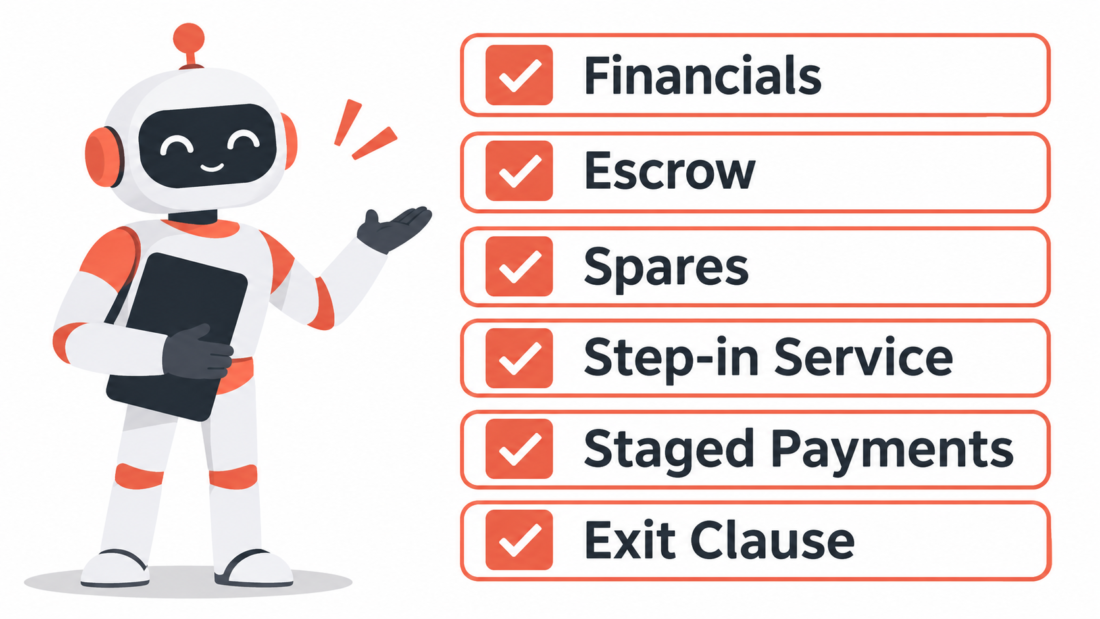
Foundation Future Industries Lesson: Robot Vendor Continuity Checklist (copy-paste)
- Financial evidence: request audited or investor-verified statements covering at least [12] months of runway. Re-request every [6] months.
- Escrow: software source, firmware build tools and calibration data held by a third-party escrow agent, released on insolvency or [30] days of missed service.
- Spares: [12] months of critical spares on your site or bonded, with part numbers listed.
- Service step-in: a named third-party technician is allowed to service the robot without voiding the warranty.
- Payment staging: no more than [30]% up front; the rest tied to delivery and acceptance tests.
- Exit clause: a right to terminate and recover prepayments if the vendor misses [2] consecutive service-level targets.
Rule of thumb: if the vendor refuses escrow and step-in rights, price the robot at its resale value, not its list price.
⚠️ Hypothetical scenario: A Lagos logistics operator prepays for four humanoids from a young vendor. Months later the vendor pauses service while it raises money. The robots sit idle, and the operator has no spares, no firmware access and no refund clause. A continuity checklist signed at purchase would have limited the loss.
💡 CreedTec Analyst’s Note by Daniel Ikechukwu
Strategic Impact
Much of this story rests on internal emails and anonymous sources, and key facts remain unconfirmed. We do not draw conclusions about the company’s future. The durable point for operators, whatever happens at Foundation Future Industries, is that vendor stability is a technical specification, because a robot is only as good as the support behind it.
Stop / Start / Watch
- Stop: prepaying large sums to early-stage robot vendors.
- Start: demanding escrow, spares and step-in service rights in every robot contract.
- Watch: whether the Base investment is finalized, and whether the MKII specifications are published.
ROI Outlook
Illustrative math: a USD 100,000 robot with 70% prepaid exposes USD 70,000. Capping prepayment at 30% cuts that exposure to USD 30,000 per unit.
— Daniel Ikechukwu
Get the next playbook. One copy-paste robotics procurement tool per issue, built for operations and procurement leads. Subscribe to the newsletter below.
For vendors: every buyer weighing Foundation Future Industries or its rivals needs continuity cover. If you sell robot escrow, vendor-risk monitoring or third-party robot service, email creedtec@creedtec.online to sponsor the next edition.