Fast Facts
The FAA SMART AI ground stop story is not about whether AI caused the outage. Officials say aging telecom equipment did. It is about the fact that nobody could instantly prove otherwise, three days after an AI tool reached all 22 air route control centers.
If you run operations, build the evidence before the first incident: a read/write inventory, a kill switch and append-only logs. The five-step checklist below gives you starting parameters you can paste into a rollout plan today.
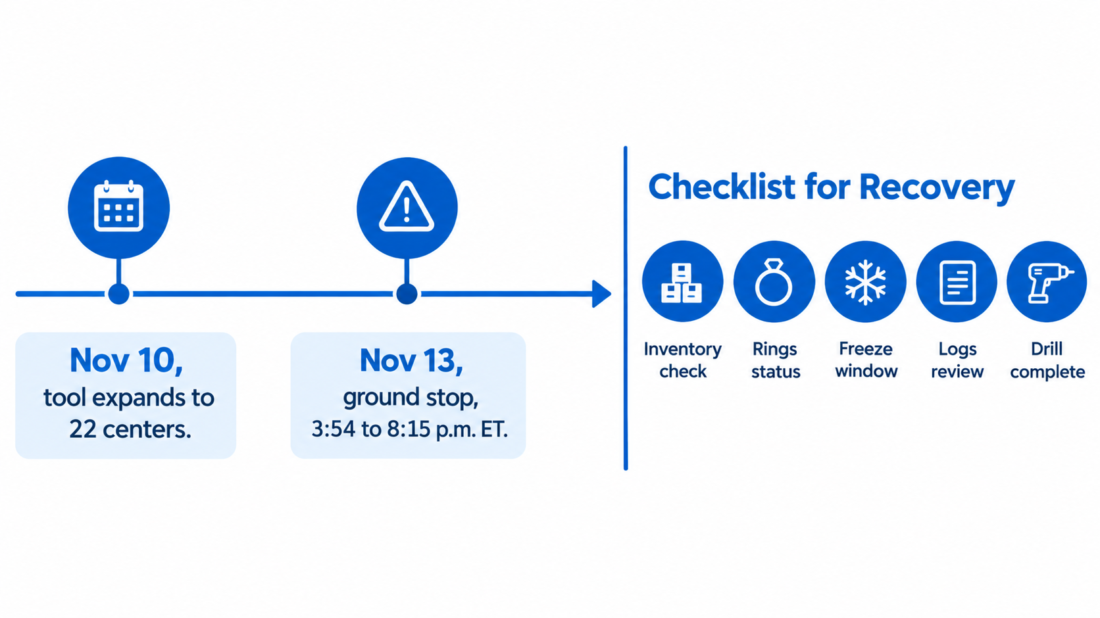
On Friday, November 13, the FAA halted departures nationwide for more than four hours. Three days earlier it had announced that SMART, an AI-supported traffic management tool built by Air Space Intelligence, now covered all 22 air route traffic control centers. Officials and the vendor say the two events are unrelated. Operators should still treat the FAA SMART AI ground stop as a free case study in attribution risk.
What Officials Have Established So Far
The facts are narrow. The stop began around 3:54 p.m. ET and lifted at 8:15 p.m., with more than 3,500 aircraft airborne at the start. Transportation Secretary Sean Duffy blamed overloaded switches and routers in aging analog telecom infrastructure, while newer digital equipment kept working. SMART only recommends actions to controllers, he said, and is not connected to the STARS or ERAM systems. Earlier in the day Homeland Security Secretary Markwayne Mullin said investigators were checking for a link; by evening he reported no evidence of a cyberattack or AI interference. The investigation continues.
“There’s no possible way SMART would have impacted what happened.”Sean Duffy, U.S. Transportation Secretary, via AVweb
| Metric | Figure / Detail |
|---|---|
| SMART expansion | 3 days (Nov. 10–13) |
| Nationwide ground stop | 4+ hours |
| Aircraft airborne | 3,500+ |
| Diversions | 827+ by 7:05 p.m. ET (Cirium via AP) |
| Reported SMART cost | $875 million to the Transportation Department |
Sources: AVweb (Nov. 13); The Hill; Washington Times.
Why the FAA SMART AI Ground Stop Is a Rollout Lesson
Air Space Intelligence replied within hours that the stop was not based on or a result of the SMART system
. The denial landed because SMART is advisory. Most enterprise AI is less lucky. Dispatch assistants, ticket-routing agents and invoice bots routinely hold write access, so any coincident outage points at them first.
Without evidence, “we don’t think it was us” is the best answer you can give a regulator, insurer or customer. During the FAA SMART AI ground stop, a cabinet secretary was publicly checking the link while engineers worked a router fault. See our analysis where we explain why containment failures are now an industry pattern, and where we explain what an outside audit found missing from agent monitoring at a frontier lab.
Three habits follow. Separate advisory from write access in writing. Expand in rings, and never stack an AI expansion on top of infrastructure change; see our analysis where we explain why orchestration has become the enterprise deployment gate. And treat legacy plant as a co-suspect: see our analysis where we explain how one cloud outage exposed the fragility of global automation, because the official explanation points at analog hardware, not software.
AI Rollout Attribution Checklist After the FAA SMART AI Ground Stop (copy-paste)
Starting values are our suggestions. Tune them to your risk tolerance.
- Map the blast radius. List every system the AI reads from and writes to, with direction and protocol. Any write path needs a named owner and a one-click kill switch. Advisory-only tools need a signed “no write path” confirmation from IT.
- Roll out in rings. Pilot site, then 10% of sites, then 100%, with a 14-day minimum soak per ring. Do not advance within 7 days of a Sev-1 or Sev-2 incident on shared infrastructure.
- Freeze overlapping changes. No AI scope expansion within 5 business days before or after a scheduled network or platform change. Log any emergency exception as one joint change record.
- Log for attribution. Record every AI input, output and action, timestamps synced to within 1 second, in append-only storage, retained 12 months.
- Run the 60/24 drill. Within 60 minutes of a major outage, test whether disabling the AI changes anything. Within 24 hours, publish one line: “AI involved: yes / no / unknown,” evidence attached.
Step 1 starts with an inventory, and unsanctioned tools break it; see our analysis where we explain how the shadow AI governance gap inflates breach costs.
⚠️ Hypothetical scenario: A Lagos port-logistics operator extends an AI gate-scheduling assistant to all four terminals on Monday. On Thursday a network switch fails and truck check-in freezes for five hours. The assistant is advisory and never touched the gate system, yet the port authority, customers and insurer all ask one question: can you prove the AI wasn’t involved? With no logs, no kill-switch test and no change record, the operator cannot. The switch gets blamed for the outage, but the AI program carries the distrust into every renewal.
💡 CreedTec Analyst’s Note by Daniel Ikechukwu
Strategic Impact
The FAA SMART AI ground stop shows that attribution is now part of AI product quality. A tool that cannot prove what it did, and did not do, inherits blame for every nearby failure. Buyers should price evidence capture into the contract instead of bolting it on after an incident.
Stop / Start / Watch
- Stop: expanding AI scope without ring-based soak periods and a named kill-switch owner.
- Start: requiring append-only AI action logs and a signed read/write inventory from every vendor.
- Watch: the investigation findings on the FAA SMART AI ground stop, and whether any SMART data fed the affected systems.
ROI Outlook
Illustrative formula: blame exposure = outage hours × hourly revenue at risk × probability the AI gets blamed. A four-hour outage at USD 50,000 per hour and a 20% blame probability puts about USD 40,000 on the AI program, before any insurer review.
— Daniel Ikechukwu, CreedTec (AI Systems Analyst)
Get the next playbook. One copy-paste operations tool per issue, built for engineers and procurement leads. Subscribe to the newsletter below.
For vendors: every team scaling AI after the FAA SMART AI ground stop needs steps 2 to 4. If you sell AI observability, immutable audit logging or progressive-delivery tooling, email creedtec@creedtec.online to sponsor the next edition.
Sources
- AVweb: FAA Rules Out SMART AI System as Cause of Nationwide Ground Stop
- The Hill: AI company behind FAA’s SMART tool denies link to ground stop
- The Washington Times: FAA expanded AI air traffic tool days before ground stop
- Futurism: Entire US airspace shut down days after AI tool rollout
- WISN: FAA ground stop raises questions after rollout of new AI system