Fast Facts
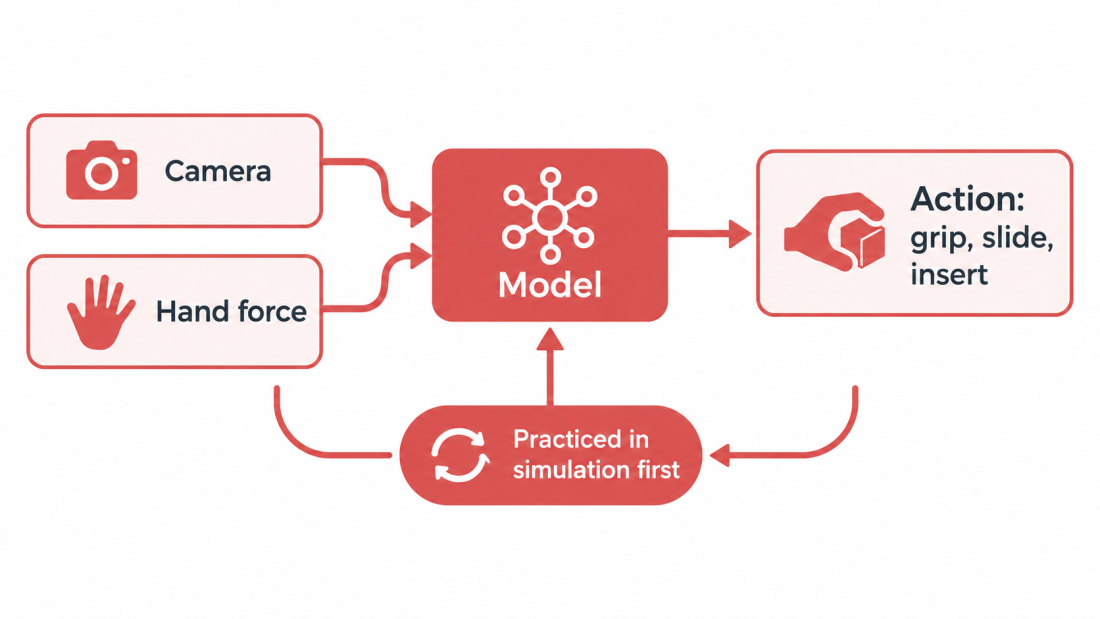
A vision-force-action model adds touch signals to camera input, so a robot can correct a slipping grip, locate an object by contact and adjust during insertion. On October 20, Eka Robotics announced a $150 million Series A led by Andreessen Horowitz and F-Prime, trained in physics simulation with reinforcement learning.
The evidence so far is company-reported: up to 1,500 picks an hour against a human baseline near 600, in laboratory tasks, with no named customers. Use this guide to judge any force-sensing robot pitch, not just this one.
Most robot demos are judged by eye. Touch is invisible on video, which makes it easy to oversell. A vision-force-action model is the design that treats contact as data, and it is now attracting serious money. This guide explains how it works, where simulation fits, and what to ask before a purchase.
What a Vision-Force-Action Model Is
Many current robot models combine camera input and instructions to output movements. A vision-force-action model adds a third stream: the forces the robot’s hand feels when it touches things. Eka’s investors at a16z describe designing the model, sensing, controller and hardware together so the robot can “use physical contact itself as information.” Their examples are practical. A slipping grasp can be corrected, contact can help locate an object, and resistance during insertion can change the motion.
That is a hardware commitment as much as a software one. See our analysis where we explain how force-sensitive grippers redefine touch in robotics. Investors are backing the same theme elsewhere, as in HD Hyundai Robotics’ $9.7M bet on robot touch.
Why Force Matters When Vision Fails
Vision is weakest at the moment of contact, when a wrist camera is often blocked by the hand or the object. A Stanford preprint posted August 2, 2026 by Pares-Morlans, Bohg and colleagues found that vision-language-action models struggle in contact-rich tasks. Its fix, called FACT, reached a 66% average success rate across five tasks, against about 41% for the best earlier force-augmented baseline, over almost 2,500 real-world rollouts.
66% vs 41% | 1,500 vs about 600 picks/hour
Left: Stanford FACT preprint, one robot platform and five tasks. Right: Eka’s own lab claim versus a human baseline. Neither is independent production evidence.
“Sustaining that performance through full production shifts is the next test.”
— a16z, on Eka Robotics
The Stanford work used a different system from Eka’s, so it supports the principle, not the product. It also covered a single robot and sensor placement. Treat both as early evidence that adding force helps, not as proof any vendor’s hand will hold up on a factory shift.
Where Simulation Fits In
Eka says it trains its vision-force-action model with reinforcement learning in physics simulation, varying object position, friction and contact. The company says this produces thousands of hours of robot experience in minutes. a16z argues robot experience “can increasingly scale with compute rather than human labor.”
The hard part is transfer. Wired, via BGR, reported in June that the founders have not disclosed how they cross the sim-to-real gap, and that the robot often needed a few attempts to finish a task. a16z says the real-to-sim gap is falling but publishes no transfer metric. That is why the headline numbers deserve scrutiny. See our analysis where we explain what ABB and NVIDIA’s 99% sim-to-real accuracy claim leaves out.
Five Questions to Ask a Vision-Force-Action Model Vendor
1. What sensors, at what specification? a16z gives no sensor specifications, so ask for force range, sampling rate and drift over time.
2. What is the real-world success rate on first deployment? Ask for results with no real-data fine-tuning, in your lighting, with your objects. See our analysis where we explain what zero-shot sim-to-real transfer actually claims.
3. How long can it run? a16z itself names full production shifts as the next test. Ask for continuous-hours data, not best-run clips.
4. What does a new task cost? If simulation does the retraining, ask who builds the scene and how many days it takes. See our analysis where we explain how a sim-to-real leap let robots run an hour alone.
5. Can the model move to other hardware? A model designed with its own hands may not port. Lock-in is the price of tight integration.
⚠️ Hypothetical scenario: A Lagos produce exporter trials a force-sensing arm for packing plantains. The lab demo packs fast, but in a humid cold room the sensors drift and the robot starts squeezing too hard by midday. A vendor who never published continuous-shift data has no answer. The exporter wishes it had asked question three first.
💡 CreedTec Analyst’s Note by Daniel Ikechukwu
Strategic Impact
The vision-force-action model idea is credible because it targets the real failure point, contact. But $150 million buys proof of ambition, not of reliability. The test is production-shift performance, which Eka’s own investors say is still ahead.
Stop / Start / Watch
- Stop: treating lab picks-per-hour as a throughput forecast.
- Start: requiring sensor specs, drift data and continuous-hours logs in any tender.
- Watch: Eka’s first named customer and any published sim-to-real transfer metric.
ROI Outlook
No price or deployment schedule is public, so no ROI figure is defensible. A claimed 2.5x speed in the lab is not 2.5x throughput on a shift with stoppages. Model the cost of retraining and downtime before the speed gain.
— Daniel Ikechukwu, CreedTec (Robotics Training Sims Analyst)
Touch is the next robot bottleneck, and the next marketing claim. Get the weekly robotics training sims briefing. Subscribe free