Fast Facts
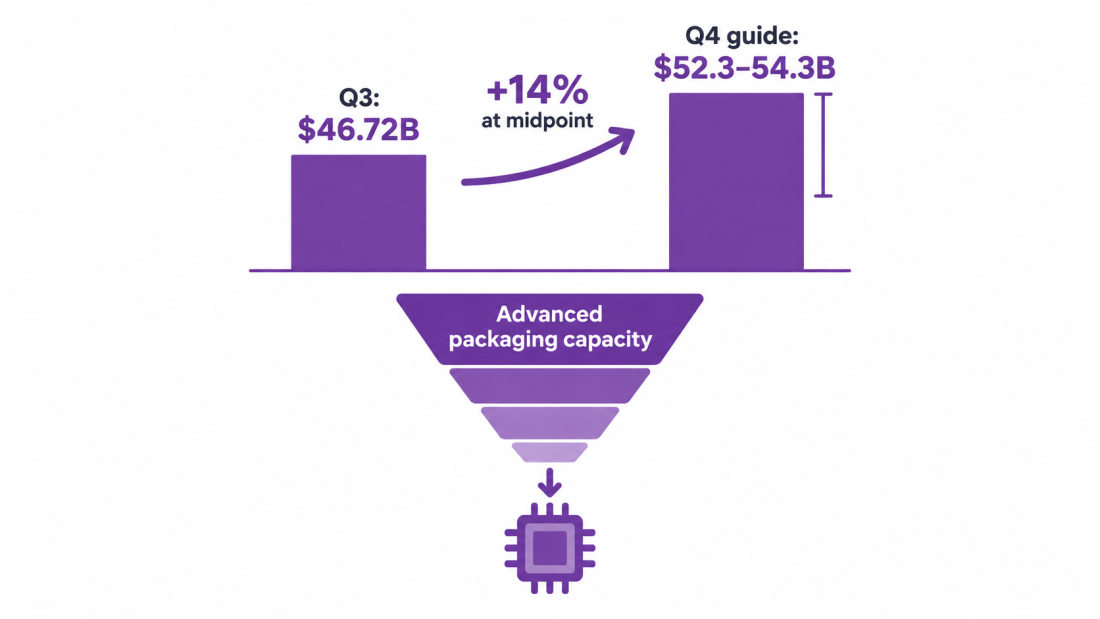
TSMC Q3 results, reported October 15, showed revenue of $46.72 billion, up 41.2% year over year and 16.2% from Q2, above the top of its $44.6 billion to $45.8 billion guidance. High-performance computing was 68% of sales. Q4 guidance of $52.3 billion to $54.3 billion implies about 58% year-over-year growth at the midpoint. TSMC (NYSE: TSM) shares fell 3.4% on margin and capex worries, per Investing.com.
The useful signal is not the beat. It is CEO C.C. Wei’s statement that demand exceeds supply and that packaging capacity limits customers’ growth. For anyone budgeting AI hardware, that means delivery time, not demand, is the constraint through 2027.
The AI trade has been jittery, and the market wanted proof that orders were real. The TSMC Q3 results supplied it, and then some. Per Investing.com, the quarter beat guidance, operating margin was 58.7% against a 56% to 58% guide, and EPS was NT$29.43. Gross margin slipped 1.3 points to 66.4% as the 2nm node ramped. Investors read that dilution, not growth, and sold the stock.
What the Numbers Say, and What They Do Not
HPC was 68% of revenue, up from 57% a year earlier, per StockTitan. But HPC is broader than AI: it includes server and PC processors and networking chips. TSMC does not report a quarterly AI figure; its only AI disclosure was that AI accelerators were a high-teens percent of 2025 revenue. So the TSMC Q3 results are a strong proxy for AI demand, not a measurement of it.
Mix also shows concentration. The node split was 3nm at 33%, 5nm at 28%, 7nm at 10% and 2nm at 8%, per a report summarizing the call, and North American customers were 79% of Q3 sales, per StockTitan. See our analysis where we explain how Broadcom’s AI semiconductor revenue crossed 56% of total sales; the customers at the top of TSMC’s order book are the same names.
$46.72B | 68% HPC | $52.3–54.3B Q4 guide
Q3 revenue, high-performance computing share of sales, and Q4 revenue guidance. Sources: Investing.com; StockTitan; CRN Asia, October 15, 2026. HPC is a broader category than AI.
“Our packaging capacity is so tight that now it limits my customers’ growth.”
— C.C. Wei, CEO, TSMC (via StockTitan)
Why the TSMC Q3 Results Point to a Supply Ceiling
Wei said demand remained far above what TSMC can supply, per CRN Asia. He cited advanced packaging at five times reticle size and said TSMC is being prudent in planning for 2027. Capex for 2026 stays at $60 billion to $64 billion, with 2026 to 2028 spending significantly higher than the prior three years. 2nm capacity is expected to more than double in 2027, and a second Arizona fab is scheduled for volume production in Q3 2027.
The supply chain is tight beyond logic chips. See our analysis where we explain how the AI memory shortage drove Samsung’s 250-fold profit surge and how memory costs are already squeezing Nvidia’s revenue. A chip is only worth what its slowest component allows.
The Risks Inside the Beat
StockTitan points out that, behind the TSMC Q3 results, September sales were 0.6% below August, so hitting the Q4 range requires monthly sales roughly 8% to 12% above September. TSMC’s own 2026 growth guide was “slightly above 40%” in July; the roughly 44% figure is that article’s arithmetic, not a company forecast. Wei also cited pressure on consumer segments from rising component prices, and smartphone chip revenue was roughly flat year over year.
Gross margin faces further dilution: the 2nm ramp is expected to cost about 3 to 4 points in the second half, and overseas fab dilution is expected to widen. Customer financing is the other risk. See our analysis where we explain how CoreWeave’s revenue data revealed a seven-year bet on three-month deals. If the AI buyers at the bottom of the chain tighten, orders could slip even while capacity stays full.
The wider picture is a historic one. See our analysis where we explain how AI semiconductor revenue is driving the industry past $1 trillion in 2026.
⚠️ Hypothetical scenario: A Lagos telecom plans an AI network-analytics rollout for mid-2027 and signs a dollar-priced server order in October. The vendor’s delivery date slips two quarters because advanced packaging is full. Meanwhile the naira weakens against the dollar. The project’s business case, built on a Q2 launch and a fixed budget, no longer clears.
💡 CreedTec Analyst’s Note by Daniel Ikechukwu
Strategic Impact
The TSMC Q3 results show AI hardware revenue limited by supply. That favors suppliers with secured capacity and hurts buyers without allocation. For industrial buyers, edge and factory AI projects compete with hyperscalers for the same chips.
Stop / Start / Watch
- Stop: budgeting AI hardware on list price and quoted lead times alone.
- Start: asking vendors for allocation commitments and delivery penalties in writing.
- Watch: TSMC’s monthly sales for October and November against the 8% to 12% step-up needed for Q4, and any slip in 2nm timing.
ROI Outlook
When supply is the constraint, delay is the cost. For emerging-market buyers paying in dollars, a two-quarter slip adds currency exposure on top of idle capital. Build contingency into the hardware plan after reading the TSMC Q3 results, and consider cloud capacity as a bridge.
— Daniel Ikechukwu
Chip demand is a headline. Delivery dates are your budget. Get the weekly industrial AI revenue briefing on what vendors leave out. Subscribe free
Sources
- Investing.com: TSMC Q3 2026 slides, AI boom drives record revenue despite margin pressure
- StockTitan: TSMC Q3 2026 earnings, its 2026 outlook now implies about 44% growth
- CRN Asia: TSMC third quarter revenue tops guidance as CEO says AI demand still exceeds supply
- BigGo Finance: TSMC Q3 2026 earnings call