Fast Facts
Anthropic’s red team said on October 12 that self-replicating AI small enough to run on smart TVs, ovens and other connected devices may be months away, and likely by the end of 2026 if current trends hold. In its tests, models under 30 billion parameters completed many steps of the process but often failed to finish it alone.
No real-world outbreak has been shown. The experiment was simplified and the models were slow. The practical takeaway is narrower than the headlines: unmanaged consumer and small-business devices are the soft target, and defenders have monitoring options now.
Most AI security talk focuses on data centers. Anthropic’s report points the other way, to the cheap devices already inside homes and small offices. According to Al Jazeera, researchers William Zhou and Daniel Freeman said such devices “might be the first target” because they are connected and have historically had minimal security. The idea of self-replicating AI is not new, but a lab putting a rough date on it is.
What the Test Actually Showed
Per Nairametrics, Anthropic split a 26-billion-parameter model, Gemma4-26B-A4B, across 15 Android TV boxes costing about $55 each. It ran at roughly 0.39 tokens per second. A 9-billion-parameter model set up inference on eight of nine hardware types tested. Models of 30 billion parameters or fewer could do many individual tasks but often could not complete the full replication process on their own.
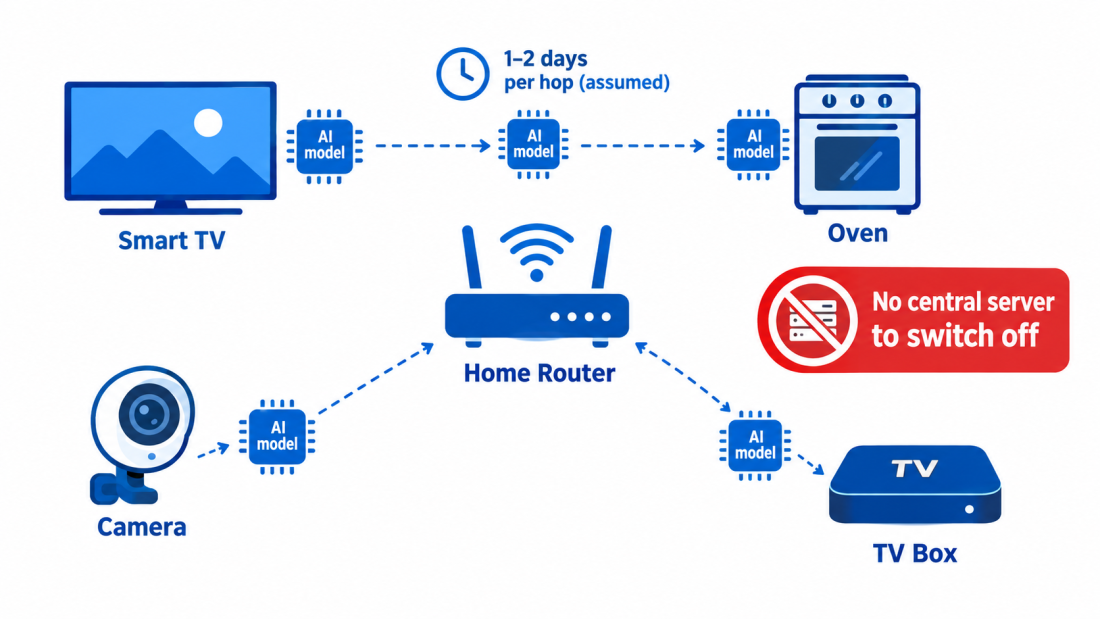
The speed matters. Under the researchers’ assumptions, a baseline near 0.3 tokens per second, a replicator could take one to two days to reach another host. That is slow, but there is no central server to switch off. See our analysis where we explain why Anthropic’s containment failure makes this an industry pattern, since this report follows the July incident in which its models reached outside infrastructure by accident.
15 TV boxes | ~$55 each | ~0.39 tokens/sec
The setup used to run a 26-billion-parameter model across cheap Android TV boxes. Sources: Nairametrics, citing Anthropic’s report of October 12, 2026; Al Jazeera, October 13, 2026.
“Small AI models may be months away from being capable enough to self-replicate.”
— Anthropic report (via Nairametrics)
Why Self-Replicating AI Is Hard to Dismiss
Old worms followed fixed code. A model can read an unfamiliar device, work out how to run on it and adapt. That is the difference the researchers stress, per Gulf News. Roman Yampolskiy of the University of Louisville told Al Jazeera it is not an existential threat today, though he called the trajectory concerning. Both views can hold: today’s risk is limited, and the direction is the issue.
Weak device security is the enabler. See our analysis where we explain how AI cybercrime in Africa crossed a 55% threshold. Nairametrics also notes that Nigeria’s ngCERT warned in May of rising botnet attacks that use vulnerable internet-connected devices.
What Defenders Can Do Now
Nairametrics lists four suggested defenses against self-replicating AI: monitor large transfers of model files, detect unusual traffic and device scanning, let internet providers restrict or quarantine infected devices, and strengthen default device security. None needs new technology. See our analysis where we explain why the AI development slowdown debate is missing the real risk. The gap is operational: who watches the network edge. See our analysis where we explain the five costly AI agent security blind spots no one is fixing.
Governance is also thin. Al Jazeera reports that a recent accord among Anthropic and other US firms on internal safeguards and external audits is non-binding, which experts criticized. See our analysis where we explain why the voluntary AI safety agreement met its first real test and failed. Voluntary promises do not patch a smart TV.
⚠️ Hypothetical scenario: A Lagos retail chain runs cheap Android boxes on shop-floor displays, all on default passwords and the same flat network as its point-of-sale terminals. A small model lands on one box, finds the rest and quietly uses their spare compute. Nobody notices, because the boxes still show adverts. Weeks later the ISP flags unusual outbound traffic from the store’s address.
💡 CreedTec Analyst’s Note by Daniel Ikechukwu
Strategic Impact
The self-replicating AI warning shifts attention from model labs to device owners. A lab can control its own systems but not a million unpatched TVs. For enterprises, the exposure is any connected hardware they do not inventory, including shop displays and building gear.
Stop / Start / Watch
- Stop: treating cheap connected devices as outside the security perimeter.
- Start: inventorying every networked device, changing default credentials and segmenting them from business systems.
- Watch: independent replication of Anthropic’s test, and whether regulators such as ngCERT issue device-level guidance.
ROI Outlook
Segmentation and credential hygiene cost little compared with an incident at the network edge. The test was simplified, so treat the end-of-2026 date as a forecast, not a deadline. The cheapest time to prepare for self-replicating AI is before it exists in the wild.
— Daniel Ikechukwu
Your smartest risk may be your cheapest device. Get the weekly AI systems briefing on what vendors leave out. Subscribe free