Fast Facts
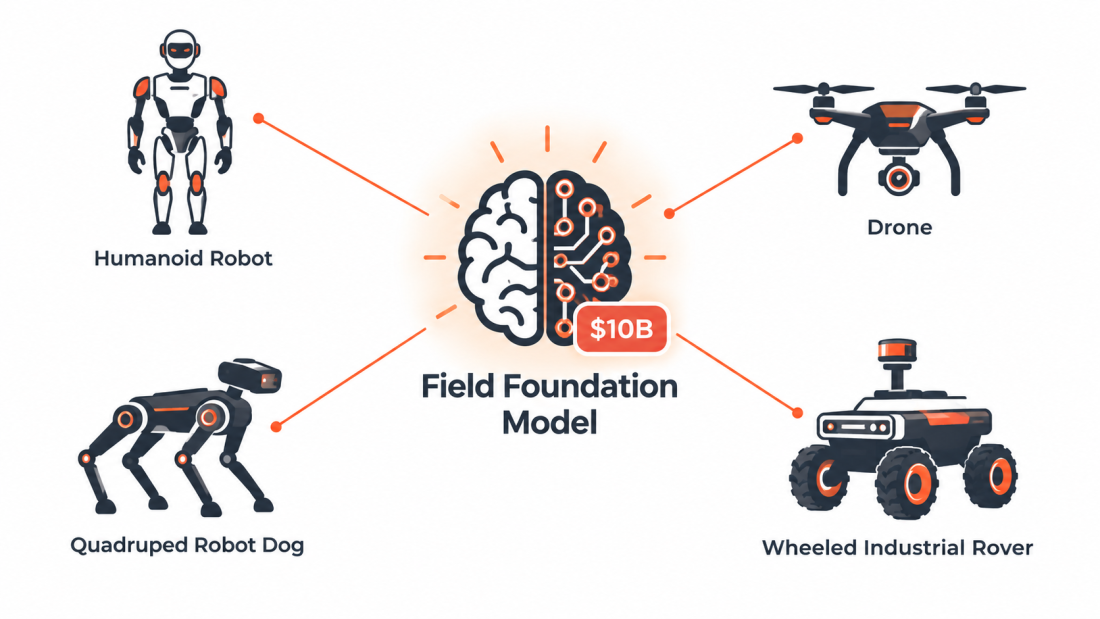
FieldAI has raised $700 million at a $10 billion valuation, more than quadrupling its worth in just over a year, for a “universal general-purpose brain” meant to run humanoids, drones, robot dogs and industrial rovers — without FieldAI building any of the hardware itself. The FieldAI robot brain thesis bets that the most valuable company in robotics won’t be the one making robots at all.
The round puts FieldAI alongside Physical Intelligence (~$11B) and Skild AI (~$14B) in a three-way race to own the intelligence layer underneath robot hardware. Backers span Nvidia, Intel, and Hyundai Motor Group, which signals real interest from both chipmakers and an actual robot manufacturer in not owning the brain they depend on.
The FieldAI robot brain just became one of the largest late-stage bets in physical AI. The new round values the Irvine, California company at $10 billion, up from $2 billion roughly a year ago, placing it in the top 4% of all-time late-stage deep tech rounds in the US. FieldAI has not disclosed which firm led the round. The company makes no robots; it sells the software that decides what robots do, regardless of who built them.
The FieldAI Robot Brain’s Revenue Is Catching Up
Since June, FieldAI has added at least $35 million in revenue and customer contracts, bringing its total past $135 million, with customers spanning construction firms, data center operators and defense contractors. That’s real commercial traction behind the FieldAI robot brain valuation, not just investor enthusiasm — though a $10 billion price tag still implies the market expects the growth curve to steepen sharply from here. \
Founded in 2023 by Ali Agha, Shayegan Omidshafiei and David Fan, veterans of NASA’s Jet Propulsion Laboratory autonomy programs, FieldAI built its Field Foundation Models around “physics-first” reasoning rather than retrofitting a vision or language model for robot control. See our analysis where we explain how Skild AI’s robotics manufacturing foundation model approaches the same problem and why running models locally is already a hedge against vendor dependency.
The Brain-vs-Body Bet
The round’s real significance for the FieldAI robot brain is what it says about where robotics investors think the margin actually sits. FieldAI, Physical Intelligence and Skild AI all pursue the same thesis from different angles: hardware will keep commoditizing across humanoids, quadrupeds and wheeled platforms, but a single intelligence layer controlling many bodies could become the durable platform everyone else builds on.
That’s a bet against the idea that whoever builds the best robot wins — instead, whoever owns the brain inside everyone else’s robot wins. See our analysis where we explain why one-brain-multiple-embodiments is really a fixed-cost amortization play.
Verified numbers
| Stat | Detail |
|---|---|
| $10B | New FieldAI valuation, up from $2B about a year ago |
| $135M+ | Total revenue and customer contracts, with $35M added since June alone |
| $11B / $14B | Rival valuations of Physical Intelligence and Skild AI, the closest competitors in the same “universal brain” race |
“The mission is to build a single robot brain that can generalize across different robot types,” Ali Agha, FieldAI’s founder and CEO, has said.
Who’s Actually Backing a Brain That Isn’t Tied to Their Hardware
FieldAI’s investor list is the detail worth sitting with: Nvidia (NASDAQ:NVDA) via NVentures, Intel (NASDAQ:INTC) via Intel Capital, and Hyundai Motor Group have all invested, alongside Jeff Bezos’ family office and Khosla Ventures. A chipmaker funding a hardware-agnostic brain hedges against any single robot maker winning outright. A robot manufacturer funding the same thing bets that owning a brain in-house isn’t worth building from scratch. Both point the same direction: the brain is becoming a separately priced layer.
What’s Still Unproven
The valuation bets FieldAI’s brain can hold up in messy, unstructured real-world settings, which has tripped up robotics companies before — a controlled demo and an unsupervised deployment across construction sites and mines are very different tests. No regulatory framework has assessed a model like this yet either; the EU’s rules for this category don’t start until 2027, leaving buyers to do their own diligence on reliability claims meanwhile. See our analysis where we explain the robot maintenance cost model every procurement team gets wrong.
⚠️ Hypothetical scenario (illustrative only, not a reported case)
A Lagos construction firm evaluates two warehouse-robot vendors: one with its own proprietary control software, another running on FieldAI’s brain across a mixed fleet. The FieldAI-powered option promises faster redeployment if the firm switches hardware later. The procurement lead asks what happens to performance and support if FieldAI itself changes pricing or gets acquired — a dependency question a single-vendor purchase never raised.
The Buyer Question This Raises
For any enterprise evaluating robotics vendors, this is a preview of a decision that will keep recurring: buy a robot whose intelligence is baked in by the manufacturer, or one running a third-party brain that can move across hardware platforms later. The second option offers more flexibility and less lock-in to one maker’s roadmap — but it adds a second vendor relationship whose stability now matters to uptime. See our analysis where we explain five cost differences between industrial and collaborative robots.
💡 CreedTec Analyst’s Note by Daniel Ikechukwu
Strategic Impact
The FieldAI robot brain round confirms the market now prices the intelligence layer separately from the hardware it runs on. That’s good for buyers who want hardware flexibility, and a new dependency risk for buyers who don’t price it in.
Stop / Start / Watch
- Stop: assuming a robot’s “brain” and its body come from — or should come from — the same vendor by default.
- Start: asking any robotics vendor whether their control software is proprietary or licensed from a third-party foundation model provider, and what that means for long-term support.
- Watch: whether FieldAI, Physical Intelligence or Skild AI lands a marquee unsupervised-deployment case study that actually validates the brain-vs-body thesis at scale.
ROI Outlook
$135 million in contracts against a $10 billion valuation prices future category leadership, not current revenue. Buyers still get real near-term benefit from hardware flexibility, regardless of how the valuation ages.
— Daniel Ikechukwu, CreedTec (Robotics Analyst)
Comparing robot foundation models for your fleet?
Get CreedTec’s weekly briefing on physical AI funding, robotics vendor risk and procurement economics, written for buyers evaluating real deployments. Subscribe free.
Sources
- Dealroom: “FieldAI raises $700M at $10B valuation for its robot brain” (Oct 2026)
- TradingView/Benzinga: “Nvidia-Backed Robotics Startup FieldAI Hits $10 Billion Valuation” (Oct 2026)
- The Next Web: “Robot software startup FieldAI is set to raise $700M at a $10B valuation” (Oct 2026)
- JKN: “US Robotics Startup Field AI, Backed by Hyundai, Sees Valuation Skyrocket Fivefold” (Oct 2026)
- TechCrunch: “FieldAI raises $405M to build universal robot brains” (Aug 2025, founder interview source)